




16.09.2026
Employee Satisfaction: How to Tell If Your Team Is Truly Satisfied

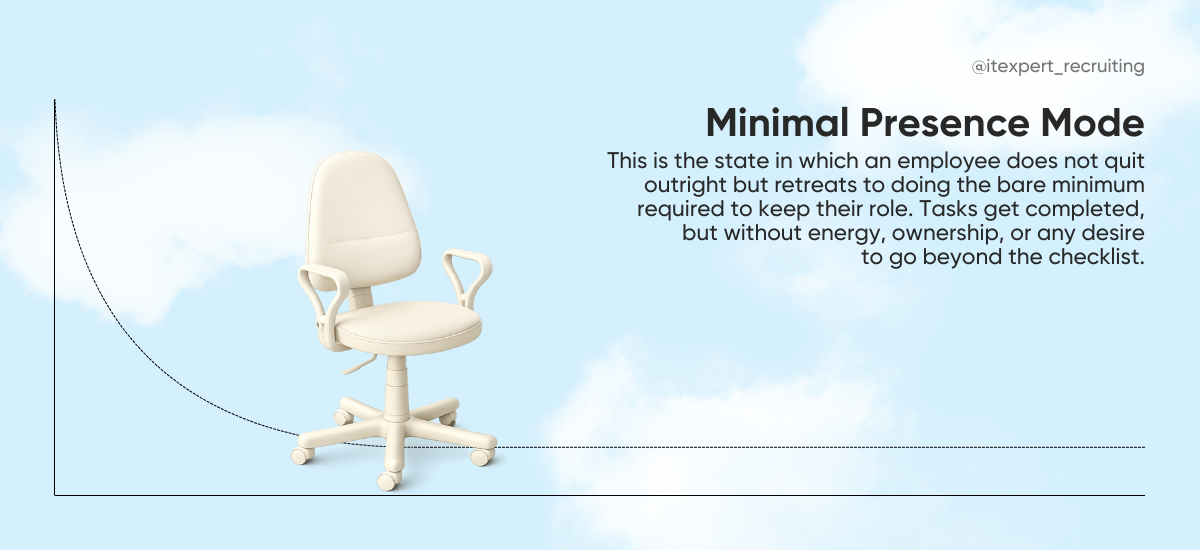
You see them every day. They join meetings, deliver tasks, and tick the necessary boxes. But the drive is gone. Suggestions to improve a feature, support a colleague, or stay for an informal gathering are met with quiet indifference. This is quiet quitting — the most insidious form of disengagement, when an employee is physically present but their emotional commitment has already left the room.
For team leads and HR managers, this is a clear signal: the current motivation system isn’t working. It’s time to rethink how to reignite interest and re-engage people who are operating at the bare minimum.
What is quiet quitting? And why is quiet quitting bad? Let’s unpack the “silence” in quiet quitting. This stage doesn’t involve dramatic steps like resigning. Instead, employees gradually dial down their engagement. Enthusiasm fades. Communication shrinks. Initiative drops.
Silence alone isn’t always a red flag. Some people are naturally reserved. For others, a heavy workload leaves no room for casual interactions. The real concern arises when someone who used to contribute actively suddenly stops taking initiative, sharing ideas, or participating in team life.
Quiet quitting often starts as something healthy: setting boundaries to keep work-life balance. On TikTok, this is known as “acting your wage” — working strictly within what you’re paid for, such as declining after-hours tasks without compensation. This boundary is perfectly valid — until it shifts into low energy, declining productivity, and disappearing accountability.
Three stages to watch for:
Once a professional reaches the elimination stage, they are already halfway out the door — mentally or literally. Quiet quitting ends here; actual quitting is next.
Gallup’s data shows a steady decline in employee engagement in the US over the past three years: 36% → 34% → 32%. The lowest engagement levels are consistently found among younger Millennials and Gen Z.
Each generation approaches work differently. Baby Boomers are often defined by a strong work ethic and a drive to prove themselves through long hours and loyalty to the company. Older Millennials helped mainstream the idea of work-life balance, pushing back against the “always on” culture.
Younger Millennials and Gen Z have taken this further. Their mentality is: “I have a life — and I work to support it. Work is a part of my identity, not the center of it.“
They also entered the workforce in a fully digital era. Technology has made work more flexible and remote-friendly, but it also reduces the amount of spontaneous, in-person interaction. Less social connection means more isolation — an environment where disengagement can quietly take root.
The signs of quiet firing vary from person to person — but they’re always systemic. They show up gradually, through small behaviors that accumulate into a clear pattern.
When these dynamics appear, it’s not just an employee quietly stepping back — it is the breakdown of the trust mechanism between the manager and the team.
In 80% of cases, the first signs are microbehaviors: subtle, almost invisible changes in daily interactions. Below, we’ve compiled the most common signals that managers tend to overlook but which almost always precede a quiet resignation.
Engaged employees naturally look ahead. They ask questions like:
“What’s the next step?”
“What’s our long-term strategy?”
“How will we scale this solution?”
During quiet quitting, this forward-looking curiosity disappears. The person stops seeking context and asks only what’s needed to complete their current tasks. If asked about goals, their responses become brief, formal, and surface-level.
This is especially visible in cross-functional teams.
How it shows up: the employee avoids calls (“Can we chat quickly?”), responds with short, context-free messages, and asks no clarifying questions. Emotional reactions disappear. Response times stretch out — even when they were previously quick. This isn’t always just “being busy.” Often, it’s a deliberate strategy to reduce the emotional load of interactions.
High-performing employees usually go slightly beyond their job description because they genuinely care about outcomes. They offer ideas, notice problems early, or support teammates without being asked.
When quiet quitting sets in, this extra evaporates. The person completes only what is formally required — no broader context engagement, no preventive actions, no voluntary contribution. Just the minimum viable effort to stay employed.
If you want to keep people engaged and avoid an “internal shutdown,” focus on addressing the triggers — not just the visible symptoms. Quiet resignation can only be prevented by improving processes and strengthening corporate culture.
When effort goes unnoticed, motivation fades. To counter this, build recognition into everyday work — not through generic “Employee of the Month” awards, but through real, specific appreciation. Research shows that the most impactful recognition formats are:
Today, employees rarely ask for a raise — they quietly find another job. Their disengagement starts long before they hand in their notice. Prevent this by reviewing compensation proactively. The cost of turnover (and months of low productivity beforehand) is always higher than the cost of timely adjustments.
58% of employees list work-life balance as a deciding factor when choosing an employer. If you want to avoid quiet quitting, balance cannot be optional. What companies can do:
And importantly: make it explicit that employees are not expected to respond after hours.
Stagnation is one of the strongest predictors of a quiet resignation. Employees try to grow — taking on extra work, improving processes, supporting colleagues — but if their efforts don’t translate into career movement, disengagement becomes inevitable.
What companies should implement:
Employees lose 146 hours per year to unnecessary meetings — one of the biggest modern demotivators. Meetings interrupt deep work, increase stress, and push people into constant multitasking.
Before scheduling a meeting, determine: Can this be a message, a recorded video, or a quick update?
If a call is unavoidable, create a clear agenda and allow people to leave once their part is done.
Regular feedback paired with trained HR teams is the most reliable way to catch early signs of disengagement. Conduct anonymous eNPS surveys quarterly to track loyalty and team sentiment. A sudden drop usually signals deeper issues: unrealistic deadlines, ineffective management, or chronic overload.
Short pulse surveys after major events (project completion, performance reviews, management changes) help capture contextual insights.
Core questions to monitor regularly:
Provide multiple feedback channels:
The critical part: show that feedback leads to action. People stay engaged where they see impact.
Unclear roles create chaos: some employees finish others’ tasks, some work overtime daily, and some feel unfairly expected to do more than their job description.
Use a RACI matrix for cross-functional work. It clearly defines who is Responsible, who Approves, who is Consulted, and who must be Informed. Ensure that roles align with actual skills which is crucial for hiring. Clear responsibilities allow you to design relevant tests and interview scenarios.
Examples: A Senior Marketing Manager may require B2C growth expertise; a junior hire does not. A Junior Data Analyst handles reporting and dashboards; a Senior Data Scientist designs predictive models.
Every company has practices that spark a collective eye roll: outdated policies, confusing legacy processes, KPIs “for the sake of KPIs.” These small irritants accumulate into daily frustration and fuel the internal “I don’t care anymore” mindset.
Team leads and HR should periodically run a process cleanup:
This simple intervention sends a powerful signal: the company listens and is willing to evolve. And engagement rises quickly when employees feel heard.
A quiet quit is not a death sentence — but it is a warning sign. Acting quickly and thoughtfully is key.
Gallup estimates that disengaged employees cost the global economy $8.8 trillion annually — nearly 9% of global GDP. The impact goes far beyond unfinished tasks: quiet employees often miss opportunities for innovation, slow down key projects, and undermine long-term growth. For HR managers and team leaders, the critical question is simple yet essential: are your people truly growing, or merely surviving?


