






20.05.2026
Most Candidates Never Ask This: 8 Questions to Ask At An Interview

Tight deadlines, disrupted plans, economic uncertainty, and ongoing change have become the constant backdrop of modern life. Yet under the same pressure, people respond very differently. Some continue moving forward even when the ground feels unstable, while others struggle with declining motivation, eroding self-confidence, and a loss of control.
What explains this difference? In many cases, the answer is resilience. And here is the key point: resilience is not an inborn trait reserved for a few — it is a capability that can be deliberately developed.
In this article, we’ll unpack what resilience is, what it’s built on, and how you can strengthen it systematically.
To understand what resilience is, it helps to start with the original meaning of the word. In fact, resilience describes a material’s ability to return to its original shape after being bent, compressed, or stretched. The material doesn’t shatter under pressure — it absorbs the impact and recovers.
Psychology adopted this metaphor for good reason. According to the American Psychological Association, resilience is both a process and an outcome: the capacity to adapt effectively to change, adversity, trauma, threats, failures, or prolonged stress — and to recover from them. Crucially, resilience is not just about “taking the hit.” It’s about continuing to live, act, and grow despite difficult circumstances.
Think of life as a bridge. Every day, it bears the weight of events, decisions, relationships, and unexpected disruptions. The bridge can’t control what crosses it, but it remains standing because of the strength of its structure. In the same way, while we can’t always change external conditions, we can reinforce our internal framework — by learning to regulate emotions, maintain a constructive inner dialogue, and take purposeful action where influence is possible.
It’s important to draw a clear distinction here: resilience is not the same as stress management. Stress is a short-term physiological and psychological response to a stimulus. Stress-management techniques — breathing exercises, relaxation practices, momentary emotional regulation — are effective for immediate relief.
However, prolonged uncertainty, economic instability, and moral crises generate more than acute stress. They often lead to chronic exhaustion, internal conflict, and a loss of meaning. In these conditions, relaxation alone is not enough. Resilience operates on a different level. It is a long-term capacity that integrates cognitive, emotional, social, and even existential dimensions.
In psychology, the systematic study of resilience began relatively recently, in 1971, with the groundbreaking work of American psychologist Emmy Werner. Werner’s longitudinal study, “Vulnerable but Invincible: High-Risk Children from Birth to Adulthood”, followed children born in 1955 who grew up in highly challenging social environments. The prevailing assumption at the time was that adverse conditions almost inevitably determine life outcomes. The results challenged this belief.
Werner’s key conclusion was transformative: circumstances alone do not define a person’s trajectory. What truly matters are protective factors — internal and external resources that enable individuals to adapt, recover, and grow under pressure.
This insight helped clarify what does resilience mean in practical terms. Resilience is not a fixed personality trait or a matter of “being strong.” It is a dynamic capacity shaped by skills, relationships, mindset, and learned behaviors. Subsequent research has consistently reinforced this view, demonstrating that resilience can be cultivated at any stage of life. In other words, resilience is not something you either have or don’t have — it is something you can build, intentionally and over time.
Resilience shows up through stable patterns in how we think, act, and relate to ourselves and others. That’s why it’s more useful to look at recurring behaviors rather than isolated reactions to stress. A cognitive-behavioral perspective helps identify these patterns by focusing on the core components of psychological resilience.
Low resilience often hides behind the phrase “I’m holding on.” On closer inspection, this state is usually accompanied by emotional outbursts — or, at the other extreme, emotional shutdown and inertia. The issue isn’t the intensity of emotions, but the difficulty in recognizing and processing them.
A resilient person does not avoid emotional experiences. They are able to identify what they’re feeling, set internal boundaries, and consciously choose how to respond. Emotional regulation isn’t about suppressing emotions; it’s about staying present and maintaining agency under pressure.
In moments of crisis, automatic thoughts are almost always rigid and pessimistic. What differentiates resilient individuals is their readiness to examine these thoughts rather than accept them as facts.
Imagine you’ve spent months working on a critical project, investing significant time and effort. Suddenly, you are told the project has been put on hold indefinitely. The initial reaction is often catastrophic: “Everything is lost. I’ll probably lose my job next.”
Feeling powerless in such moments is normal. Resilience begins with a pause and a reality check. Yes, the project is paused — but it hasn’t been cancelled. You then broaden the perspective: have there been times when plans collapsed, and you found alternatives? Most likely, yes — and those experiences helped you grow.
From there, focus shifts back to what you can influence right now. Strength lies in relying on facts, not assumptions, and choosing action instead of remaining stuck in helplessness.
Paradoxically, during the most difficult periods, people often wait for an internal sense of “readiness” before acting. In practice, a feeling of control emerges after action — not before it. Even minimal steps matter: structuring your day, completing a small task, or engaging in physical activity. These actions signal safety and continuity to the nervous system. Over time, resilience is built through consistent, manageable actions that restore a sense of agency.
Many people believe that coping alone is a sign of strength. In reality, prolonged isolation during stress weakens psychological stability. Resilient individuals understand that recovery is faster and more sustainable when support is available. The ability to ask for help, negotiate needs, and accept support from others is a key resilience skill — not a weakness. Social connection acts as a stabilizing force during prolonged uncertainty.
Resilience is not a single trait, but a combination of skills that manifest differently depending on context — levels of stress, social roles, life stage, and available support. For this reason, there is no universal or absolute resilience index. Most psychological assessments focus on individual components of the broader system rather than measuring resilience as a whole. These components may include anxiety, emotional tension, impulsivity, fatigue, burnout, and typical responses to adversity.
That said, psychological questionnaires can still serve as useful reference points and starting tools for self-reflection.
Interpreting these results in isolation can be misleading. Working with a psychologist or psychotherapist helps identify blind spots, recognize early signs of exhaustion or burnout, and determine which resilience-related skills require strengthening.
Is it possible to develop resilience? Absolutely. When we look at resilience meaning in practice, it becomes clear that resilience is not about enduring endlessly or “pushing through” at any cost. It’s closer to a resilience synonym like adaptability or psychological flexibility — the ability to regain balance and keep functioning over time, especially when patience alone is no longer enough. Below are practical strategies that help strengthen resilience gradually and sustainably.
At its core, resilience relies on the ability to recognize, name, and regulate emotions. Suppressed emotions don’t disappear — they accumulate and intensify internal stress. One effective method for developing emotional awareness is an emotion journal, a tool commonly used in cognitive behavioral therapy (CBT). Several times a day — or after emotionally charged situations — record:
Over time, patterns begin to emerge: recurring triggers, automatic reactions, and habitual responses. Awareness alone often reduces emotional intensity and allows for calmer, more deliberate, and constructive reactions.
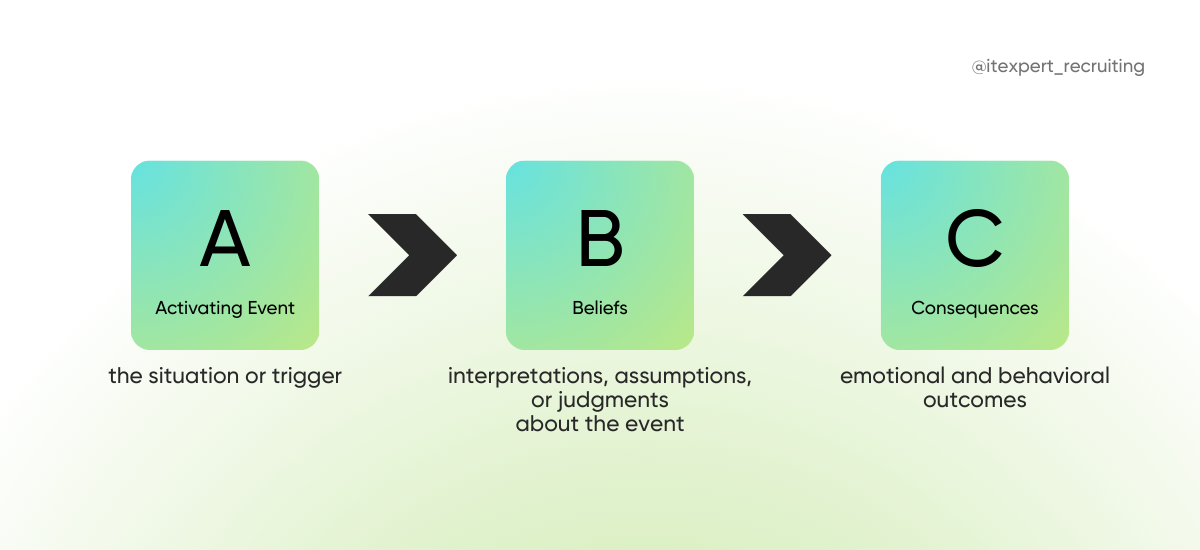
We don’t respond to events themselves — we respond to the meaning we assign to them. In cognitive behavioral therapy, this principle is explained through the ABC model.
Resilience grows when attention shifts to B — your interpretation of the situation. When something triggers a strong reaction, pause and ask: “Is this truly a problem, or is this a familiar way I’ve learned to perceive it?”
You can’t control the weather, but you can take an umbrella or adjust your plans. You can’t stop global crises, but you can help others — through donations, volunteering, or everyday acts of kindness. While circumstances may be uncontrollable, your responses are not.
Psychological resilience is anchored in internal reference points — especially personal values. When decisions align with values, stress and exhaustion decrease, even under pressure.
How to create a “values filter”:
When things go wrong, resilient individuals don’t treat failure as a personal verdict. Instead, they analyze which part of the decision-making or execution process needs adjustment. For example, you try to learn a new technology but struggle to master it quickly. The automatic thought might be: “I can’t do this — I’m a bad developer.” A more constructive approach sounds different:
👉 What is actually within my control? The pace of learning and the methods I use.
👉 What can be adjusted? Scheduling 30 minutes of daily practice, working with a mentor, or enrolling in a structured course.
In practice, this means that an IT professional with a resilient mindset hasn’t failed to learn the technology — they simply haven’t built the right learning system yet. And systems can be redesigned.
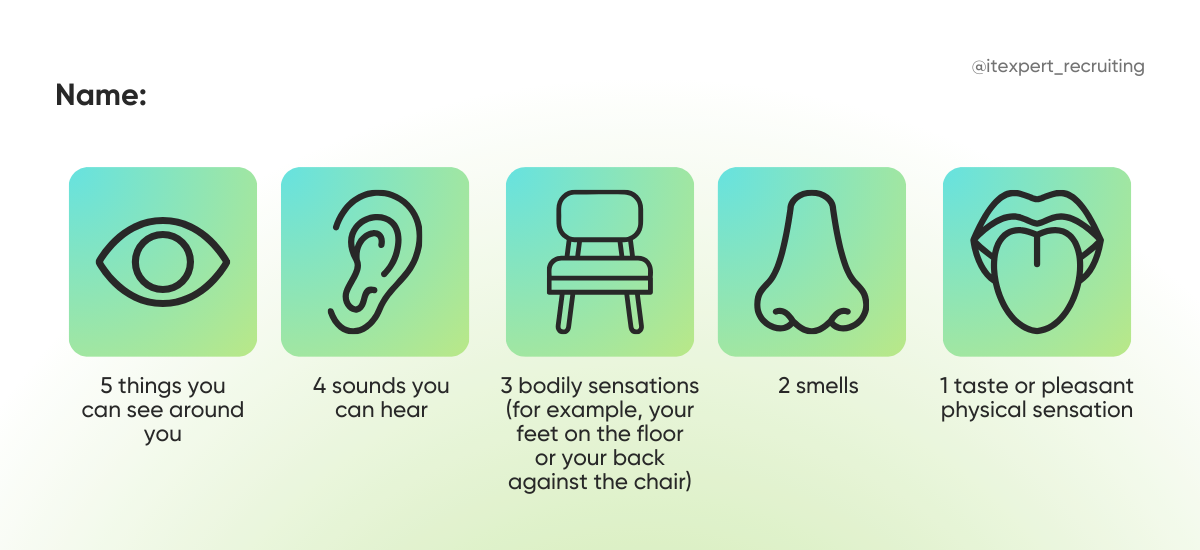
Under intense or prolonged stress, the brain often shifts into “fight or flight” mode. In this state, rational thinking, decision-making, and emotional regulation become significantly harder. Mindfulness helps restore awareness of the present moment, reconnect with the body, and reduce anxiety.
One simple and effective grounding exercise is the 5–4–3–2–1 technique. When stress spikes, try the following.
This exercise helps interrupt anxious thought loops and restores a sense of control in the here and now.
In fast-changing fields like IT, psychological stability is closely linked to adaptability. One of the most effective ways to build this adaptability is by developing as a T-shaped professional — combining deep expertise in one core area with foundational knowledge across related domains.
For example, a backend developer may specialize in Python and Django while also understanding DevOps practices, CI/CD pipelines, and basic frontend concepts. A frontend engineer deeply skilled in React and state management might also be familiar with product metrics or user flow analysis.
This approach strengthens both professional confidence and flexibility. Depth provides credibility and long-term value, while breadth enables mobility. As a result, it becomes easier to learn new technologies, transition between roles, and stay effective despite shifting industry trends.
Avoiding stress entirely doesn’t build strength. In fact, carefully managed stress is one of the mechanisms through which adaptability develops. The goal is not to overwhelm yourself, but to step outside your comfort zone in a deliberate and sustainable way. Ways to introduce constructive stress include:
Psychological resilience at the team level is no longer just a personal matter. Chronic stress carries a measurable cost for organizations. A WONE survey of employees in the US and the UK found that stress costs companies approximately $5.3 million per 1,000 employees each year, driven by higher healthcare expenses, reduced productivity, and increased employee turnover.
The operational impact is just as significant. Employees experiencing high stress levels make 11 times more errors and are 8 times more likely to take sick leave. Yet despite these realities, 68% of senior leaders admit they are not doing enough to support team wellbeing, even though 94% agree that leaders should understand and prioritize it.
This gap highlights a broader question many organizations now face: what is career resilience? At an organizational level, career resilience means creating conditions where employees can sustain performance, adapt to change, and continue growing in their roles despite uncertainty, pressure, or disruption. For teams not only to endure but to perform effectively, companies need a systemic culture of care. This includes:
Practical steps may include expert-led lectures, Q&A sessions, and interactive workshops with psychologists. Organizations can also invest in developing skills that directly strengthen resilience at work, such as:
💬 Assertive communication — expressing needs and boundaries without escalating conflict
🧠 Self-regulation — managing emotional responses in high-pressure situations
🔄 Adaptive planning — adjusting priorities and plans quickly while maintaining productivity.
These investments reduce operational risk while providing employees with tangible support. In times of instability, such an environment enables teams to adapt faster, stay engaged, and act decisively rather than becoming stuck or disengaged. Challenges shift from being sources of exhaustion to becoming opportunities for learning and collective growth.


