




04.03.2026
7 Recruitment Biases Even Seasoned Specialists Still Fall For

Hiring top talent is expensive. In IT, cost-per-hire can reach 25–30% of a specialist’s annual salary, which means every step of the recruitment funnel must perform at its best.
Now imagine a single metric that cuts through assumptions, polished decks, and “we tried everything” explanations. A number that shows, objectively, whether your offer truly resonates with candidates — or exposes weaknesses instantly. That metric is the Offer Acceptance Rate (OAR).
A high Offer Acceptance Rate signals market trust in your employer brand, compensation, and hiring process. A low one is an early warning system, highlighting issues that need immediate attention.
Understanding what is a good offer acceptance rate and how yours compares to the market can be the difference between a hesitant “maybe” and a confident “yes” from top-tier candidates.
In our article with Tech Recruiters ITExpert, we break down:
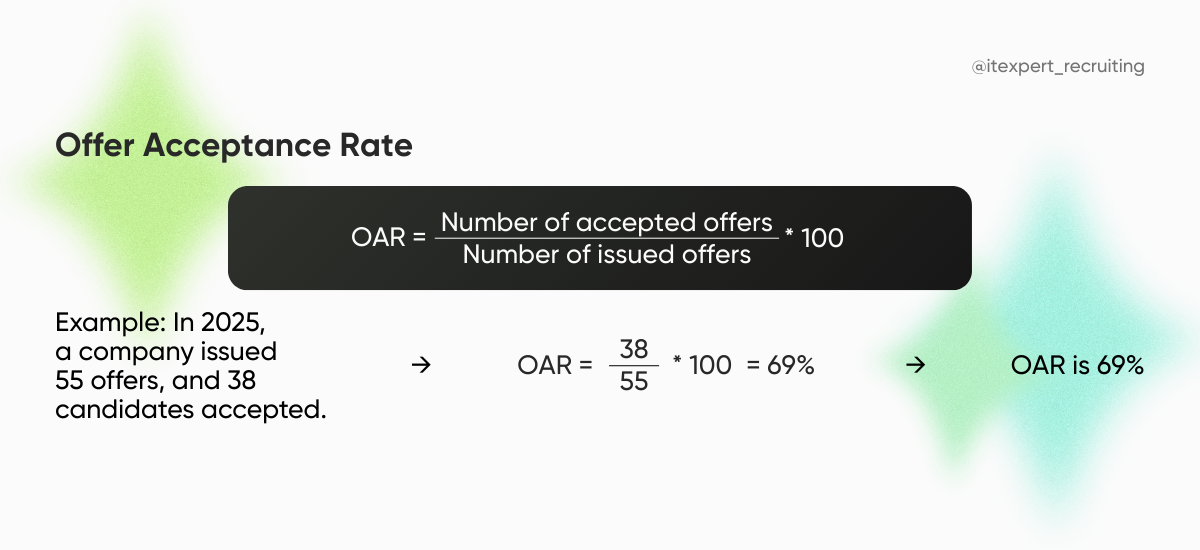
To evaluate hiring effectiveness, recruiters use a simple but powerful offer acceptance rate formula:
Here is how to apply it in practice.
1️⃣ Define the time period — quarterly, semi-annually, or annually.
2️⃣ Count all offers made during that period (this is your denominator).
3️⃣ Identify how many were accepted (this is your numerator).
4️⃣ Divide and then multiply by 100 to get your OAR as a percentage.
💡 Pro tip: track OAR trends over time. A sudden increase or drop often reflects changes in market competitiveness, candidate expectations, or the perceived value of your offer — long before those issues surface elsewhere.
When leaders ask about an offer acceptance rate benchmark, they are usually looking for a single “healthy” number. In reality, benchmarks vary significantly by role, industry, and market conditions.
According to the Ashby Trend Report, which analyzed data from over 230,000 candidates, the average Offer Acceptance Rate (OAR) falls between 77–81%. But this headline figure only tells part of the story. A closer look at offer acceptance rate by industry reveals a clear divide:
In the offer acceptance rate benchmark tech industry, expectations must be adjusted even further. For highly competitive roles — such as Senior or Lead Developers — OARs can drop dramatically, sometimes landing closer to 50%. Despite this, many companies still aim for a 90%+ target, which may be unrealistic in tech recruiting.
💡 Key takeaway: benchmarks are not fixed. They fluctuate with the labor market, economic pressure, and evolving candidate priorities. Tracking trends over time is far more valuable than chasing an “ideal” number.
If your OAR is declining, it’s rarely random. It is a signal that something in the hiring system needs attention. Below are the most common drivers behind a low OAR — especially relevant in offer acceptance rate benchmark tech recruiting.
If your offer doesn’t align with the market — or the candidate’s expectations — acceptance rates will drop fast.
Common issues:
What helps:
✅ Run regular market and compensation reviews
✅ Strengthen the total package, not just base pay: health coverage, modern tech stack, learning budgets, sabbaticals, equity, or career mobility.
The average hiring process takes around 44 days, yet top candidates often leave the market within 10 days. Slow approvals and over-engineered interview loops cost you offers.
Typical breakdowns:
What helps:
✅ Reduce interviews to only what is essential
✅ Align early on the candidate profile
✅ Set clear timelines (e.g., feedback within 48 hours)
✅ Use smart screening tools: skills tests, async video, structured CV filters.
Candidate experience has a direct, measurable impact on OAR. Research shows that 25% of candidates discourage others after a negative experience, while a positive experience increases the likelihood of offer acceptance by 38%.
What hurts impression:
What helps:
✅ Personalized, timely communication
✅ Clear and professional feedback
✅ Well-prepared interviewers
✅ A transparent, predictable candidate journey
Flexibility is no longer optional. 77% of candidates would choose flexible working conditions over a higher salary. Rigid schedules and mandatory office presence are common rejection triggers.
What helps:
✅ Remote or hybrid work options
✅ Adaptable schedules aligned with real business needs
✅ Annual reviews of work policies to stay competitive
Even strong compensation can’t compensate for a weak or unclear EVP. Candidates want purpose, credibility, and trust.
Red flags:
What helps:
✅ Rethink EVP to reflect reality, not marketing slogans
✅ Actively manage employer reputation
✅ Involve employees in sharing authentic stories
✅ Be honest about challenges, not just perks

“Everything ultimately comes down to candidate motivation. That’s what determines whether an offer is accepted or declined. When someone enters the job market, they are looking for something better than what they have today — higher compensation, a more interesting tech stack, a stronger product, greater flexibility, additional vacation time, or a combination of factors they personally value.
That’s why effective offer management starts with understanding the candidate’s true motivation. What conditions matter most to them? Which criteria will actually drive their final decision? Once those expectations are clear, you can shape the offer, the hiring strategy, and the communication in a way that feels genuinely relevant to that individual.”

“I once worked on a case where a candidate declined an offer from a company in the trading space. From the start, the environment felt very different from a traditional IT setup — no familiar Scrum rituals, heavy bureaucracy, and highly specific internal processes. The candidate was looking for a classic IT structure, so the domain itself became a deal-breaker.
The same dynamic often appears with startups. For some candidates, startups represent freedom, speed, and excitement. For others, they signal chaos, instability, and unpredictability. If a specialist has never worked in that kind of environment, the likelihood of rejection at the final stage increases significantly.
That’s why these factors should be addressed early on — ideally in the first conversations. Being upfront about the company’s domain, operating model, and process expectations helps set the right context and prevents surprises when it is time to make the offer.”

“Beyond the Offer Acceptance Rate itself, I closely monitor time-to-offer — the number of days between first contact and extending an offer. The longer the process takes, the higher the risk of rejection. During that time, candidates often receive competing offers and make decisions faster than we do.
Another important metric is the drop-off rate, especially at the final stage or just before the offer decision. This helps identify what’s actually driving rejections:
By systematically analyzing these reasons, we can clearly separate what can be improved internally from what’s outside our control.”

“The first and most obvious indicator is the Offer Acceptance Rate itself. But it’s only the starting point. The second critical area is Rejection reasons analysis:
These insights are extremely valuable when working with future candidates — they help you avoid repeating the same mistakes.
The third key metric is conversion from the final interview to the offer. This shows how accurately candidates are selected for the final stage and how effective the assessment process really is. I also track conversion at every stage — from the first conversation to offer acceptance. If there’s a stage where a large number of candidates drop off — whether it is an HR interview or a technical interview — that’s a clear signal to revisit the process or rethink how the role is being presented.”
When it comes to offer acceptance, pressure tactics don’t work. What does work is trust, transparency, and a deep understanding of candidate motivation. These elements directly influence whether an offer turns into a signed agreement. Below are practical, field-tested tips from ITExpert tech recruiters on how to increase acceptance rates — without aggressive selling.
Start by creating a safe, open conversation. Candidates should feel comfortable sharing what excites them — and what doesn’t. Show that your goal isn’t to “close” them at any cost, but to find a genuinely strong mutual fit. Trust built early makes later offer discussions far more effective.
Right after each interview, ask targeted questions:
Document this feedback carefully. These insights allow you to tailor the final offer and address doubts before they turn into rejections.
Misaligned expectations discovered at the final stage are one of the most common reasons offers are declined. Discuss upfront:
Transparency early on prevents disappointment later.
“I once had a candidate decline an offer because of working hours. He wanted to finish at 4:00 PM, while the company’s standard day ran until 5 or 6 PM. Another case was about office location: the candidate was open to coming on-site, but the commute was simply too long.”
If a candidate shows signs of doubt, initiate a calm, thoughtful conversation. Ask when the hesitation appeared and which factor became decisive. Sometimes a refusal isn’t final. Even when it is, the insights you gain will improve future hiring outcomes and overall conversion rates.
If a candidate has other offers, ask respectfully about their terms, if they are open to sharing. Remind the candidate that they are close to the final decision with your company and that completing the process will give them a full comparison. The goal isn’t to win against competitors — it is to help the candidate make a well-informed decision based on the complete picture.
Candidates don’t always share the real reason behind a rejection. Asking the right questions helps uncover meaningful insights:
“I had a case where a candidate received two offers — one for a Lead role and one for a Senior role. He waited longer for the Lead offer because that was his preference. But after receiving it, he gave vague, unrelated reasons for declining.
Only after carefully analyzing each argument did the real reason come out: the salary difference was just $500, while the responsibility gap was significant. He realized the additional workload simply wasn’t worth it.”
Focus on your strengths: product maturity, stability, transparency, leadership, and collaboration story. Avoid negative comments about other companies. Criticizing competitors often backfires, undermines trust, and can feel manipulative to candidates.
A strong final conversation requires preparation. Revisit the candidate’s core motivations. Clearly articulate the key benefits of the offer. Also, structure your main talking points, anticipate objections, and prepare thoughtful responses. A well-prepared final interview reinforces confidence and often becomes the decisive moment in turning an offer into a “yes.”


