










04.03.2026
7 Recruitment Biases Even Seasoned Specialists Still Fall For

Imagine you’re looking for a rare specialist for a senior+ position. You post the vacancy on various job boards, but the response rate is low. Or worse, you receive plenty of applications, but none of the candidates have the necessary skills.
Here’s another scenario: you need to fill six or more QA automation vacancies within a month. You organize a meetup and a hiring day but fail to account for all possible setbacks. Deadline is missed.
How do you tackle these challenges and successfully fill even the most difficult vacancies? A well-thought-out sourcing strategy is key. Together with Recruitment Team Leads and Technical Recruiters at ITExpert, we’ve explored how to craft it and what approaches and sourcing tools to use to quickly show candidates, and how to use trends to your advantage.
What We’ll Cover:
Sourcing is a crucial part of IT recruitment. It involves actively searching for, reaching out to, and engaging candidates from a wide range of sources. Simply receiving clear job requirements, posting a vacancy, reviewing a few strong applications, and making an offer sounds like a recruiter’s dream — but it rarely happens that way in reality. Most sourcing strategies require a more nuanced approach.
What is sourcing in practice? You might post a vacancy on a job board, research IT professionals on LinkedIn, or even ask DevOps engineers in your network for referrals. Our team has seen cases where recruiters invited candidates for interviews after spotting their comments on YouTube videos. These are just a few of the many sourcing channels available to experienced recruiters.

“GitHub and Kaggle are great, but they don’t tell the whole story! Some of the most surprising places where my colleagues and I have found candidates include:
A skilled recruiter always has their ‘radar’ on. If they overhear a Java conversation in a café or chat with a taxi driver who talks about his IT routine, that could lead to a valuable new connection.”
Strategic sourcing in recruitment involves several key steps:
To stay organized with request variations and platforms covered, senior recruiters often create a dedicated document outlining their sourcing strategy, including:
📌 Tip: For large recruitment teams, it can be useful to keep sourcing strategies synchronized. If recruiters are working to fill the same or similar positions, they can share platforms or requests among themselves. This prevents duplicate efforts and ensures time isn’t wasted testing ineffective methods. Instead, the team can cover a broader talent pool.
Historical data from the past 3–6 months can also help junior recruiters quickly adapt to new vacancies and minimize the need for extensive back-and-forth with hiring managers. Of course, this applies to similar or recurring positions.
A sourcing strategy document also helps present your work and justify necessary changes to the hiring manager. In some cases, a sourcing strategy is also combined with a candidate tracker or sourcing plan, which records the forecast and actual results by channel.
Let’s analyze classic and creative strategies of staff sourcing: when and how to use them to find the perfect match.
One of the most common and effective IT sourcing methods is identifying the most suitable candidate and sending them an enticing offer. In this industry, most candidates are “cold” and already employed, so they respond more actively and quickly to direct contact from a recruiter.
This approach is also ideal when searching for specialists with rare expertise. If you know exactly who you’re looking for — even if the talent pool is small — your recruitment funnel conversion improves. Bonus: you won’t have to sift through 30+ irrelevant applications from job platforms.
Where to Find Candidates:
Skilled researchers know how to extract candidate contact details and where to reach out to maximize response rates. Even if a platform lacks direct one-on-one messaging functionality, that won’t stop a great recruiter from making a hire.
👉 When to Use This Approach:
If vacancies have standard requirements and the recruiter is ready to spend more time filtering them, posting across various platforms and channels come into play. Some of the most popular ones in IT and digital include Indeed, GoAbroad, Glassdoor, etc.
*Premium LinkedIn users can post vacancies using job slots, making them visible in a dedicated section for candidates.
Vacancy posting is undoubtedly effective for attracting a broad audience of specialists who are actively seeking new opportunities at this very moment. However, the downside of this approach is that candidate sourcing turns into filtering through incoming applications. Sometimes, even after reviewing dozens of responses, there’s still no candidate ready to move forward to the interview stage.
👉 When to Use This Approach:
Talent donor companies are organizations that employ specialists with the exact skill set required for your vacancy. Product-based companies operating in niche industries often have specific candidate requirements — such as prior experience in Blockchain. Recruiters can either analyze each application and profile individually or take a different approach: identify companies where relevant specialists are already working and source their contacts. This method is known as recruitment through talent donor companies.
Bonus Advantage: You can craft a highly personalized first message to the candidate, taking into account their previous experience, strengths, and how they align with your role.
👉 When to Use This Approach:
Sourcing in recruitment also means mastering headhunting techniques. Hiring “star” candidates is common when a company has a specific specialist in mind, they want to bring on board. Imagine a client wants to hire John K., who has over 15 years of experience in senior positions at IT service companies, understands their operational nuances, how business is built, and knows how to scale it. In this case, the recruiter will craft a highly personalized offer to catch his interest.
Applying mass recruitment methods or posting vacancies on traditional platforms won’t yield the desired results in such cases.
Sometimes, headhunting also refers to sourcing rare talent that’s in short supply. The employer may not know the names of potential candidates, but they may have rather unique wishes for the candidate’s portrait: for example, they want to find a charismatic manager who can motivate the team and regularly participate in webinars and conferences to represent the company. In this scenario, the recruiter will likely focus on specialists who have already spoken at industry events and built strong personal brands.
👉 When to Use This Approach:
Another sourcing approach is the internal mobility of IT specialists between departments or internal recruiting. Employees who have already completed onboarding and training can save the company time and money on hiring. According to LinkedIn research: 81% of companies say internal recruiting helps reduce employee turnover and another 69% of businesses report high productivity of new hires. Additionally, this approach can boost team engagement, as employees see clear career growth opportunities within the company.
Internal recruiting is especially relevant for large product-based or outsourcing companies with a talent pool, bench specialists, and a generally big team. However, any organization can experiment with this method. If this strategy fits your company but you’ve never posted vacancies internally, give it a try.
Drawbacks of This Approach:
👉 When to Use This Approach:
Organizing training and networking events is a powerful sourcing strategy if you can’t attract enough candidates or if their availability on the market is low. These could be a hackathon, meetup, panel discussion, or a hiring day (fast-track recruitment events held within a single day, often combined with industry-related lectures).
Hiring events are also useful when you need to attract a large number of specialists within a tight deadline. A great example is Jaguar’s collaboration with Gorillaz in 2016. They launched a gamified hiring contest. At the first stage, the participants had to assemble the Jaguar I-PACE Concept in a 360-degree environment (as if in the garage of the Gorillaz band). In the second, they had to “crack” the code in an alternative reality mode.
Winners were fast-tracked through the hiring process. The challenge helped Jaguar recruit over 1,000 IT specialists, including electronic and software engineers.
👉 When to Use This Approach:
Be creative! Hiring can happen through referrals, networking, boomerang hires, or a hot candidate database — and this is not the whole list of sources. A strong employer brand also plays a crucial role. It increases the number of applications, improves candidate interest in a vacancy, and boosts conversion rates at different stages of the hiring funnel.

“A recruiter shouldn’t limit themselves to just a few approaches. It’s important to constantly test new platforms and sourcing tools. I’ve had multiple cases where the initial strategy didn’t work, but after adjustments or fresh ideas, we found the right (and relevant!) candidates, successfully filling the vacancy.
Here are some examples:
To find specialists who are actively looking for a job, pay attention to the IT market updates. If a company has experienced layoffs, you can offer its specialists a job. This way, you will help people find a company quickly, and the communication process will be fast, and candidates will be interested.
Key Takeaway: Always stay open to new ideas and test them in practice.”
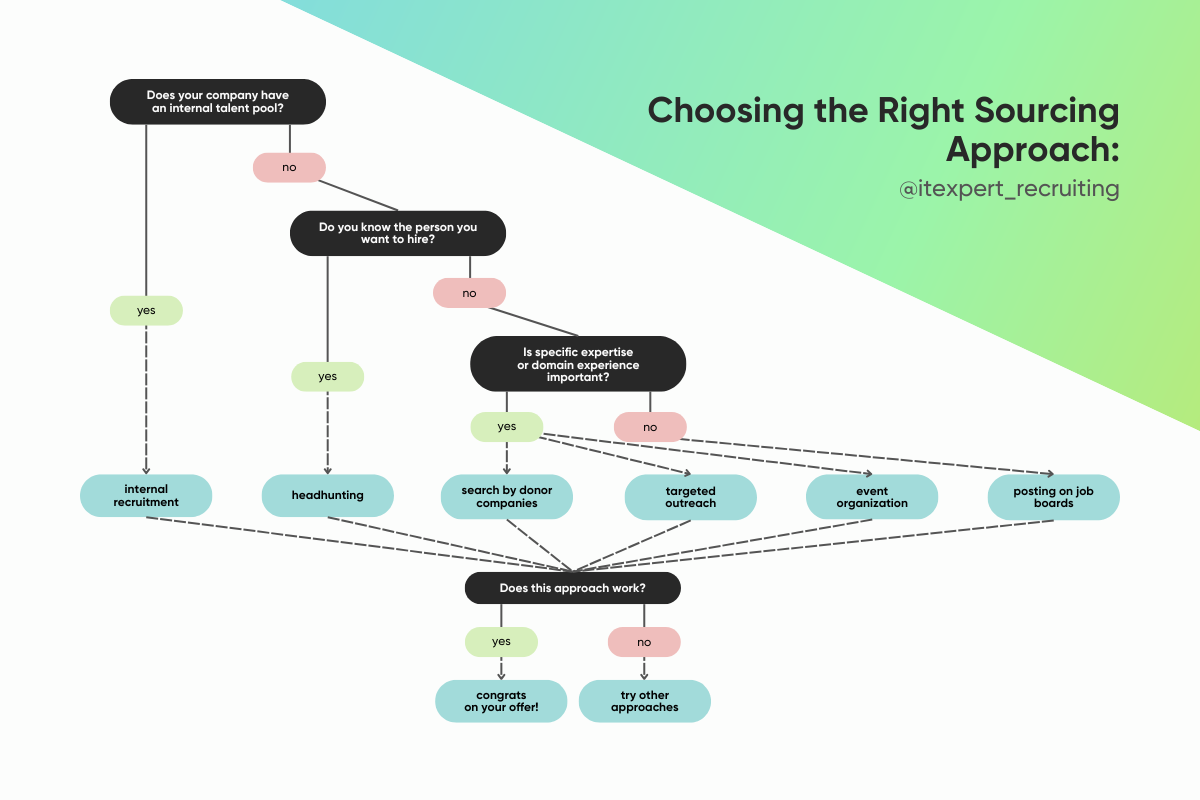
Which approach you choose always depends on the candidate profile, available resources, and the timeframe for hiring. We’re sharing with you a simplified scheme of how to prioritize the main methods, but your vision of how and in what order to use them may differ.
Let’s explore common sourcing strategy mistakes and ways to prevent them.
At first, you may feel like you remember everything — your main requirements, the approaches you’ve tested, and all the places you’ve searched. But as more vacancies pile up, all your ideas disappear. Or you might overlook new ideas for expanding your search — missing out on a whole pool of potential candidates.
Keeping your sourcing strategy only in your head isn’t OK! Instead, maintain a sourcing strategy document consistently (and sleep with a calm mind 🙃).
Each platform or approach is your assumption about whether candidates will respond. If a specific search query or messaging strategy isn’t yielding results within 2–5 days, don’t keep pushing it. Instead, tweak something: refine the vacancy description, adjust the filters, or discuss lowering requirements with the hiring manager.
Still not working? That happens. Drop the approach and test a different one. The one thing you shouldn’t do in recruiting is scale up a failing strategy.
Staff sourcing is like cooking — you need more ingredients than just LinkedIn and Djinni. Even for seemingly typical vacancies, these platforms might not deliver enough candidates. Or maybe you can’t use them due to restrictions or high costs. Keep an eye on emerging candidate search platforms and experiment with different ones for various vacancies. That’s how you’ll discover the right tools that work best for the roles you’re hiring for.
Although AI tools are already changing recruiting and helping with sourcing, strategic decisions still rest on the recruiter’s shoulders.

“There’s a lot of debate about AI tools in hiring, and once again, we’re hearing claims that ‘recruiters will soon become obsolete.’
I can’t agree with it. Complex and creative tasks are still best handled by humans. Take sourcing strategy development and approach selection — these are critical tasks that, in my experience, AI simply can’t manage effectively.
For example, LinkedIn Recruiter is already rolling out AI-driven tools for writing personalized messages and developing a smart assistant to simplify filter settings and composing Boolean queries. However, while these tools can make certain tasks easier, they don’t always provide relevant or well-crafted suggestions. AI-generated message templates can be helpful, but understanding cultural nuances and context remains the recruiter’s responsibility.
Building a comprehensive sourcing strategy and collaborating within a team require hands-on expertise and real-world experience.”
Recruitment is constantly evolving — hiring processes get updated, priorities shift due to managers’ workloads, and candidate profiles are refined based on interview feedback, etc. Ignoring these changes is a mistake. As soon as you receive new information that could impact your search, update your sourcing strategy, refresh vacancy postings, and create new Boolean queries to test.
Final Thoughts. Sourcing in recruitment is always a challenge — especially when looking for senior IT specialists or candidates with niche stacks. Stay flexible, leave room for creativity and continuous learning, and you’ll be able to fill any vacancy 🙌


