




04.03.2026
7 Recruitment Biases Even Seasoned Specialists Still Fall For

IT professionals aren’t always enthusiastic about job opportunities in the banking industry. Some of them expressly state in their job platform profiles that they don’t want to receive such offers (as well as vacancies from gray niches). At the same time, banks are undergoing an active transformation as the market is expanding and can offer developers a modern stack, interesting solutions, a competitive social package, and open vacancies! According to the Financial Services Digital Transformation Survey, most banks have already developed a digital transformation strategy.
So, how can we make IT recruitment in this field more effective, successfully compete for talent, and combat stereotypes about “old, uninteresting banks”? Let’s figure it out with the help of ITExpert professionals in the article.
We’ve already mentioned that FinTech is on the rise, and the banking sector is no exception. The digitalization of all processes increases the demand for banking product services and, as a result, for developers in this field.
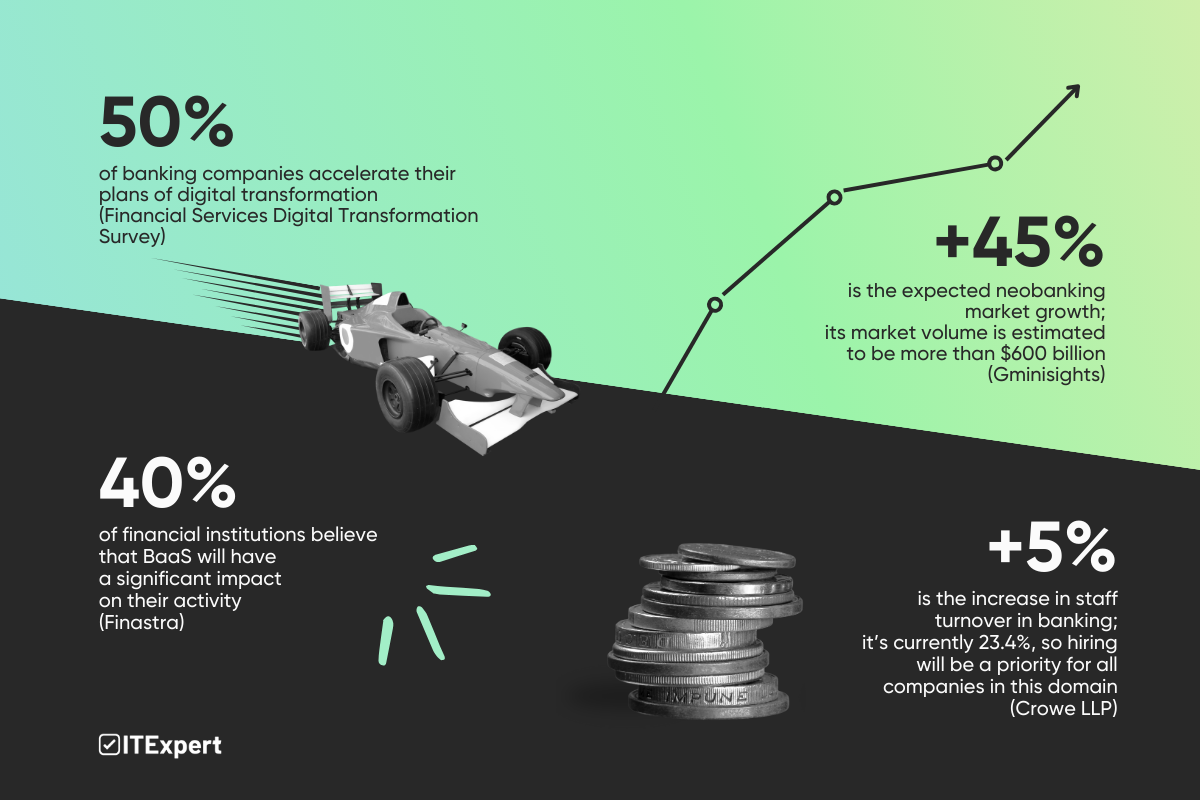
For example, according to the Financial Services Digital Transformation Survey, which included more than 100 C-level professionals in this field in the US, most banks have already developed digital transformation strategies, and nearly half are accelerating their plans. Also, neobanking is a distinct trend of recent years, with the market expected to be worth more than $600 billion (+45%) by 2028.
B2B banking is also growing. BaaS (banking as a service) is a model where online banks lease their infrastructure to smaller banks, as well as retailers, fintech startups, and other companies. According to research, 40% of financial institutions believe that this area will have a significant impact on their operations.
Banking IT products also use modern technologies: private clouds, microservices, data lakes, etc. You can find vacancies for both Java EE Developers and developers with a state-of-the-art stack, machine learning engineers, data analysts, IT solution architects, DevOps and FinOps engineers, big data specialists, cybersecurity specialists, QA, and many others.
As the banking sector has seen an increased demand for hiring IT specialists, filling vacancies in this domain is not easy. The global situation and the war in Ukraine (for local hires) also make successful recruitment rather challenging. It is necessary to take the following into account:
Despite the fact that about 8% of candidates work in the Fintech sector, vacancies from banks are frequently avoided. According to ITExpert recruiters’ experience, candidates indeed refuse to consider banking jobs due to the domain and industry stereotypes. Some specialists indicate in their profiles on job sites that they won’t consider banking vacancies along with offers from gambling, dating, and gray niches.
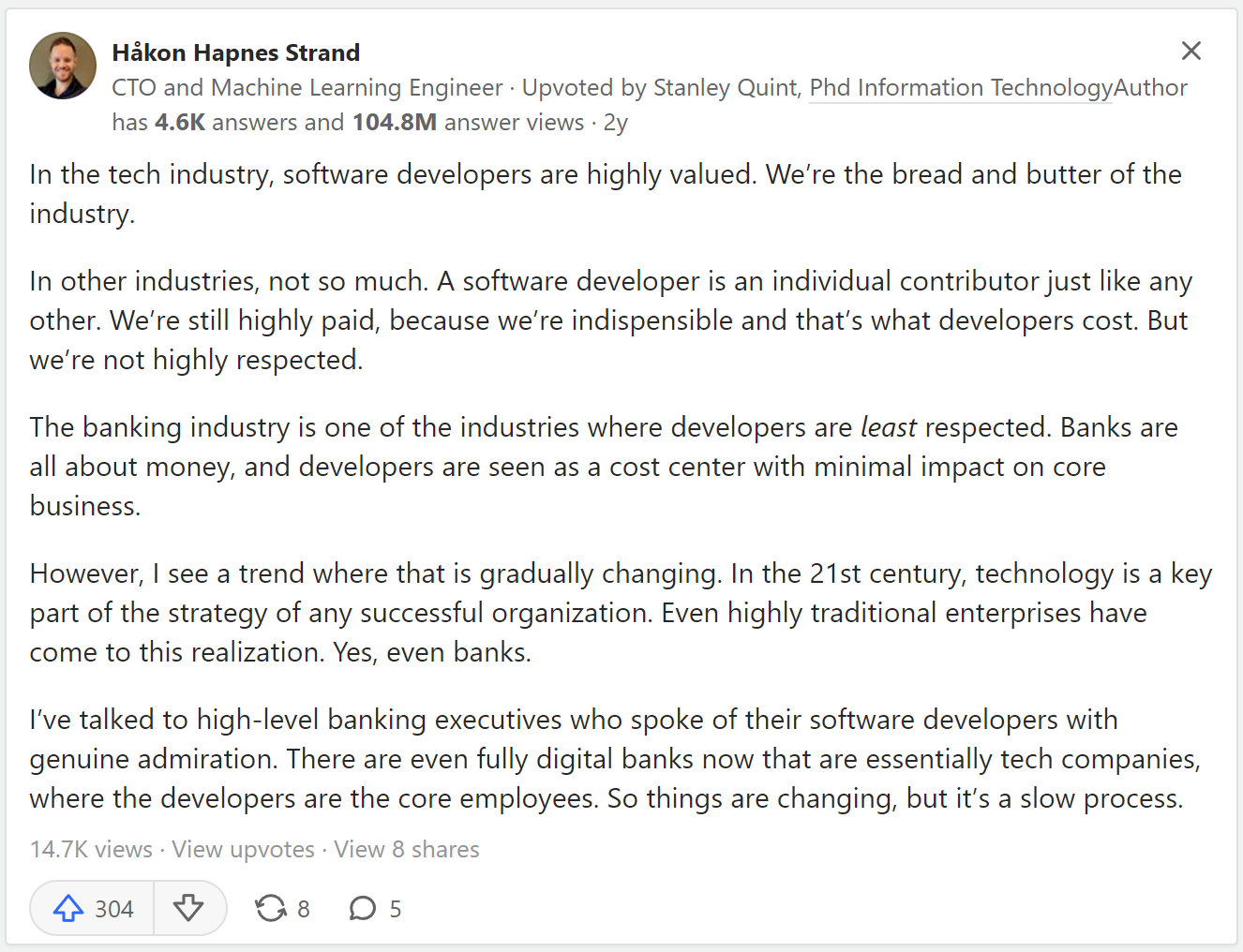
There are many stereotypes about the industry that influence candidates’ decisions. For example, IT professionals complain on the Internet that when they work for banks, they’re treated with less respect and recognition (though this has improved in recent years).
Formalities and bureaucracy are another deterrent for IT candidates. Banking recruitment and processes are frequently not tailored to IT professionals. A large number of hiring stages (including test tasks), long feedback sessions, and a lack of flexibility are all particularly triggering. IT people, who are used to working remotely and communicating on a first-name basis with the founder, are not very comfortable with formal vacation processes, dress codes, and only working from the office. And while many businesses in the banking sector have already adapted and are moving away from unnecessary bureaucracy, this reputation still affects the effectiveness of recruitment.

“We’ve worked with and communicated with banking representatives from various countries. I can confidently say that modern banks are in the process of active transformation and improvement. Some are more like startups, keeping their finger on the pulse of market changes and ready to adapt to the needs of candidates, while others are more focused on stability and, while still growing, implement decisions about changes more slowly.
There are still formal banking organizations that view developers as loners from the “IT guy” meme. This, however, is becoming increasingly rare. Banks, similar to IT companies, are often willing to hire IT professionals in Ukraine as individual entrepreneurs (B2B contracts), offering flexible hours, remote work, and standard employee benefits. They’re also adapting internal processes to modern realities. Businesses realize that customers expect efficient IT products and rapid changes, and this cannot be provided without a strong development team.”
Actually, employer branding in banking also has some positive aspects. Usually, IT professionals appreciate the following:
However, everything depends on the specific workplace and may vary.

“Stereotypes about banking and the challenges in recruiting for such positions do exist. However, it all depends on the specific offer and the recruiter’s ability to present it. There are numerous examples of vacancies in banking that offer:
Some IT people already understand this and can clarify the specific tasks of the position, while others need this explained as early as the first message. In any case, modern banking and neobanking solutions are viewed favorably by candidates.”
97% of fintech companies and banks consider hiring IT professionals a priority. Let’s figure out how to compete with other companies successfully and close positions on time with ITExpert professionals.
“Align the job description and update it as needed. Banks are usually large companies that have several projects with different stacks. If you put everything in one job description, you may find that you need a unique ninja. However, in practice, a specialist won’t work with all technologies.
To avoid such an overestimation of the job requirements, agree on who should be the responsible hiring manager that knows exactly what is used on the project and synchronize the search plan with them.”
“I would advise you to objectively evaluate your offer and employer brand in relation to other companies and understand your strengths and weaknesses. Sometimes, the average budget of other IT companies is higher, and candidates will not agree to lower their salary expectations. This cannot be ignored if you really want to fill a vacancy on time, as salary is one of the top factors in choosing a job among IT professionals.
Another factor is the high job requirements in the banking sector. It’s indeed a complex field that demands heightened responsibility from developers. Sometimes, however, including in a job description nice-to-have skills or technologies that aren’t planned to be used soon narrows the market of available candidates and, as a result, extends the time required for hiring. Differentiate between what you absolutely need in order to build a product right now and what you might be able to set aside so that you can meet the deadline.”
Do you want to optimize IT recruitment in banking? Our team can help you with this. We have experience working with companies like BNP Paribas Group, Xapo Bank, and many others. Thanks to our hot database of specialists, we will find the first candidates for you within 3-5 days. Leave your contact information, and we will discuss the specifics of your vacancies!


