





18.03.2026
Bend But Don’t Break: How to Develop Resilience in Times of Constant Stress

Can you step away from routine, see more of the world, and avoid spending your entire paycheck on travel? Today, work no longer forces that trade-off. With the right setup and the workation concept, you can combine professional responsibilities with a change of scenery, refreshing your mindset without dropping out of core workflows. This approach is often called a workation, meaning a blend of work and vacation where employees continue working remotely while temporarily living in another location.
In this article, we examine workation as both a managerial and individual tool:
P.S. This piece is grounded in real life. It was written during an actual workation — by our copywriter, working remotely from sunny Tenerife.
Workation hasn’t always looked the way we picture it today — laptops by the pool and sunset Zoom calls. As a work format, it began taking shape in the early 2010s and followed a very different logic. Initially, workation (meaning a structured blend of work and travel) was primarily a corporate initiative, not an individual lifestyle choice. Large companies in Europe and the U.S. were among the first to experiment with it, using temporary offsite workspaces as both an employee benefit and an alternative work format. These trips often involved several teams — or even the entire company — working together outside their usual environment. The objective was to improve focus, encourage informal communication, and strengthen collaboration, especially for what we would now call a distributed team workation.
A well-known example is the American company ZenPayroll (now Gusto). Twice a year, it brought employees together for 5-day trips to San Francisco. The team rented a large house, worked intensively on the product, ran hackathons, and spent evenings hiking, watching movies, or playing board games. For a workforce that spent most of the year working remotely, this format helped synchronize people and rebuild shared context.
A similar approach was used by Konnect Public Relations, an SMM and PR agency that regularly organized group trips — to ski resorts, sea cruises, or wine tastings. The idea was simple: a team is not just tasks and deadlines, but a community. These early formats laid the groundwork for how distributed team workation models would later evolve.
Over time, this approach transformed. The growth of IT and digital tools, the gradual shift to remote work, and later the pandemic accelerated the change. Workation stopped being a one-off corporate event and became an individual, flexible practice — often decoupled from the team entirely.
In its modern form, workation comes with almost no formal limits on duration, location, or structure. However, greater freedom also blurs the boundaries between work and rest, productivity and burnout. That’s why today, distributed team workation is less about an office with an ocean view and more about the maturity of workflows, self-discipline, and explicit agreements within teams.
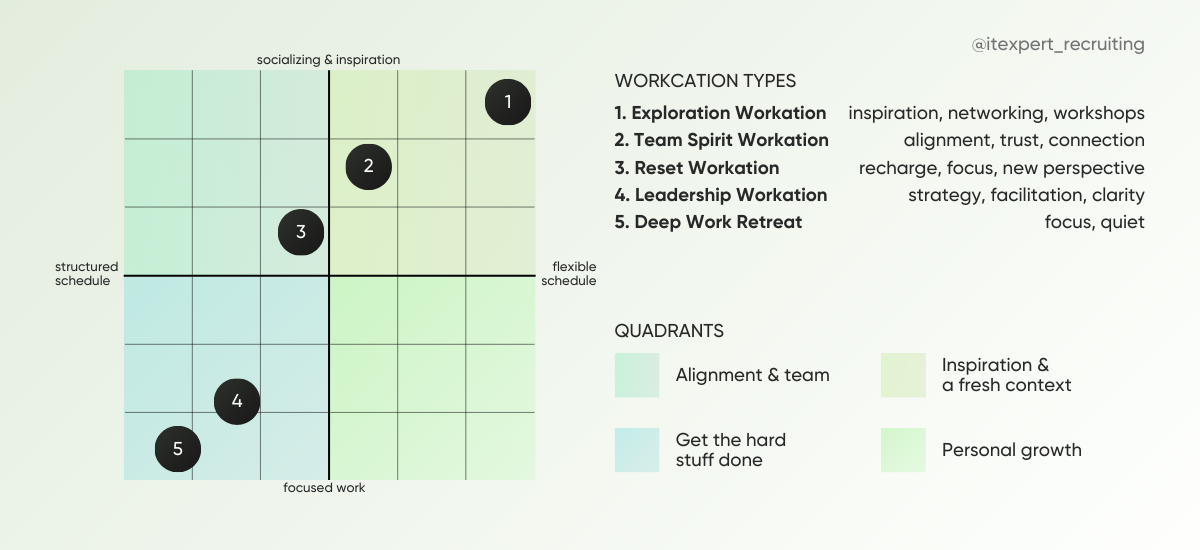
A workation is like a Spotify playlist: pick the wrong mood, and the result can feel off. For a change of location to actually deliver value, it’s critical to understand why you are going in the first place. Below is a practical (and slightly playful) typology of workations, illustrated with real-life scenarios.
Meet Mark, a developer at a SaaS company. His team has been fully remote since the pandemic. Day-to-day tasks keep moving, deadlines are met — but energy is gone. Motivation has quietly disappeared, ideas rarely surface, and the team chat feels abandoned.
Why this format works: Mark’s team needs a quick reset — a change of environment to restore focus and momentum without completely stepping away from work. This type of workation helps break monotony while keeping productivity intact.
How it works: The team relocates to a small town for a few days, reduces online meetings to a minimum, and prioritizes focused individual work combined with short, in-person syncs. Within days, discussions become more dynamic, and fresh ideas begin to flow again.
Sabina is the CEO of a small product company. Her calendar is packed: calls, deadline adjustments, client demands. Strategic thinking has been pushed aside by constant micromanagement, increasing both stress and operational chaos.
Why this format works: Sabina needs distance from day-to-day execution to think strategically. A leadership-focused workation creates space to step out of operational noise and reassess the business from a higher level.
How it works: Sabina and the leadership team spend a week in a quiet location outside the city. They focus on 6-month planning, strategy sessions, product roadmaps, and risk assessment. When they return, the company has a clear direction — and Sabina regains confidence in long-term decision-making.
Lisa works with a distributed team of product designers. In theory, everything looks fine: daily Zoom stand-ups and active chats. In reality, team members barely know each other. Trust is low, ownership is unclear, and company goals feel abstract.
Why this format works: For distributed teams, real human connection can’t always be built online. A distributed team workation focused on bonding helps turn a group of individuals into an actual team.
How it works: The team goes on a multi-day trip — either out of town or to another city. Time is split between light work sessions and team activities: walks, board games, quests, cooking together, or creative workshops. The result is stronger trust, clearer collaboration, and more effective communication once the team returns to remote work.
Alex is a data analyst at a fintech company. The office is full of distractions: chats, meetings, and kitchen conversations. Working from home doesn’t help either — family life makes deep focus impossible.
Why this format works: Alex needs uninterrupted concentration to tackle complex analytical tasks. A deep work retreat removes distractions and creates the conditions for high-quality output.
How it works: He spends a week in a quiet city, cancels non-essential meetings, and strictly defines working and rest hours. By the end of the retreat, reports and models are complete — and Alex returns without exhaustion.
Anya is a product manager working on a new product. Lately, every idea feels like a recycled version of something the team has already built.
Why this format works: Creative stagnation often comes from a lack of new input. An exploration-focused workation introduces fresh contexts that spark innovation.
How it works: Anya travels with her team to a new location, attends cultural events, meets local startups, and participates in workshops. New impressions quickly turn into unconventional product concepts — ideas that would never emerge in a familiar office environment.
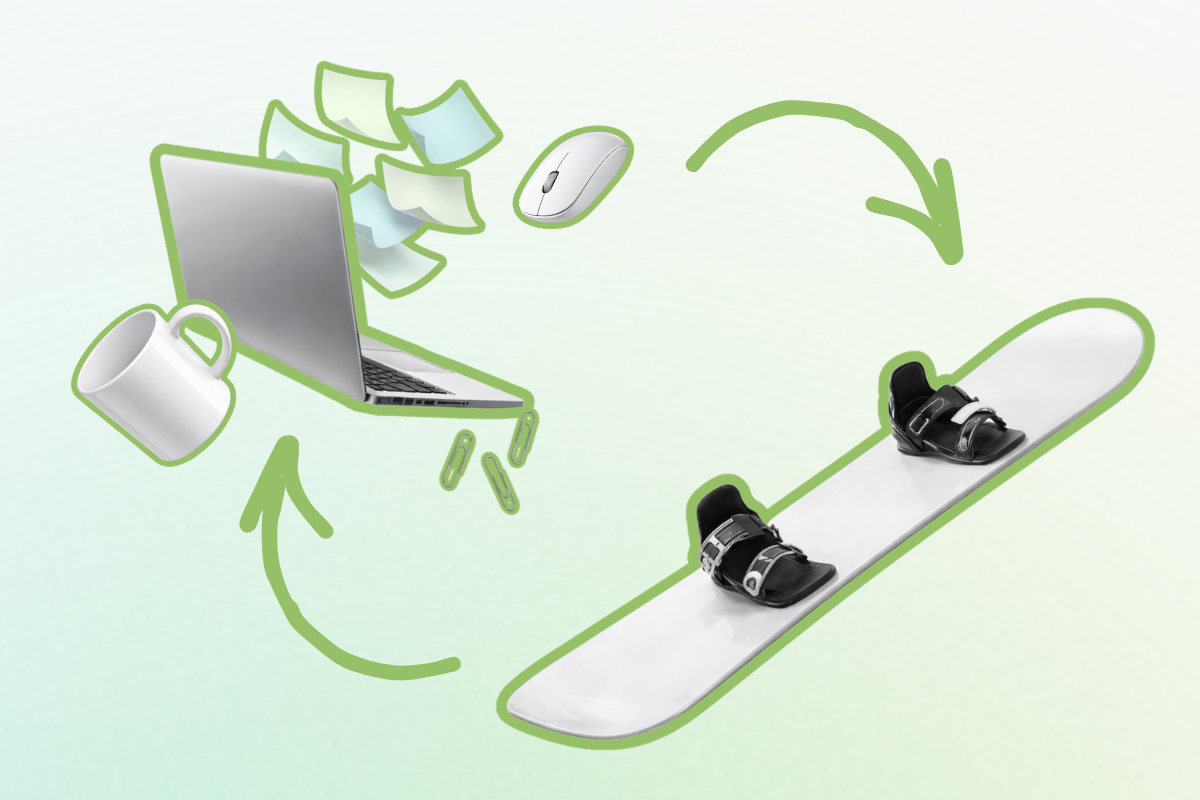
Picture this: you’re working from a terrace overlooking the ocean or snow-covered mountains. A laptop, a cup of coffee, fresh air. After hours, it’s the beach, a snowboard run, or a sauna. Instead of gray office walls — colorful streets or alpine views.
It looks like the perfect setup. But does a workation really work as smoothly as it does on Instagram? And why do some companies tighten controls — just to make sure no one is dialing into a Zoom call from a hot tub in Tahoe or Aspen? Let’s take a clear-eyed look at what actually works in practice — and what often turns into a headache for both employers and employees.
A new environment, fresh stimuli, and distance from office routine can provide the spark that’s missing in day-to-day work. When done intentionally, a workation can deliver tangible benefits.
➕ A creativity boost. Changing your surroundings helps you see familiar problems from new angles. Research from Columbia Business School shows that exposure to new environments increases creative thinking and cognitive flexibility. This is especially valuable for professionals working on complex, long-term challenges where solutions require repeated iteration and sustained motivation.
➕ Soft skills you don’t plan for — but gain anyway. Interacting with people from different cultures naturally strengthens communication, adaptability, and networking skills. These benefits extend beyond personal growth and show up in better collaboration — both within teams and with clients.
➕ A way to stretch a vacation without dropping out of work. Traditional vacations often end just as you start to unwind. A workation can act as a middle ground: you extend your stay, change the scenery, and stay professionally engaged without fully disconnecting.
Despite its appeal, a workation is not a universal solution. What looks effortless in photos usually demands strong self-discipline, thoughtful planning, and clear agreements. Here are the most common pitfalls.
🗿 Paradise can be stressful. Your brain thrives on rhythm and predictability — two things a workation often lacks. Living out of a suitcase, unreliable Wi-Fi, awkward workspaces, or the absence of a proper desk can quickly erode focus.
🗿 Time zones matter (more than you probably think). When your team’s workday starts, it may already be evening where you are. Late-night Zoom calls under a ceiling fan are far less glamorous than they sound.
🗿 Constant distraction. A new city competes aggressively for your attention — while emails, Slack messages, and deadlines keep pulling you back to work. The result is split focus and a lingering sense that you are neither fully working nor fully resting.
🗿 Everything depends on the internet. An unstable connection is one of the biggest risks of any workation. When the internet fails, even the best-planned schedule can collapse into missed meetings and delayed deliverables.
🗿 Re-entry isn’t always smooth. Returning to a traditional office or home setup after a workation can take time. Productivity may dip temporarily as your brain readjusts to routine.
🗿 Not a cure for burnout. If procrastination or disengagement is driven by chronic overwork or burnout, a workation won’t fix it. In those cases, only real rest — not a change of scenery — will help.
Before you book flights or reserve accommodations, take time to think through the basics. A successful workation depends far more on preparation than on the view from your window.
When selecting a place for a workation, think like someone who will be working there every day:
Constantly moving between locations drains energy and increases adaptation time. Staying in one city for at least a month is usually optimal. It allows you to settle into a routine, stabilize work processes, and often reduce accommodation costs.
Time zones don’t disappear just because you are working remotely. Even if you’re a manager or a key specialist, the team shouldn’t have to reorganize their day around your new location — unless most of the team moved with you. Therefore, define in advance when you’re available for calls, when you focus on deep work, and when you are offline. Clear boundaries prevent friction and burnout on both sides.
Before you leave, align schedules, meeting times, and expectations with your teammates and managers. Clear agreements help avoid blocked workflows, protect everyone’s focus, and preserve healthy working relationships.
Every few years, Culture Trip publishes a ranking of the world’s best destinations for working remotely. Southern Europe consistently dominates the list, with Portugal and Spain leading the way. These cities aren’t chosen for aesthetics alone — they are evaluated using practical criteria such as internet speed, cost of living, coffee prices, housing affordability, access to cultural attractions, and overall comfort for both work and everyday life.
According to the 2023 ranking, the top 10 workation-friendly cities were:
Just outside the top tier but still highly regarded are Kraków, Łódź, and Warsaw. These Polish cities were also highlighted as strong options for combining productive work with a comfortable lifestyle, often at a lower cost than Western European capitals.
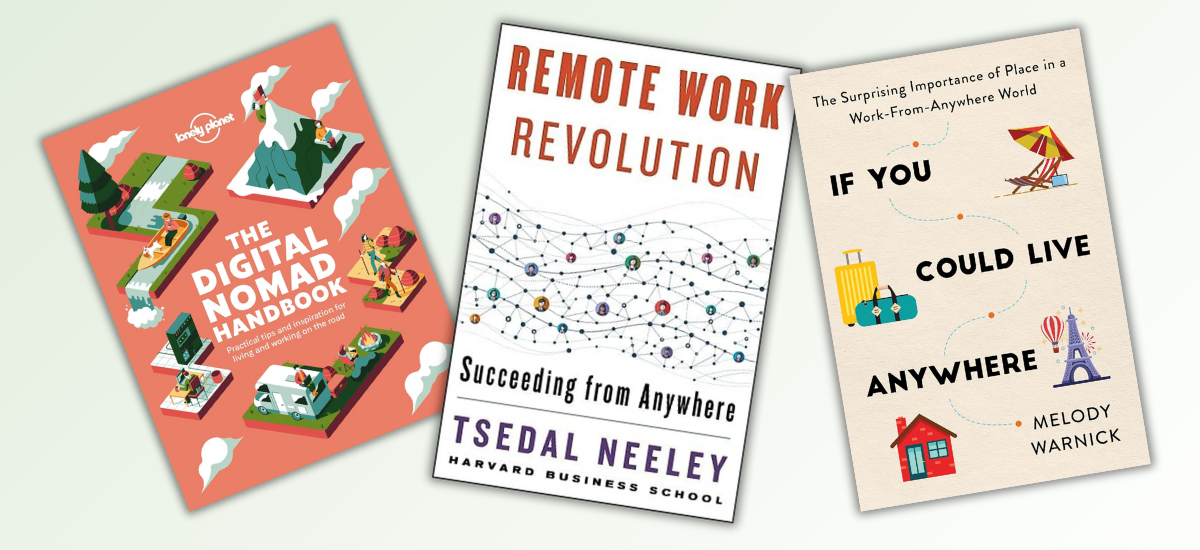
“The digital nomad handbook”
The book is divided into two practical sections. The first focuses on the realities of working on the move: how to earn money while traveling, stay connected, protect your health, and even learn new languages faster in unfamiliar environments. The second explores popular destinations for digital nomads, outlining their pros and cons alongside real-life stories from people who live and work on the road.
Written by experienced travelers and digital nomads from the Lonely Planet team.
“Remote work revolution”
Longlisted for Business Book of the Year by the Financial Times and McKinsey, this book takes a more strategic view of remote work. Harvard Business School professor Tsedal Neely explains how leaders and teams can stay effective without daily in-person interaction. She addresses core challenges such as building trust at a distance and choosing the right tools and management practices for distributed teams.
“If you could live anywhere”
When work no longer dictates your address, how do you decide where to live? This book challenges the way we typically compare cities and locations. It highlights overlooked factors — budget, environment, personal values, and lifestyle — that play a major role in long-term satisfaction. A thoughtful guide to choosing a place that truly fits you, not just your job.
So — should you go or not? A new environment has a positive side effect: in inspiring places, we’re less likely to fall into the “one more email, one more task, then I’ll stop” cycle. Travel forces you to plan your free time — what to see, where to go, and when to slow down. That structure naturally limits overtime and supports better mental health.
At the same time, many elements of everyday city life temporarily disappear: routine appointments and endless small obligations. This creates mental space and often improves focus.If your company allows flexibility, you are comfortable working remotely, and the idea of “changing the scenery” resonates with you, a workation is absolutely worth trying. Just be honest with yourself: a workation is not a vacation. It changes the context of work, but it doesn’t replace real rest. Eventually, even the most beautiful view loses its power to offset fatigue. And when that happens, the only solution that truly works is a full pause, not a change of location.


