





16.09.2026
Employee Satisfaction: How to Tell If Your Team Is Truly Satisfied

Having “Team Lead” in your LinkedIn headline doesn’t automatically make you a leader. Even that shiny “Senior” tag in a CV won’t guarantee someone can rally the team when production crashed.
In today’s reality — where projects are sprinting toward deadlines, burnout can affect anyone, and competitors keep poaching top talent — true leaders are scarce. Not just managers, but people who set direction without waiting for instructions. The real question is: should you hire them from outside, or grow them from within your own crew? Let’s see what the experts think.
Companies often face a crossroads: hire a team lead or develop one within the organization. Hiring externally can bring fresh ideas and new expertise, but onboarding consumes time and resources. Instead, developing a manager’s leadership qualities strengthens corporate culture and increases employee loyalty.
How to make a decision?
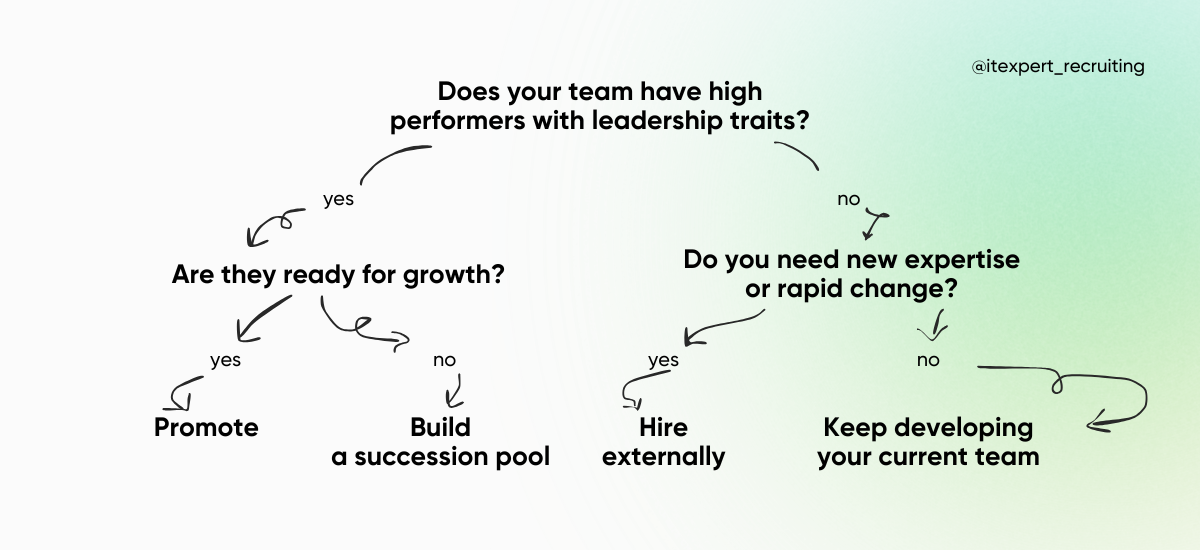
If you want to promote from within, you need a solid talent pool. Ideally, these are top performers with leadership instincts — people hungry for new challenges. Such individuals already have a good understanding of the company culture, adapt more quickly to a new role, and often demonstrate higher loyalty. Additionally, their promotion sends a clear signal to the entire team: growth here is genuine.
But if you don’t have ready candidates within your team, need fast change, or are missing specific expertise, it’s smarter to look outside. For example, when launching a new business unit from scratch or pivoting to a different model, an external leader can not only bring a fresh perspective but also re-energize the team. And that energy often translates directly into revenue.
To make the right decision, answer a few key questions — use our diagram.

“Leadership isn’t a static gift — it’s the result of continuous self-growth and inner work.
It’s not about power, status, or external wins. It’s a process shaped by experience, openness to change, self-reflection, and the ability to stay authentic without wearing masks.”
So, how do you spot a potential leader? Look for these markers:
✔️ Initiative — they don’t just wait for tasks from a manager. Instead, they propose new features, streamline processes, and generate ideas. They’re not afraid to take responsibility for decisions, even when those decisions push them out of their comfort zone.
✔️ Accountability — a leader doesn’t wait for instructions. They set priorities, make tough calls, and act as a true part of the team. If a project gets delayed, they won’t waste time looking for someone to blame. Instead, they’ll suggest a recovery plan.
✔️ Empathy — essential for leading a team effectively. A real leader knows when someone has missed a deadline, who needs a break, and who’s ready for a new challenge. They don’t just “expect results” but know how to motivate, support, and guide people into productive teamwork.
✔️ Flexibility — leaders must adapt to change, make decisions quickly, and reframe plans when unexpected situations arise.
✔️ Strong communication skills— a great leader doesn’t just push for ideas. They know how to pitch them, explain complex concepts in plain language, give constructive feedback, and facilitate discussions without letting them turn into another endless, unproductive meeting.
✔️ Strategic thinking — it’s not only about knowing what needs to be done today. It’s about seeing the bigger picture: where the product is heading, which market trends matter, and what will be critical for the business in six to twelve months.
✔️ Self-organization — without it, even the strongest hard skills won’t save the day. A leader needs to manage their own time effectively, prioritize tasks, and avoid turning every day into fire-fighting mode.

“For a manager, experience and results are critical. Leadership isn’t about earning a title once — it’s about consistent achievements. It’s about being, not just becoming and checking a box. A leader is someone with proven cases that show their ability to make tough calls. For instance, a manager who once built a new department from scratch, or a team lead who turned a struggling team into a productive, high-performing unit.
Equally important is a results-driven mindset. A true leader doesn’t obsess over processes for the sake of processes — they keep the end goal in focus and guide the team toward it. Imagine a manager who doesn’t micromanage every step but creates an environment where people want to take initiative. They don’t shy away from problems and challenges — they see them as opportunities for growth.”
IT companies don’t just hire seniors and managers — they invest in building a culture that grows leaders from within. This approach enhances team efficiency, reduces turnover, and fosters stronger employee engagement. According to research, companies that invest in talent development see a 58% improvement in employee retention.
Here are several must-have practices to integrate into your process.
Start by identifying who on your team already shows leadership traits. It’s not always apparent from day-to-day tasks, which is why it’s critical to track progress and ask directly during 1:1s.
Pay attention to soft skills, such as initiative, accountability, ownership, and a process-driven approach — all clear markers of a potential leader.
Delegation doesn’t just ease the manager’s workload — it gives employees the chance to level up their skills. Research shows that managers who boost team engagement through delegation bring in 33% more profit. Give employees opportunities to own projects, support them, and allow them to learn from mistakes.
Mentorship and coaching are powerful tools for developing leadership skills. A 2023 study by the European Academy of Leadership Coaching found that 84.6% of companies implement a coaching culture, signaling a strong trend toward internal leadership development. Internal mentoring works best when there’s a specialist capable of transferring knowledge with relevant, up-to-date expertise.
“Today, leadership can no longer be defined by outdated management models that treat organizations as machines made of separate parts. In this complex reality, we need a new paradigm — an organization as a social system.
People are not just ‘cogs’ to be micromanaged. They are complex adaptive systems driven by inner motivation.”
Transparent IT grades and career tracks help employees see a future with the company. A structured system of career progression increases engagement and retention of key professionals.
“Every company needs to retain its key people, and that requires a clear and transparent growth plan. Employees should understand where they can move next and what it takes to get there. Helpful tools include:
Being a leader in an IT team isn’t just about technical know-how or task performance. It’s about actions, influence, behavior — and most importantly, the inner decision to be the person who doesn’t just complete tasks but creates the context for the entire team’s growth. And this is something anyone can — and should — develop.
The first step is learning to manage yourself: your focus, emotions, and energy. A leader doesn’t wait for instructions — they see the goals, initiate movement, and take responsibility not just for results, but for the people around them.
“Not every performer can be a leader. Doing your job at the highest level is one thing. But leading people, motivating them, and building true team synergy — that’s something completely different.”
Assertiveness is the ability to communicate openly, clearly, and respectfully. It’s the skill of saying “yes” or “no” at the right time without breaking team balance. Paired with empathy, it builds absolute authority — not through pressure, but through trust.
A leader doesn’t just see their own scope of work — they see the big picture. They generate ideas, initiate changes, and establish direction. Strategic vision doesn’t happen overnight; it’s a muscle you grow through projects, knowledge-sharing, and continuous learning.
“True leaders don’t compete. They play their own game, where every move leads to a deeper understanding of themselves and their team. And the game is freedom. Freedom to be yourself, to take risks, and to create what truly matters.”
Leadership is a journey. Without a roadmap, it’s easy to stall. Build your own personal development plan: what skills to level up, what growth areas to target, what roles you want to take on in the future. Pick courses, read key books, and keep a reflection journal.
Must-reads for future leaders:
Beyond reading, Oksana recommends deep self-reflection and honest self-development as a leader by asking:
The path to leadership takes time and patience, but anyone can walk it — if they’re willing to work on themselves and their interactions with the team. Think of it like code optimization: to achieve meaningful results, you need to continually refine your strengths and weaknesses, address errors, and enhance efficiency.
“Leadership requires not just determination and discipline, but the courage to be authentic, open to change, and supportive of others’ growth. Anyone can become a leader if they walk the path from self-awareness to action. Your ability to be authentic, true to yourself — that’s what defines real leadership.”
No. But everyone should have access to it. Not everyone has to be a leader, and that’s okay. Still, everyone deserves the chance to try — through support, mentorship, and growth opportunities — and then decide: is this for me or not?
Leadership isn’t about titles. It’s about choice. Companies that empower people to choose and grow build real growth environments — and that’s where leaders are born, the kind who take businesses to the top.
So, the real question isn’t “can everyone be a leader?” but rather: “Is your company creating the conditions where leadership becomes possible?”


