






02.09.2026
4 Practices That Help Recruiters Align Stakeholders and Secure Offers Faster

Outsourcing recruitment as a turnkey service is a really bad idea.
It may sound like a dream: someone else searches for, interviews, and brings a ready-made candidate to your office. You pay the bill and remove the issue from the agenda.
But that’s not how it works. Recruiting isn’t a fixed service with a neat set of deliverables. It’s a living, evolving process where business context, management style, team culture, and dozens of subtle factors play a decisive role — things no agency can ever know as well as you do.
In this article, we will analyze why the turnkey model doesn’t work, where it breaks down, and which parts you can safely delegate to get the results you want.
Even in the best partnership with an agency, you can’t offload the entire recruiting process. There are critical points in the process that only you can own. Here are five reasons why “full-cycle recruiting” doesn’t deliver results.
Let’s draw a simple analogy — buying an apartment. You wouldn’t just hand a real estate agent a pile of money and say, “Handle everything. I’ll move in on October 1st.” Even if the walls are the right color, there will always be many nuances: the sockets are in the wrong place, the windows face the courtyard and not the park, or the kitchen is too small. Recruiting works the same way: a candidate may look like a dream on paper, but without interim team checks, you’re taking a risk.
Recruiting is not just about skills in a CV. Two people with the same experience in Java can impact the team in entirely different ways: one drives initiatives, while the other quietly delivers tasks with steady consistency. Take product managers: one might hold stunning demos and inspire clients but struggle with analytics; another might excel at numbers but find communication draining. Which one is right for you?
When it’s less about formal requirements and more about whether it feels like a fit, there’s no clear answer. And even metaprograms or hundreds of behavioral questions won’t help. The context is the main criterion, i. e. current business priorities, team dynamics, and management style.
No recruiter — not even an internal one — can fully feel that context. You can list “adaptability” or “strong communication skills” in the job requirements, but those words rarely mean much until the final interviews reveal the real fit.
In a recent case, the candidate performed very well in the interview with the recruiter — motivated, engaged with the domain, and communicative. But the technical interview showed a complete mismatch — shallow explanations and attempts to “Google on the fly” rather than personal reflections. Even a great first impression doesn’t guarantee an offer — you also need to communicate with the team.
From a technical standpoint, the candidate may seem flawless — Java skills, the right experience, and motivation. But when it comes to development approaches, the real difference emerges — one will advocate for Spring as a universal framework, while the other will argue for Quarkus as the better fit for your case. It’s not about whether the candidate has the skills or not, it’s about mindset, experience, and how well their approach matches your team’s way of working. Recruiters can verify tool familiarity, but deep tech conversations are not their responsibility. In such cases, it is critical to involve “technical crew.”
That’s why even outsourcing companies have long since moved away from turnkey to a periodic engagement model. This is also why the best hires happen: the manager actively participates in the recruitment process, evaluating candidates in real time.
You can create a so-called “perfect candidate portrait” at the start of a search and it’ll go stale in a week. In IT, business moves fast: a new client, a delayed release, a budget cut, or sudden scaling — every shift affects job requirements.
With a turnkey setup, there is an illusion everyone’s aligned. But they’re not. Information is distorted in chats or simply lost: the recruiter keeps searching under outdated criteria, while the CTO has already revised priorities. The result? Wasted weeks and a poor candidate experience.
What matters here is not the number of updates in Trello or Jira, but a constant dialog. Because you can’t convey real-time context in the terms of reference. You’re either in sync with the agency or you’re losing the right “hands.”
💡 Tip: implement the Weekly Sync Rule. At least once a week, the manager should have a catch-up with the recruiter to briefly discuss business status, new risks, changes to projects and priorities, and provide quick feedback on CVs received. Fifteen minutes a week can save you weeks of blind searching and give a clear picture of what you’re actually looking for.
You can’t just hand over job requirements, say, “Go find someone,” and expect the right person to show up. You need to communicate with recruiters constantly. At first glance, LinkedIn looks full of profiles, but once you filter by the details, the pool shrinks fast. The reasons are usually technical or business-specific job requirements.
For example:
This way, hundreds of profiles quickly narrow down to a dozen viable ones. In these cases, the recruiter might suggest lowering experience requirements, considering CVs with related backgrounds, offering hybrid options, or raising the salary range. But no one can decide for you. Are you ready to compromise the requirements? Are you able to raise the budget? Or will you wait for the “perfect” one, risking wasting time? The answer is up to you.
This is why the turnkey approach does not work: strategic decisions are always made in management’s favor.
An example from our experience. The company was looking for an ML (OpenCV) specialist. The requirements seemed clear — until technical interviews revealed the real need: generating photo and video content. That’s a much narrower niche, with far fewer qualified candidates. We had to experiment and expand the search to present enough relevant CVs. It wouldn’t have been possible to learn about it or find a solution without the client’s involvement.
An agency can open the door to your company, but it doesn’t control what the candidate sees inside. Do you have a clear growth system? What does the first day of work look like? Who welcomes a newcomer?
When recruiting is outsourced, it’s tempting to think the agency will handle everything. But the employer’s brand, HR, and management can’t be delegated as a bonus. If there’s no engaged internal stakeholder, you risk ruining the candidate’s impression even after the recruiter has done an excellent job.
We once had a major fuck-up case about five years ago. We arranged for a developer to start on a new project. Everything looked perfect during the hiring process: a friendly team and quick approval. But the start date was postponed for two months, and the candidate was simply forgotten. On his first day, he had no access and no tasks. Formally, that wasn’t the agency’s responsibility, but ever since then, we’ve been consulting clients on onboarding processes, just in case 😉
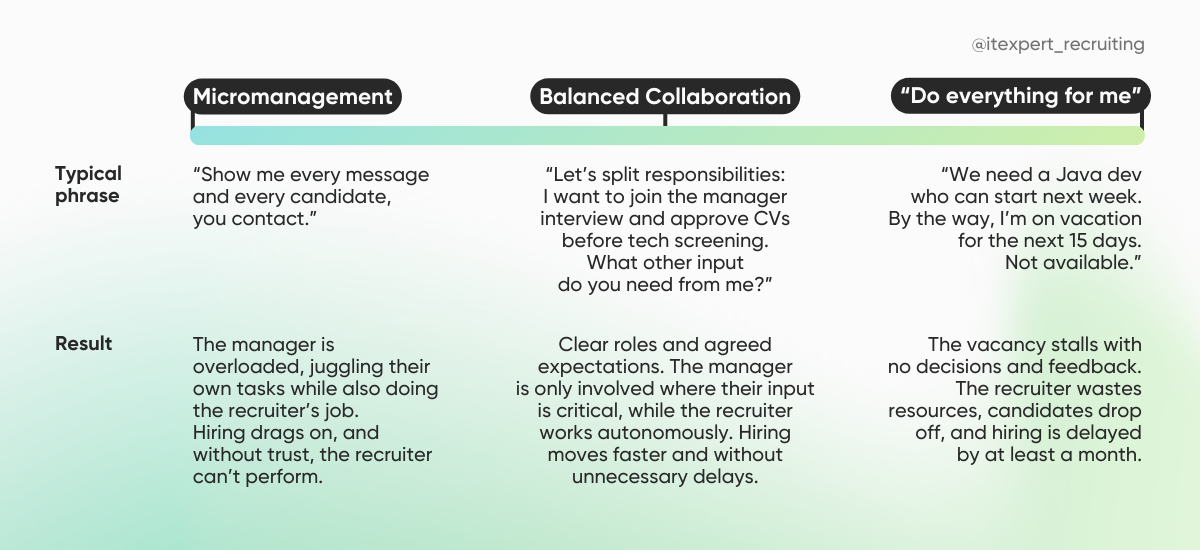
Recruiting does not operate in a vacuum. It’s always a team effort: the agency manages the market, sources candidates, and advises; managers assess the match and make decisions. If one side falls out, the process freezes.
The “turnkey” model hides a particularly dangerous trap — blurred responsibility. It creates the illusion that someone else is taking care of it, and critical decisions get delayed. The result:
The biggest paradox is that the recruiter does their part, but without management involvement, the hire never happens ⎯ even when the position should have been filled yesterday.
A typical situation: a company was looking for a Team Lead, the pipeline was high-quality, but the decision on the offer took more than a month to be finalized. During that time, all three top candidates accepted other offers. The agency did its job, but the business’s slow reaction canceled out the result.
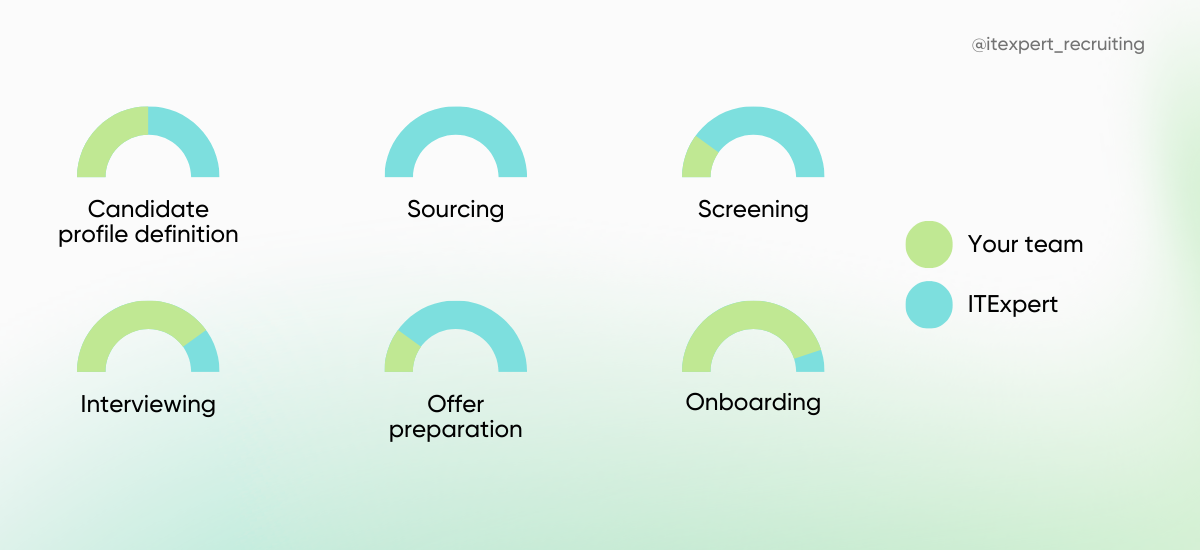
Here’s how we distribute responsibilities with our clients:
Other agencies may arrange functions differently, and that’s fine. The key is to discuss the rules upfront.
Internal recruiters are not a magic wand either. Just like external ones, they don’t always have full access to the business context. If managers don’t stay in regular contact with them, recruiters, at best, just forward CVs without understanding the team’s real pain points. As a result, the risks of blurred responsibility inside the company are almost the same as when working with an agency.
Here’s how it works:
The difference between an agency and an in-house team here is minimal. In any format, success depends not just on the recruiter but on the manager’s willingness to be part of the process.
Recruiting does not exist in a full outsourcing format. But delegating specific parts of the process is possible. It lightens the business’s load and lets you focus on key decisions.
What you can delegate to an agency:
Of course, this only works when you build a true partnership: give clear terms of reference, respond quickly, and listen to recommendations. In this model, the agency doesn’t replace you. It amplifies your efforts where time or resources are limited.
So once again: turnkey recruiting is a myth. It sounds great in presentations but falls apart in real life. No agency will take over your context, culture, or final decisions. But the right partnership can elevate your hiring process to a new level: you keep control over strategy while delegating routine and niche expertise to those who do it every day. In the end, everyone wins — the business stays in control, recruiters work smarter, and candidates walk away with a great experience.


