





04.03.2026
7 Recruitment Biases Even Seasoned Specialists Still Fall For

Every startup knows this moment — when the dream is big, but the wallet is not. You can’t outbid tech giants with salaries or social packages, and your “office perks” probably boil down to good coffee and shared enthusiasm. Yet, great specialists are out there — and many are willing to trade comfort for meaning.
So, how do you become that magnet for the bold and the brilliant? How to hire for a startup? In this article, we’ll uncover what candidates truly value, how to pitch your mission instead of material perks, and where to find the people who believe in your “why.” You’ll also hear ideas and tips from experts who have done it before.
For many IT professionals today, a stable salary and a glossy benefits package no longer feel like the ultimate prize. They’ve had their fill of long approval chains, layers of management, and that sinking sense that their work is just another cog in a massive, impersonal machine.
That’s why more and more candidates are turning their eyes toward startups. Startups offer something that big corporations rarely can: meaning, ownership, and the thrill of seeing your fingerprints on a product that is actually growing. If you’ve ever wondered how a startup can hire a developer who truly believes in the mission — not just the paycheck — it starts with understanding what IT professionals are really looking for:
➕ Direct impact: in a startup, every line of code, every marketing experiment, every design tweak leaves a visible mark. You can actually see your work shape the product, influence users, and move the company forward — something that’s hard to feel when you are one of thousands.
➕ Fast growth and constant learning: startups force you to stretch beyond your job title. One day you are writing backend logic; the next, you are presenting ideas to investors or building an internal tool from scratch. It’s a place where curiosity is currency — and where professional growth happens in months, not years.
➕ Freedom and ownership: forget endless check-ins and “alignment calls.” In startups, autonomy isn’t just encouraged — it is a necessity. People who thrive here are those who love taking initiative, owning outcomes, and steering their projects.

“Let’s be honest: a startup shouldn’t try to outplay corporations at their own game. Because in a startup, the key things are meaning and impact. People are chasing the chance to create a product that shifts the market and rewrites the rules altogether.
Modern research confirms that candidates today want to see the value of their work, and not just exchange their knowledge and expertise for material benefits. Although, of course, these are not mutually exclusive things.
What a startup can offer (real ownership, freedom to experiment with different approaches, and even a potential stake in the company) often outweighs the comfort of a standard benefits package. Especially when you look at it not in months, but in years.”
When your startup doesn’t have a million-dollar budget for salaries, office massages, or a gym overlooking the skyline, the question naturally arises: what can you offer instead? Here is what truly resonates with candidates when resources are limited but ambition runs high.
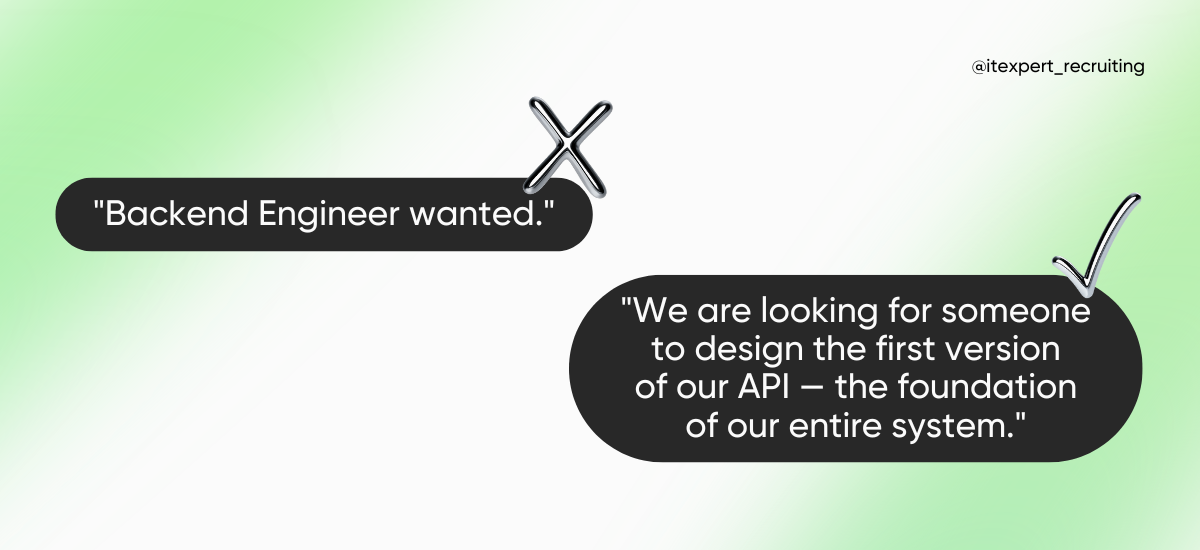
If you are figuring out how to hire a programmer for a startup, you need to sell not perks, but purpose. Show candidates that their ideas won’t vanish into Jira tickets or endless review loops — that what they build will shape the company’s future.
How to shape a startup EVP around impact:
How to present it to candidates:
✅ During interviews: Be specific. Tell stories that show how new hires will leave their mark: “You’ll be responsible for building module X — a feature that will directly affect 80% of our users.”
✅ Show proof of impact: “When we redesigned onboarding, retention grew by 20%. That idea came from one of our engineers.” These stories do more than describe a job — they let the candidate imagine their impact.
In a startup, there are no narrow lanes — every team member wears multiple hats, experiments with new ideas, and adapts on the fly. For candidates tired of corporate silos and slow promotions, this kind of environment feels electric. When thinking about how to hire developers for a startup (or any IT talent, really), remember that what you are offering is not a static role. What that looks like in practice:
How to build an EVP around growth:
How to present it to candidates:
✅ Tell success stories. Show real examples of how your employees have grown. “Anna joined us as a QA engineer — today she leads a product team of five.”
✅ Discuss development goals. Ask about their aspirations during the interview, then show how your startup can help get them there. “If you want to lead a team within a year, here is the roadmap to make it happen.”
Show candidates that you believe in their judgment and give them the space to experiment. When people feel trusted, they become invested. Loyalty in a startup isn’t measured by years of service — it is measured by passion, initiative, and results.
And while a corporate idea can spend months crawling through ten layers of approvals, in a startup it can go from concept to production in a single day. That is the kind of story that makes talented people’s eyes light up.
How to build it into your EVP:
How to present it to candidates:
✅ During interviews: Highlight the balance of freedom and accountability. “We value independence and initiative. You’ll have full freedom to choose the tech stack for your project — and the responsibility for seeing it through.”
✅ Through real stories: Nothing sells speed like proof. “We launched an idea on Monday, onboarded our first users by Wednesday, and redesigned the architecture by Friday.”
For most startups, options are the ultimate signal of trust. At first glance, they may seem less glamorous than a hefty salary. But unlike a fixed paycheck, options carry the potential to multiply tens, hundreds, or even thousands of times if the startup succeeds.
Even more importantly, options align the employee’s interests with the company’s long-term success. When someone holds a stake, they are invested in the growth, the milestones, and the ultimate vision of the company.
Therefore, if you’re figuring out how to hire a programmer for a startup, framing options the right way can make your offer irresistible — even if your salary budget isn’t.
How to build options into your EVP:
How to present it to candidates:
✅ Sell participation, not percentages. Instead of “you’ll get X% after the round,” frame it as joining a team of co-owners whose stake grows with the company.
✅ Explain scenarios, not hypotheticals. Show what their stake could mean at seed, Series A, or exit.
✅ Answer the “why now” question. Make it clear why joining today is potentially more valuable than joining a year later.

“It is the belief in the founder and a genuine interest in the project that motivates people to join a startup in the first place — even without a generous compensation package. You often hear stories like, ‘I’ve already made some money, so now I want to spend some time working in a startup whose idea truly inspires me. If it doesn’t work out, I can always go back to coding another CRM.’
That said, it wouldn’t be accurate to claim that startups today operate without any form of bonus or reward. Once a viable MVP is in place, investment funds often step in, providing early-stage capital. These investments typically go toward scaling the team — attracting experienced specialists who can take the product to the next level. And to bring such people on board, startups need to offer competitive, market-level conditions.”
“At Swarmer, we started with the basics — a hybrid work format and health insurance. Even then, it felt like a solid offer for a growing startup. But our main focus was never the benefits package. It was the mission — and the role each person would play in bringing it to life.
Whenever someone came to an interview and opened with, “What’s your benefits package?” we knew right away: this probably wasn’t our match. Our conversations were always centered on different questions — What are we building? Why does it matter? And how will your role shape the outcome?
Over time, we did expand our benefits package, but not as bait for new hires. It became a way to support and thank the people who had already chosen to grow with us.”
What makes people join a young company isn’t the snack bar or the nap pods. And that’s the heart of startup recruitment best practices — not just finding the right people, but moving them. An EVP is a narrative that explains why joining your startup is a once-in-a-lifetime opportunity. Your task is to turn values into emotions, and abstract promises into tangible impact. Share that message where your audience actually listens.
Your message should highlight what makes your startup different — not just in what you offer, but in how you work, think, and grow. Paint a picture so vivid that the candidate can already see themselves sitting in your Slack channels, debating product decisions, and celebrating small wins with your team. Don’t rely on abstract promises. Speak in the language of facts, stories, and results instead.
1. Mission and Vision
No one dreams of “joining an innovative company.” They dream of solving something that matters.
Instead of saying: “We are an innovative company that changes the world.”
Say: “We are building an AI platform that helps doctors diagnose cancer 30% faster. By joining us, you’ll help change the way medicine works — and we can show you what the next six months look like.”
2. Product Impact
Developers don’t want to be cogs in a machine. They want to see the effect of their code.
Instead of saying: “You’ll influence the product.”
Say: “You’ll lead the development of our new payment gateway — the Q3 flagship project that drives 100% of our revenue. You will be able to choose the tech stack, make architectural calls, and ship a system that scales globally.”
3. Growth and Learning
In startups, there is no waiting for annual reviews or corporate training calendars. Growth happens fast — through risk, experimentation, and iteration.
Instead of saying: “We offer opportunities for professional development.”
Say: “Our last mid-level dev became a team lead in eight months. We work with serverless AWS architecture — something 90% of local companies haven’t adopted yet. You will master it in your first quarter and earn AWS certification on us.”
4. Culture and Team
Every startup has its own heartbeat, its own rituals that shape the workday and bring people closer. Maybe it’s the open Slack threads where anyone — from a junior dev to the founder — can challenge an idea or drop a spontaneous brainstorm.
Maybe it is your #kudos channel, buzzing with daily shoutouts and that moment of collective pride when someone is crowned “Hero of the Month.” Or perhaps it’s Coffee Roulette, the small but powerful ritual where two random teammates get matched for a 15-minute chat that often turns into the spark of the next big idea.
Instead of saying: “We have a friendly atmosphere and a great team.”
Say: “Every Friday, we host Demo Day — a team-wide show-and-tell where everyone, from engineers to designers, presents what they’ve built and gets instant feedback from the CEO. We also have Fail Fridays, a safe space to share experiments that didn’t go as planned — and what we learned from them. Tuesdays are for Pizza & Code, when we grab slices and dive into new tech trends or debate architectural decisions.
Want to feel the vibe? Check out the video from our latest hackathon [link] or read our CTO’s post on DOU about how failure became our favorite teacher [link].”
5. Autonomy and Freedom
In corporations, a new idea might need ten approvals. In a startup, it can go live by the end of the week.
Instead of saying: “We value initiative and flexibility.”
Say: “Here, you are the CEO of your own task. We give you the problem — you choose the tools, methods, and timeline. Want to rebuild a legacy module in Rust? Make your case, get buy-in from the team, and go for it.”
When you don’t have the luxury of a massive recruiting budget, spreading yourself thin across every possible platform is a rookie mistake. The secret to effective startup recruitment lies in focus — finding the few channels where your dream candidates already spend time and where your voice will sound authentic. Here is where to start:
Your career page and blog. Make it the heart of your employer story. Add a “Life at [Company Name]” section that captures the spirit of your team.
Social media:
Professional communities:
Events and meetups. Send your specialists to share real lessons at niche conferences — for example: “How we built CI/CD for 10 microservices with zero budget.”
“Start by finding like-minded people and those who are affected by the problem you want to solve. Build and expand your network — it’s often through connections that you will find specialists who can fill key competencies, especially in the early stages.
And, of course, don’t forget to seek investment. There is always competition for top talent, but investment funds are also vying to back promising products. If your idea is viable and you know how to present it, securing early-stage funding shouldn’t be a problem. That funding can then support competitive salaries, team scaling, and future bonuses.”
“It’s worth being honest: clearly communicate what exists, what doesn’t, and what you can offer in return. This isn’t about giving up — quite the opposite. Invest in a clear role pitch, a compelling mission and vision, and train your recruiters so they can confidently answer any question.
Candidates quickly sense competence and sincerity. Focusing on your strengths while acknowledging limitations is far more effective than trying to mask weaknesses. And remember: build relationships for the long term. A candidate might say no today, but if they remember your honesty and respect, they could very well return a year from now.”
During interviews, many startups fall into the same trap: trying to make everything look flawless. Show candidates the real picture. This kind of transparency does more than attract — it filters. The ones who stay are the people who believe in your mission deeply enough to weather the chaos with you. And in a startup, that’s worth far more than a perfect pitch.


