




16.09.2026
Employee Satisfaction: How to Tell If Your Team Is Truly Satisfied

Nearly 50% of professionals are already gaming outside of work, yet companies continue to stick with dry, uninspired training methods instead of gamification strategy. It’s a missed trick: a University of Colorado study found that those who engaged in gamified training outperformed their peers using traditional approaches. Moreover, 67% of participants said that the gamified courses lit a fire under them to study harder.
Let’s dive into:
Gamification for employees involves incorporating game elements — like scenarios, interfaces, virtual currency, and ratings — into non-game processes. About 40% of the world’s top Global 1000 companies, including giants like Google, Facebook, and Sony, have already embraced gamification tools.
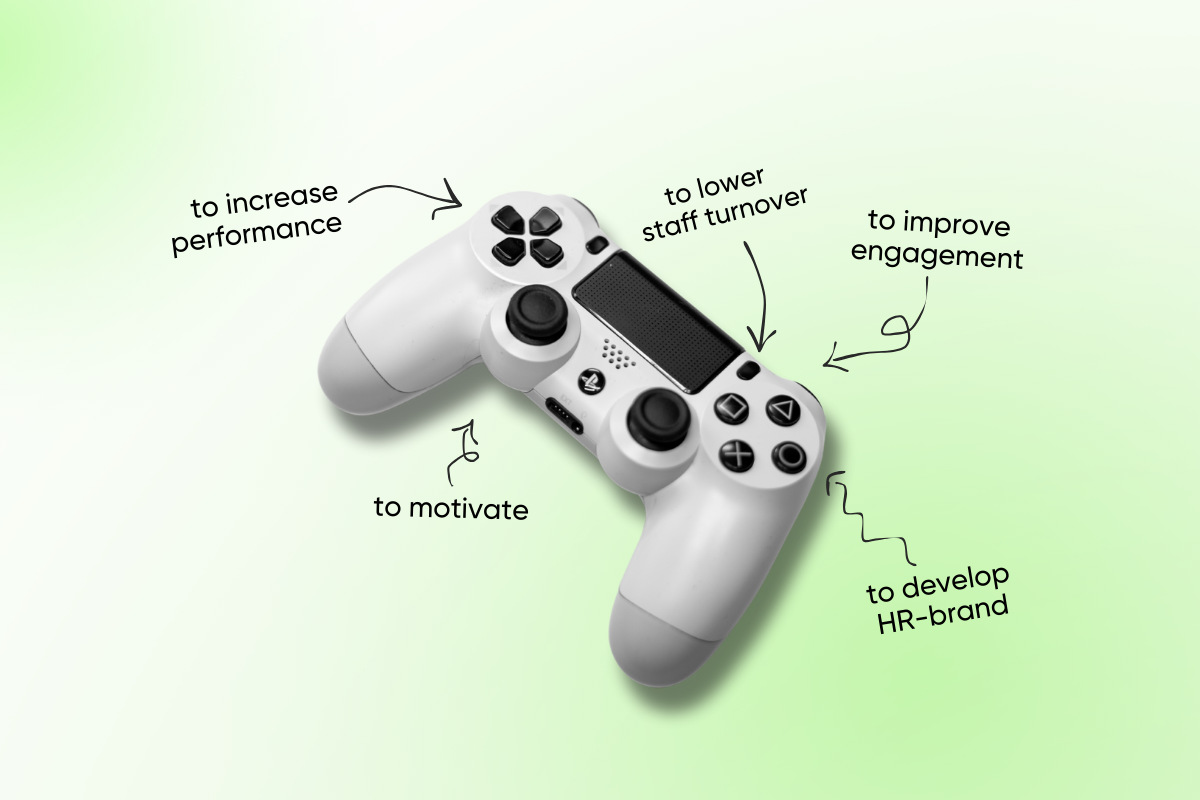
The game-based approach delivers impressive results: employees are often more motivated during training when it’s gamified, compared to traditional lectures or workshops. Research also shows that incorporating game elements into training boosts employee engagement significantly.
Advancing through levels and completing missions provides a sense of progress and accomplishment, triggering the release of oxytocin, serotonin, and endorphins. This biochemical boost enhances the desire to continue learning and achieving.
Game elements can be used in almost any company process, for instance:
Even in large corporations with thousands of processes, numerous decision-makers, and lengthy decision cycles, implementing game mechanics in specific departments and teams can still make a significant impact.
We’ve compiled the key gamification methods for company employees, including ratings, corporate currency, bonuses for completing training, challenges and quests, leaderboards, badges, and more.
Some companies use a point-based assessment system to recognize and mark completed training, individual lectures or workshops, and other achievements, whether for teams or individuals. The approach is straightforward: achievements unlock as employees complete specific stages.
You can also introduce creative nominations to reward employees for reaching various levels, such as:
These nominations can be both formal and playful, using succinct phrases or titles that reflect the evaluation criteria and achievements.
For example, ITExpert hosted an internal recruiter tournament featuring four stages: written tests, a sourcing quest (finding candidates for challenging vacancies on niche platforms), resume consultation, and a case survey. The top performer earned the title “Master of Offers” and received gifts including a T-shirt and hoodie with the humorous inscription “for connecting interviews” and a thermal cup labeled “Master of Offers.” The tournament assessed not only the accuracy of responses but also self-presentation skills, which are crucial for a recruiter.
The Trailblazer Community, part of the leading CRM platform Salesforce, gamifies learning by awarding points for each completed module. The learning experience is themed around camping and hiking, where users navigate a trail (course) guided by engaging characters. With over 450 badges to earn through courses and tests, participants can showcase their achievements on LinkedIn, adding a social element to their progress.
Achievement system in Trailblazer Community from Salesforce
Want to achieve record-breaking results? Organize a competition! This tactic, widely used in sports, is also a powerful tool in business. For instance, some companies run sales competitions where the top manager who closes the most deals in a month earns the title of top performer and receives extra rewards.
Leaderboards can take various forms:
Monday Service Leaderboard
However, tread carefully with this approach, as it can backfire if your corporate culture values collaboration over competition. Ratings and progress tables might demotivate those in lower positions, who may feel it’s impossible to reach the top ranks. This can lead to team conflicts and dissatisfaction.
Additionally, avoid falling into biased evaluations. As Einstein wisely noted, everyone is a genius, but if you judge a fish by its ability to climb a tree, it will spend its whole life believing it is a failure. To ensure fairness, your rating system should be based on clear, relevant criteria and KPIs specific to each role. This way, every employee’s performance is assessed on meaningful and appropriate benchmarks.
Progress bars offer a visual snapshot of an employee’s training journey, showing how far they’ve come and how much remains to hit the 100% mark. Think of them like the LinkedIn profile progress bar, but tailored for various corporate processes or training stages.
For example, Deloitte’s Leadership Academy (DLA) program revamped its e-learning platform by integrating points, certificates, and a social network format. On the main screen, participants see updates in a news feed from the users they follow and can interact similarly to how they would on Facebook. This social and gamified approach boosted the Completion Rate (COR) by over 50%, proving that engaging and interactive elements can significantly enhance training effectiveness.
Training at Deloitte Leadership Academy
Many IT and other companies offer cash bonuses for referring friends to open positions, but why not explore a system of cumulative motivation and rewards that can be redeemed for items from a corporate store?
For instance, Laba Business School has a successful rewards system for its sales team:
Points do not expire, and on average, sales managers collect enough to redeem for the latest iPhone within about a year.
Similarly, Astound Commerce’s Credits for Merits program uses an internal currency — bonus points. Employees earn points by being nominated by colleagues for their contributions, such as departmental activity, knowledge sharing, or internal project development. Managers review these nominations, and if approved, the employee receives bonus points. The points can be exchanged for various rewards:
Some IT firms are setting up stores where employees can exchange points for corporate merchandise. To make these stores appealing, consider offering more desirable items beyond branded cups and tote bags. For example, options could include extra vacation days, a day without meetings, or a coffee break with the CEO.
While financial bonuses can be a powerful motivator, their impact often fades after just 3–5 months. Nevertheless, they remain one of the most effective ways to influence employee motivation. For instance, some IT startups offer developers stock options as a reward for personal achievements.
At ITExpert, we’ve tailored our approach to foster long-term relationships between recruiters and candidates. Each recruiter manages a personal database of candidates, enhancing access to detailed information about their experience and cultural fit. This personalized approach not only speeds up communication and boosts loyalty but also lowers the cost-per-hire.
To further drive engagement, we launched a competition to encourage more active use of these personal databases and increase the number of successful offers. The top 5 recruiters who excelled in the competition received extra bonuses of up to $500.
The leaderboard tracked metrics such as the number of accepted offers from the database, the total salaries of candidates who accepted, and other performance indicators. As a result, the number of resumes from the databases grew 4.5 times, and the number of job offers accepted soared by over seven times.
Results of ITExpert’s Personal Candidates Database Competition
When implementing gamification, it is crucial to fine-tune every detail before launching the game elements. Additionally:
To gauge the effectiveness of gamification in your workplace, start by reviewing the goals and expected outcomes you set before launching it. For instance, if you aim to enhance the quality and speed of ticket processing in the support department, measure these metrics both before and after implementing gamification. If you see improvements, it suggests the game mechanics are making a difference. However, this is just a hypothesis; other factors might also influence the results.
Additionally, keep an eye on employee engagement. If staff are actively involved in the gamified elements and show satisfaction with the changes, it strongly indicates that the gamification efforts are paying off.
Looking to kickstart or supercharge gamification in your IT teams? Here are some must-read books that will guide you from the basics to advanced strategies in gamification:
Gamification isn’t a cure-all, but when done right, it can be a real game-changer. It helps to lift the company’s spirits, get employees more engaged, and boost business performance.


