













04.03.2026
7 Recruitment Biases Even Seasoned Specialists Still Fall For

Imagine a candidate is seriously considering your offer. However, a few days later, they dropped the “sorry, I’m going with another company” line. Not because someone offered a bigger paycheck, but because during communication with your recruiters, their values got ignored, or the recruiter simply didn’t get what actually matters to them in a job.
Here’s the thing about negotiations — they are less about hard selling and more about listening, explaining, and building trust. Devs and IT professionals don’t just want just figures on paper. They want to feel like their work will have an impact, that the company vibe matches their expectations, and that they are not just another line in your headcount list.
In this blog post, ITExpert recruiters break down how to level up negotiation skills — how to talk through the tricky stuff, build trust without being pushy, and make sure your offer doesn’t just look good on paper but actually gets accepted.
At first glance, hiring looks like a numbers game — salary, bonuses, contract terms. However, in practice, decisions often hinge on something else entirely: how openly the company communicates, whether the recruiter shows empathy, and if the candidate feels their values and priorities are respected. Even the most competitive job offer can lose out if the candidate doesn’t trust the company or see strong reasons behind the decision.

“As a recruiter, I see that the industry often underestimates negotiations — and here is why:
Negotiation skills in recruiting are a core lever for consistent results. They show candidates that I am protecting their interests and keep them engaged instead of ghosting at the offer stage. Negotiations also help maintain composure when the stakes (and emotions) are high.
I once had a candidate who accepted an offer that wasn’t the top-paying option. He was considering several opportunities, including ones with higher salaries, and was unsure about joining a bank. We stayed in touch daily, and I noticed later from his social media that he was into anime. I started chatting with him not just about work but about anime, travel, and hobbies. That built trust.
Later, I managed to secure a budget increase for the role and addressed his questions about responsibilities. Because the trust was already there, he was open to discussions and eventually accepted the offer — although another company offered $500 more.”
The right techniques are a recruiter’s superpower: they ease tension, help you read the candidate, and let you present the offer in a way that really resonates. Below are a couple of proven tools worth adding to your toolkit.
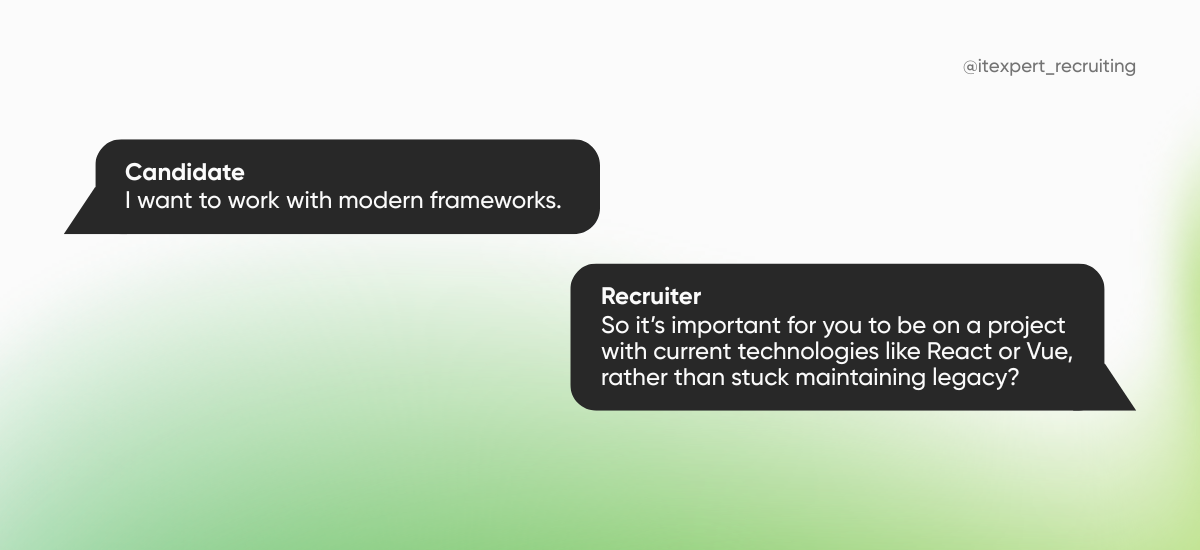
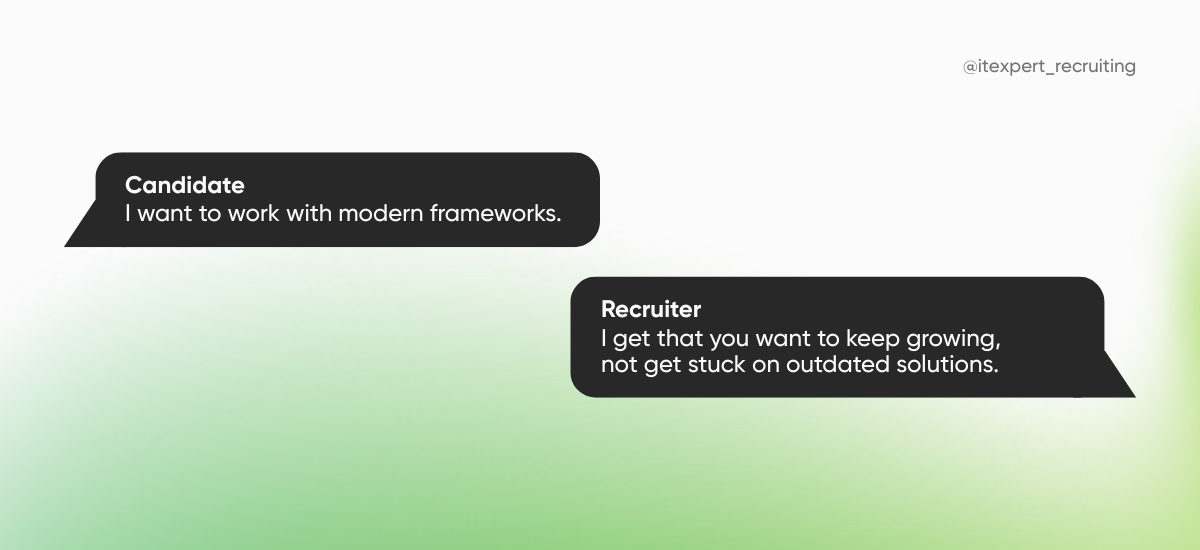
How it works: you reflect back key words or the essence of what the candidate just said. This shows you are actively listening and that their needs are at the center of the conversation.
When to use: early on, when building trust and rapport, to clarify priorities and uncover hidden motives, and when the candidate hints at what’s important but doesn’t fully spell it out.
Tips:
✅ Don’t just parrot their words — highlight the emotions or needs behind them.
✅ Zoom in on values and motivators, not only the facts.
✅ Pair this with clarifying questions to take the discussion deeper.
Useful phrases: “You mentioned that it’s important to you…”, “So your priority is…”, “If I understood correctly, you need…”
Research by Richard Wiseman, psychology professor at the University of Hertfordshire, showed that waiters who mirrored customers’ orders got 70% more tips. The same psychology works in recruiting.
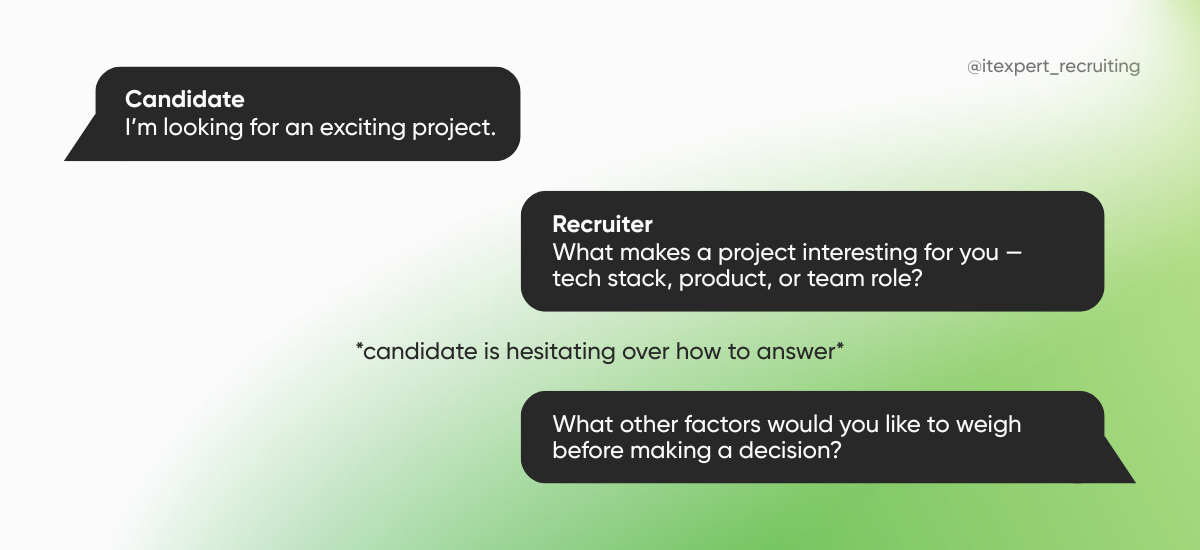
How it works: open questions (starting with what, how, when, where, who) encourage candidates to share more details about their motivations. This uncovers what truly matters to them and helps you shape the offer accordingly.
When to use: while exploring expectations and priorities, if a candidate hesitates or has doubts, or when negotiating comp & benefits to find a win–win.
Tips:
✅ Avoid “why” questions, because they often sound accusatory.
✅ Listen without cutting in; use what you learn to strengthen your pitch.
✅ Frame questions so they lead toward solutions.
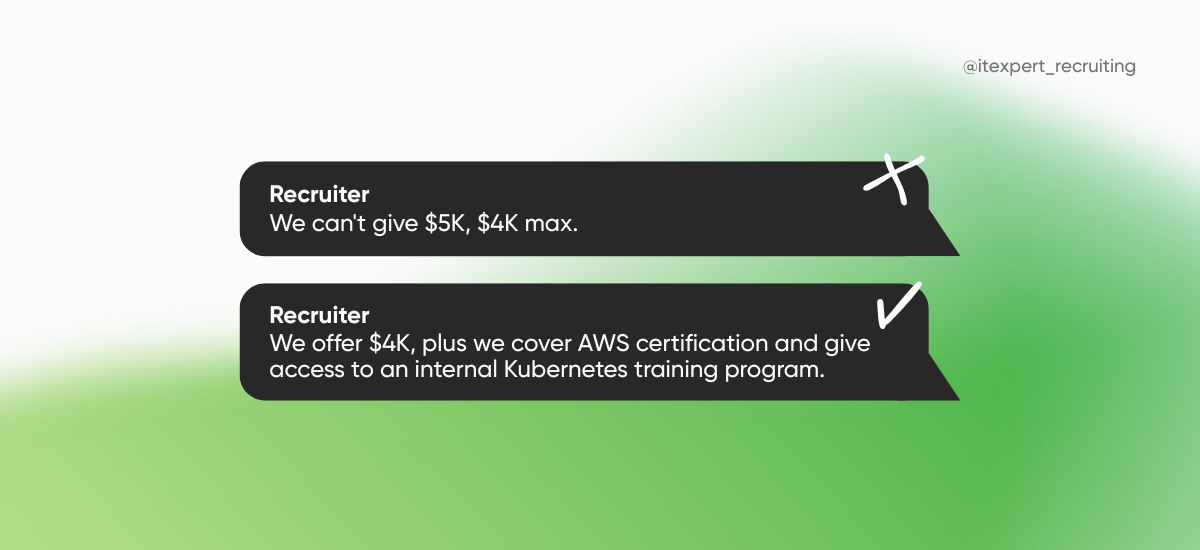
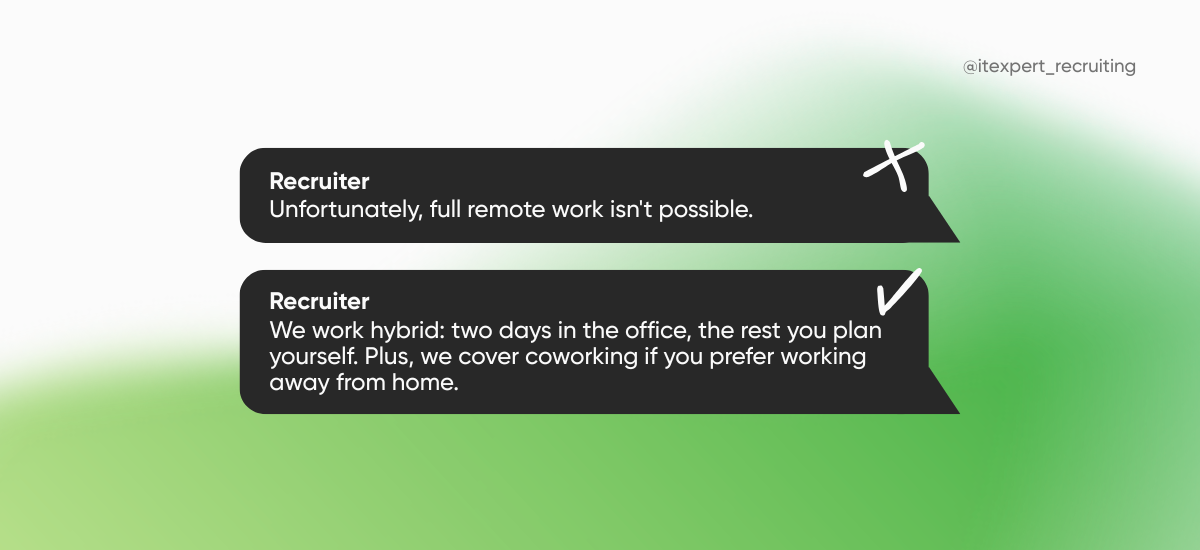
How it works: instead of focusing on what you can’t offer, reframe the conversation to highlight what the candidate will get. This creates a positive context — even when salary or conditions aren’t ideal.
When to use: the candidate expects a higher salary than the budget allows. There is a risk of refusal due to location, schedule, or perks.
Tips:
✅ Never start with “We can’t…” — go straight to the benefits.
✅ Show value, not company-side constraints (candidates don’t care why budgets are tight).
✅ Use contrast: highlight extras that balance out a less-than-perfect base.
✅ Pair with the “mirror” technique — acknowledge the candidate’s priority, then show how your offer covers it.
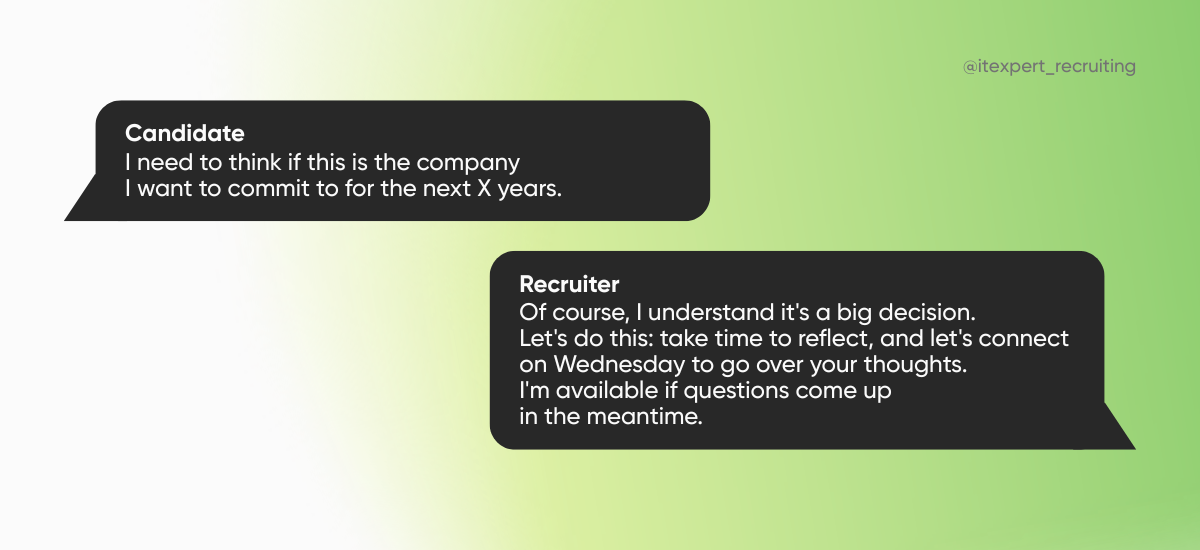
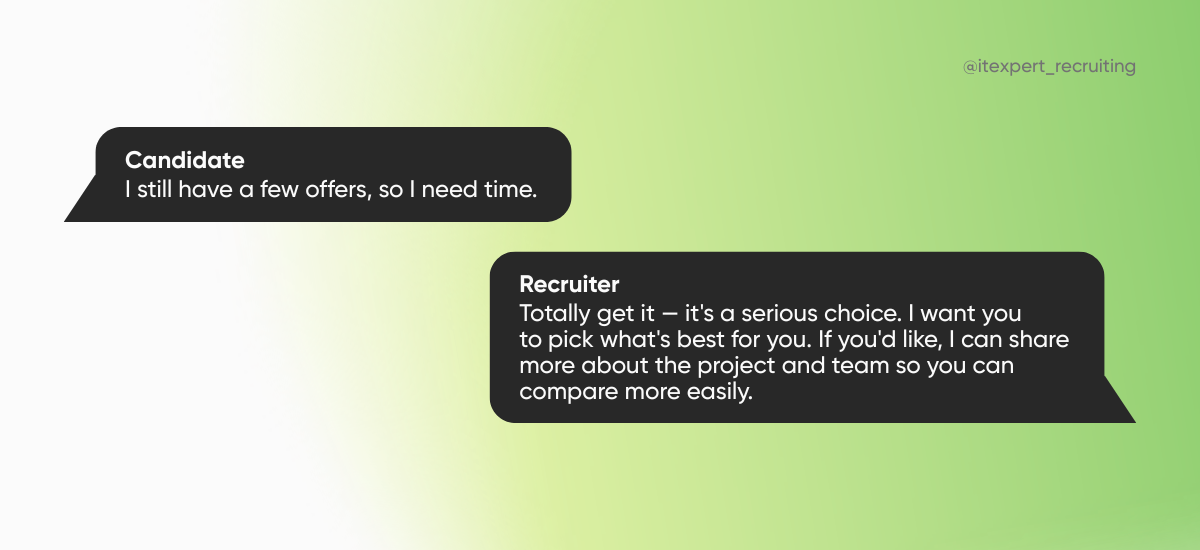
How it works: empathy builds trust by showing candidates you get their motives, values, and doubts. Instead of pushing for a decision, you acknowledge their perspective and give them space.
When to use: at the final stage, when the candidate says: “I need to think about it” or when they are comparing multiple offers. Particularly effective with Gen Z and millennials, for whom transparency and respect are key.
Tips:
✅ Put yourself in the candidate’s shoes — what’s really holding them back?
✅ Avoid pressure phrases like “You need to decide today.”
✅ Give them a sense of control: allow thinking time, but lock in the next step.
✅ Personalize — refer to their values (flexible hours, tech stack, growth opportunities).
“Candidates pick up on empathy. They feel when you are genuinely trying to help versus just ‘selling’ a vacancy. That’s what makes the difference.”
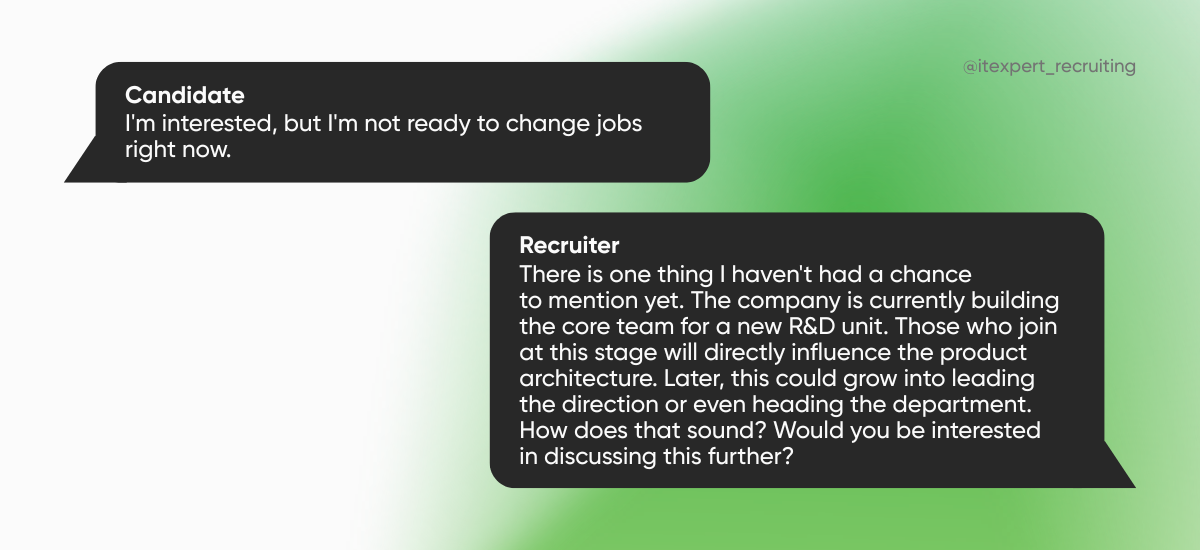
How it works: hold back one powerful, unique argument until the end. Reveal it casually, almost as an afterthought, to emphasize the role’s uniqueness and sway hesitant candidates.
When to use: The candidate is on the fence or leaning toward refusal or you have a genuine unique advantage that could tip the decision.
Tips:
✅ Don’t play all your cards upfront — save 1–2 strong points.
✅ Deliver it naturally, without pressure — like you “just remembered.”
✅ Use only arguments that could genuinely shift the candidate’s thinking.
✅ Prep a few trump cards in advance and choose the most relevant.
Strong trump cards for IT candidates:
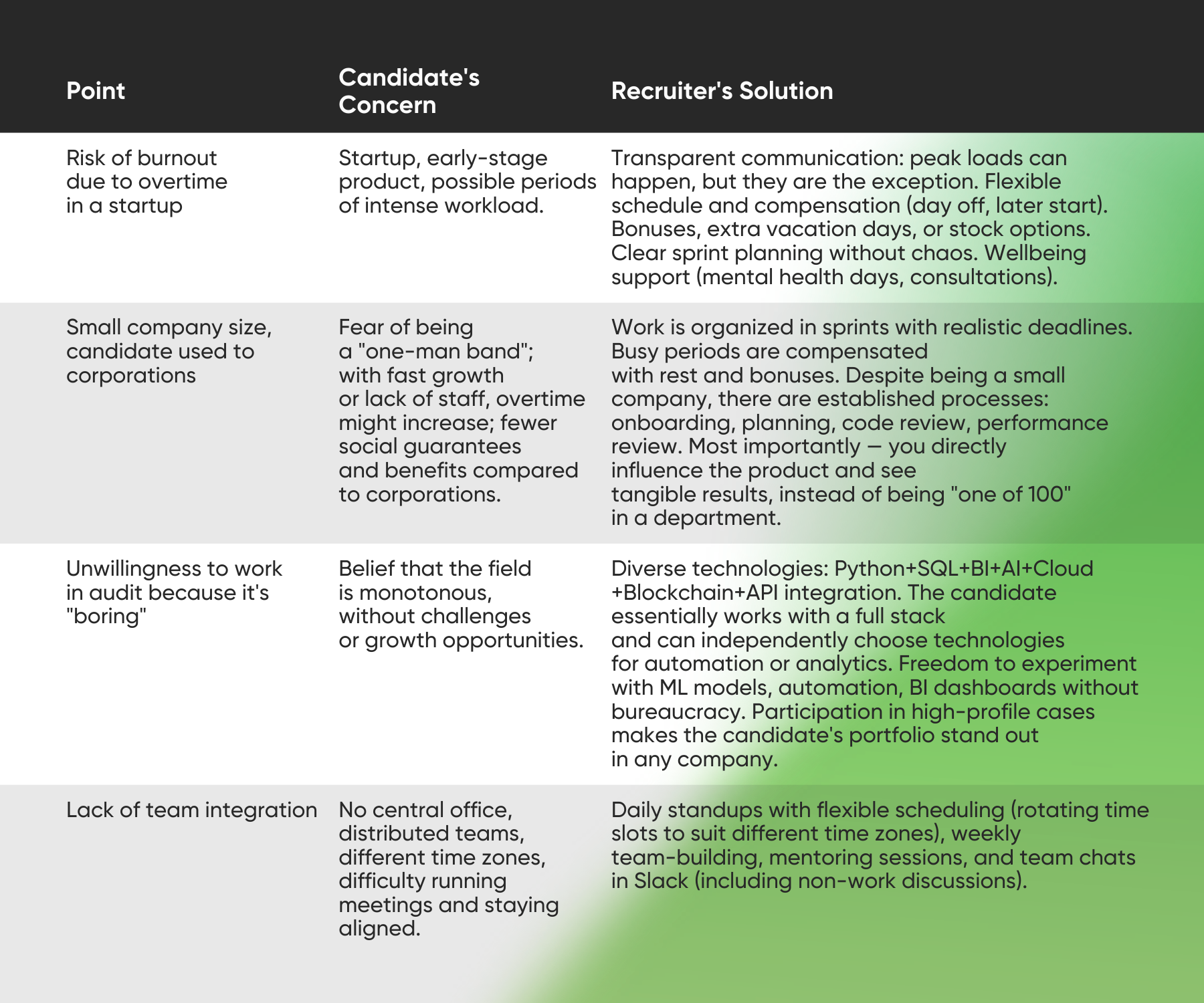
Prepare a table of arguments and objections in advance. This helps you quickly and clearly match the company’s strengths to the candidate’s concerns. It keeps negotiations under control and shows the value of the offer in any situation.

“I recently had a case where a candidate had two offers: one with a higher salary, the other with more interesting tasks and a strong team. We weighed the pros and cons together, and in the end he chose the option that offered growth and a more exciting tech stack, even though the salary was lower. I simply gave him space to think and was honest about what the company could offer.
People just need real conversations — without manipulation or pressure. I didn’t try to convince him; I just helped him structure his thoughts and answer his own questions. That is the real secret of successful negotiations.”
Negotiations aren’t just for big deals — you can practice the skill daily, even in routine work. Here are nine proven ways to level up your recruiter negotiation game:
1️⃣ Prepare in advance. Research the candidate’s background: professional interests, career moves, expectations, and communication style. Anticipate conversation scenarios and prep your arguments (salary ranges, working conditions, hiring timelines).
“I always analyze more than just the CV. I check LinkedIn, portfolios, and other sources. Career patterns are key: why did they change jobs, what roles did they choose, what might they be looking for now?”
2️⃣ Reflect after each conversation. Note what worked, where you felt stuck, and which arguments landed. Over time, this builds your personal playbook.
3️⃣ Review your messages. Look at tone, clarity, and how candidates reacted to your phrasing.
4️⃣ Simulate tough scenarios. Role-play with colleagues. Example: “The candidate doubts their ability to work with new technologies, especially AI. They haven’t done much with it before and fear they won’t adapt fast enough, while the company expects expertise from day one.”
5️⃣ Read between the lines. Pay attention to pauses, hesitations, or vague answers. Phrases like “I’ll think about it” or “I need to compare details” often mask uncertainty or competing offers. Don’t treat them as a rejection — dig into what is really causing doubt.
6️⃣ Speak the candidate’s language. Adapt your style. Some candidates want straight talk, others prefer a softer approach. The right tone makes people comfortable.
7️⃣ Track emotions and motivation. Take notes on what excites the candidate and what raises doubts. This helps you craft arguments tailored to them.
“Note what the candidate has already shared — what matters most, where they are flexible, and where they are not. That way you continue the dialogue with context, not from scratch.”
8️⃣ Practice outside of work. Negotiate in everyday life — at a coffee shop, in a supermarket, with providers. It builds confidence and flexibility in a low-stakes setting.
9️⃣ Learn from experts. Books and courses can sharpen both technique and mindset. Two must-reads: “Getting to Yes: Negotiating Agreement Without Giving In” by Roger Fisher and William L. Ury and “Never Split the Difference” by Chris Voss.

“I also jot down the strongest things I see in a company. Sometimes I suggest candidates speak to someone we previously placed there — that is why staying in touch is so important.”
Even with top-notch negotiation skills, not every offer will be accepted. Sometimes it takes weeks or months to find a unique candidate, run multiple interviews, align terms — only for the decision to flip at the last minute. Still, strong negotiation reduces risks, keeps candidates engaged, and increases your overall offer acceptance rate.


