




28.01.2026
Quiet Quitting: How to Spot It Early and Take Action

According to Deloitte*, companies that flex their learning muscles see a 52% surge in productivity. Savvy employers have already embraced this game-changer, betting big on corporate training to keep their teams ahead of the curve.
We’ve rounded up the key ingredients of upskilling and reskilling, along with tips on choosing the right approach and a peek into how IT companies are coding their success through continuous learning. Plus, we’ve tackled the burning questions: When should employees hit the books? Who picks up the tab for training? And how is AI shaking up the L&D game?
Each workforce development strategy comes with its perks. For example, Verizon has built programs that empower employees to sharpen their skills in their current roles (upskilling) or transition into entirely new career paths (reskilling). As a result, their workforce of 110,000 specialists boasts an average tenure of 12.9 years — more than three times the industry norm.
Knowing the difference between these strategies is the key to unlocking your team’s potential and choosing the right path for growth.
Upskilling is all about sharpening your existing skills or picking up new ones to grow within your current role. Think of it as upgrading a toolkit to stay ahead in an ever-evolving industry.
For example, a junior tester can climb the ranks to a middle, senior, or even lead role, eventually managing an entire QA team. This journey typically involves:
Reskilling is all about switching gears and mastering entirely new skills unrelated to your previous role. It’s a full-scale career reboot that enables professionals to take on new responsibilities or transition into different positions within a company.
For instance, a system administrator can dive into cybersecurity training, learning ethical hacking, risk management, and incident response. With this new expertise, they can shift into a cybersecurity specialist role, opening up fresh career opportunities.
Like any corporate training strategy, upskilling and reskilling require a solid game plan. Before diving in headfirst, it is crucial to pinpoint why boosting employee skills is a top priority. Once the “why” is clear, the next step is to take stock of your team’s skill levels and identify areas for growth. Let’s break it down step by step.
Put on your detective hat and assess your team’s competencies. By carefully scanning your employees’ strengths and weaknesses, you can pinpoint exactly where they need to level up and select the most effective training route to close those gaps.
Here are some tried-and-true assessment methods:
Barbara Sher, writer and motivational speaker, splits people into two types based on how they approach mastering new skills:
🤿 Divers dive deep into their area of expertise, striving for perfection and aiming for professional recognition and financial growth. Their focus is on upskilling — taking their existing knowledge and sharpening it to expert levels.
🔎 Scanners are the curious explorers, always on the lookout for new challenges. They aren’t tied to a single topic and are quick to adapt, often jumping into new roles or fields. Reskilling is their path — reinventing themselves by learning new skills and pursuing different professions.
To tailor the right development path for an employee, it’s essential first to understand their thinking style. This ensures you are not forcing a training plan that doesn’t align with their natural interests or aspirations but instead meets their real growth needs.
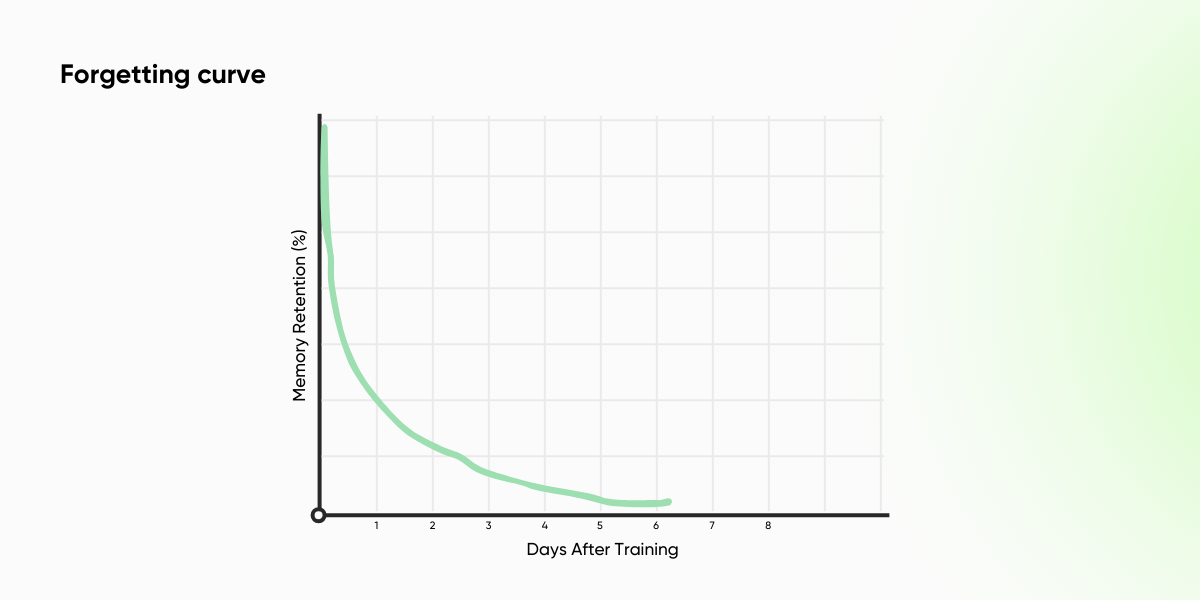
How can you craft training content that sticks and is actually put to use instead of getting lost in the “forgetting curve”? A survey from 24×7 Learning revealed that only 12% of people apply the skills they learned during training at work, so it’s time to change that.
*According to the forgetting curve, learners forget 50% of info within the first few hours, 70% within 24 hours, and 90% within 7 days.
Here are some innovative strategies to create courses that stick and deliver actual results:
✅ Rely on SMART Goals. Use the SMART methodology to design courses with clear, measurable goals that are realistic and time-bound. For example, a developer’s goal could be to learn Python in 6 months through X, Y formats and apply it to an actual project. This gives learners a roadmap and purpose.
✅ Embrace ‘Easyonism’. Simplicity is key. Long-winded courses with unnecessary frills are draining, not educational. The easyonism approach focuses on speed and clarity over fancy bells and whistles, ensuring content is concise and easy to digest. Cut out the fluff, keep it lean and mean.
✅ Don’t Skip the Visuals. Simplicity doesn’t mean boring. You can have a sleek, attention-grabbing design without complex animations or special effects. Great visuals, high-quality sound, and clear instructions make the content shine and keep learners engaged. Aim to make your course content as captivating as a top-tier Netflix series.
✅ Personalize the Learning Experience. No one-size-fits-all. Understand your employees’ pain points and create tailored learning journeys. This way, training is relevant to their roles and goals, avoiding irrelevant content that won’t be applied in real life.
Oleg Maiboroda: “In my opinion, long-term courses provide a structured knowledge system and help develop skills, while short ones address cultural issues and offer quick solutions where they are needed most. Typically, each employee should have a long-term training plan at least once every two years. However, this does not eliminate the need for regular, small, targeted developmental ‘touches’.”
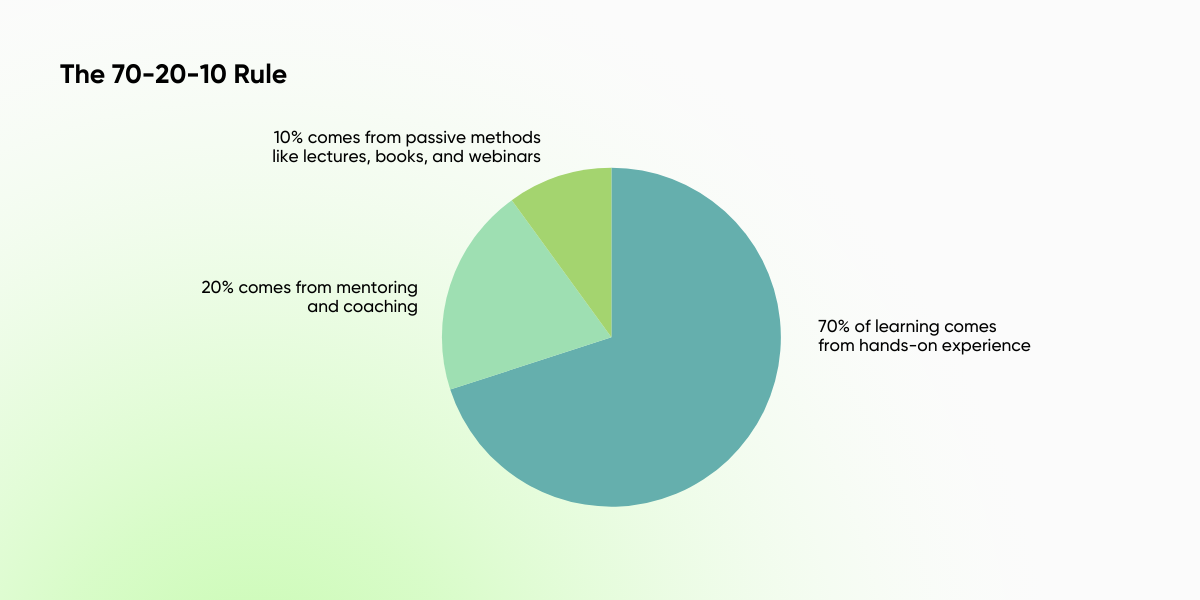
✅ Less Theory, More Practice. Follow the 70-20-10 rule.
The message is clear: theory-heavy content without practical application is a considerable efficiency killer. Replace long lectures with case studies, exercises, and tasks that can be immediately applied to the job. Tailor these to your business’s size and scale to make them meaningful.
✅ Gamify the Learning Journey. Boost engagement with a bit of fun. For instance, Boosta uses corporate currency, Boosta Coin, which employees can spend on merch or tech goods like the latest iPhone. Employees earn coins by contributing to webinars, reports, or mentoring, turning learning into a rewarding experience.
Here’s how to evaluate whether your upskilling or reskilling efforts are hitting the mark:
Lera Brezhneva emphasizes that part of training is integrating new methods into daily work. Reflection is key — employees should ask themselves: What do I already know about this? How do these new approaches stack up against my current knowledge? And how can I put this into action?
By keeping tabs on progress and encouraging self-reflection, you ensure that training doesn’t just sit on the shelf but becomes a catalyst for change.
A common concern in organizations is measuring the ROI of employee development and aligning training goals with the company’s results. Many hesitate because a range of factors impact business performance, and isolating the specific contribution of training can be challenging. Additionally, some managers believe skill development is solely the employee’s responsibility, leading them to skip budgeting for training and missing valuable opportunities for growth. Let’s dive into some of these controversial questions surrounding L&D.
👉 How to Calculate the Effectiveness of Training?

I emphasize the importance of setting clear goals and metrics before launching a training program:
I also advise setting goals in the format:
Metric will increase/decrease by X% in [time]
👉 Who Should Pay for Tuition?

Since specialists have different levels of maturity, the financial contribution an employee makes upfront helps clarify their motivation from the start of the training. This increases their awareness of what they aim to achieve or learn.
At Boosta, we cover 100% of the costs if the company initiates the training or 80% if the employee takes the initiative. However, we never sponsor training that isn’t directly related to the employee’s position. We believe that all training should be focused on improving work efficiency.
👉 When Should an Employee Study?

It’s better to study some information at your pace because not everyone learns at the same speed. If you want to acquire additional knowledge or skills outside your core role, like a recruiter learning about management to earn a raise, then this kind of training should happen independently and outside working hours.
However, if advanced training directly impacts the work and is a priority for the company, it makes sense to integrate it into the work process.

There are times when employees need to tackle specific challenges at work, like learning more about Gen AI to write quality content. In these cases, it is natural to allocate extra time for research, learning, and completing the task.
For broader professional growth or salary advancement, I believe employees should take responsibility for their development, which might involve studying outside of working hours. Soft skills training, like communication or giving feedback, should also be done on their time.
*Research shows that IT specialists typically allocate only 1% of their working time for training — that’s about 24 minutes a week. Additionally, 58% of employees are more likely to undergo training if it is short. To accommodate these realities, it is wise to optimize training with sessions lasting between 5–25 minutes per day and structure more extended programs in sprints with clearly defined blocks.
👉 Is It OK to Implement AI in L&D?
Absolutely! One of the key trends for the next few years in training is the integration of AI. What used to be resource-intensive — creating company career tracks, defining key competencies, and selecting materials — is now much faster and easier with AI.
AI will help create more personalized training programs by analyzing progress and offering new modules. Some Learning Management Systems (LMS) are already powered by AI to assist in developing e-courses, even generating content like text and graphics. At Boosta, we actively use ChatGPT to create competency development programs. For courses, we use AI-generated voiceovers. We are also experimenting with microlearning formats, such as podcasts created via Google NotebookLM. For English tutors (Boosta has over 250 specialists in the English learning program), we use Twee to streamline lesson preparation.
Knowledge is the new currency. In a world where goods and services quickly lose value, rapidly adapting and learning is becoming the most valuable skill. The most successful companies are already investing in training their teams — and it might be time for you to do the same! 😉
*”Becoming irresistible: A new model for employee engagement”, Deloitte Review


