










17.12.2025
Why a Recruiting Team Needs a CTO

How much time should you allocate to fill an IT vacancy: two weeks, one month, or two? Does the timeline depend on the role type? How long does it take candidates to move through the entire hiring process? What are the realistic timelines for MilTech positions? In this research, we explore key hiring time metrics and the factors that impact recruitment speed. The findings can help companies plan recruitment more accurately, coordinate expectations across stakeholders, and identify early signs that a hiring process is entering a risk zone.
Methodology. The study includes positions from 79 companies. We analyzed 274 IT vacancies filled in 2025–2026. Level: Middle+. Nearly half of the sample consisted of Development positions (47.8%), followed by DevOps (11.3%), Management / Leadership (8.4%), Analytics (8.4%), and QA (7.3%). The remaining 16.8% included other roles, such as Design, Marketing, Support, and more. MilTech hiring was analyzed separately and included 48 filled vacancies.
All metrics were calculated using calendar days. To preserve data quality, vacancies affected by extended hiring freezes or substantial changes in role criteria were excluded. Where multiple hires were made for the same position, only the first successful hire was included.
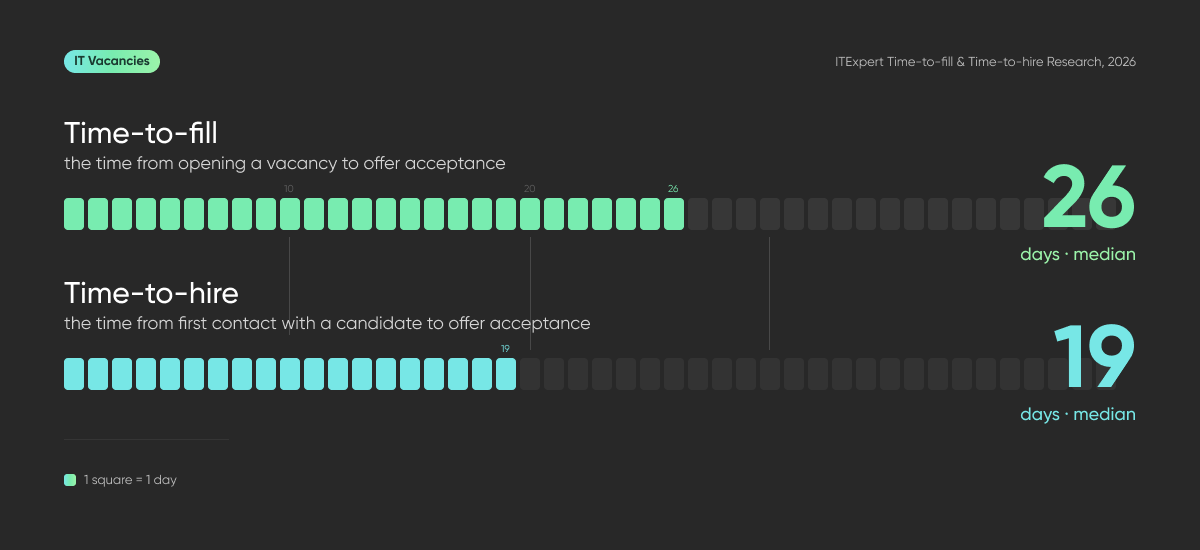
Time-to-fill — the time from opening a vacancy to offer acceptance — has a median value of 26 days. The average Time-to-fill is considerably higher at 33 days, suggesting that the sample includes a number of cases with significantly longer hiring times.
Time-to-hire — the time from first contact with a candidate to offer acceptance — has a median value of 19 days. This metric shows how long the hiring journey typically takes for a candidate.
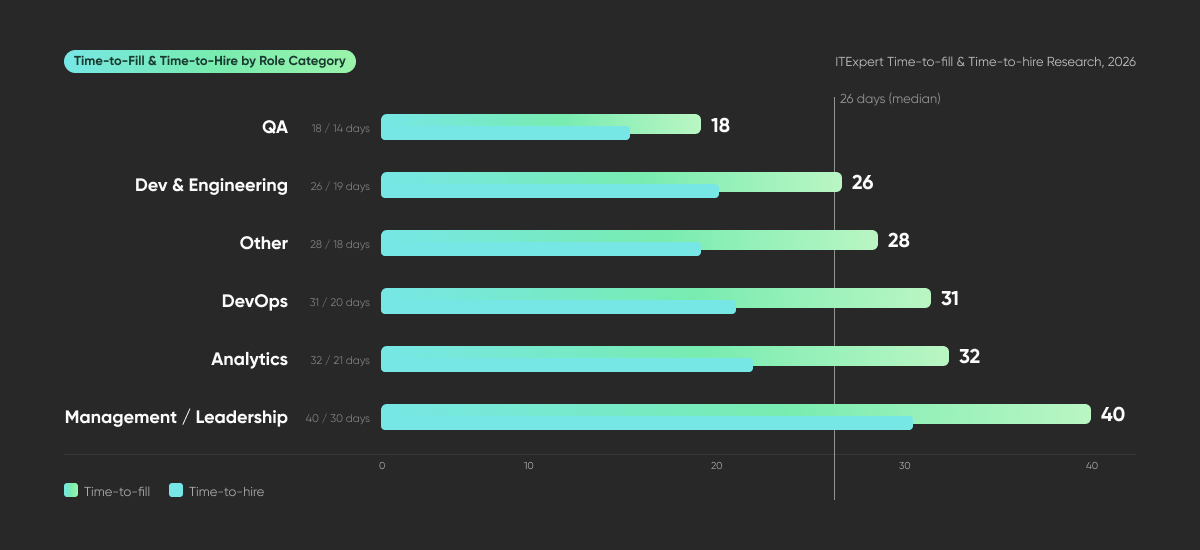
Using a single timeline for all IT vacancies could lead to substantial mismatches in expectations. We segmented vacancies by role type to identify where hiring tends to move faster and where the process is more likely to take longer:
A Few Notable Cases:

“I’ve come across companies that are willing to hire for years. Sometimes businesses would openly say: ‘Our hiring cycle typically takes 350+ days, and we’re comfortable with that because we’re looking for cultural fit.’ I understand the logic, but I don’t believe it’s a healthy hiring strategy.
Companies need people not at some abstract point in the future, but now — so that the product can move forward, and the business can grow. When every hire turns into a search for the perfect match, the company pays not only in recruiter time, but also in lost opportunities, team overload, and slower product development.”
What Is Normal and What Is a Recruitment Red Flag?
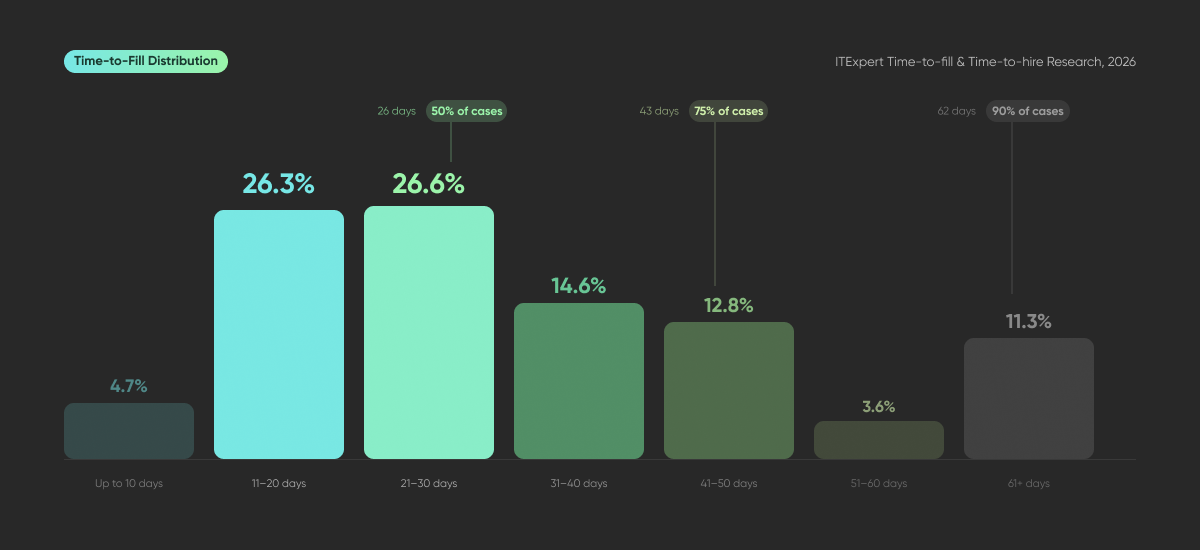
Only up to 5% of vacancies are filled within 10 days. The largest share of vacancies was filled within 11–20 and 21–30 calendar days, 26% and 27% respectively. Meanwhile, every fourth vacancy remains open for more than 40 days.
To better understand the boundary between a typical hiring process and a prolonged one, it is useful to look at how vacancy closure times are distributed across the sample:
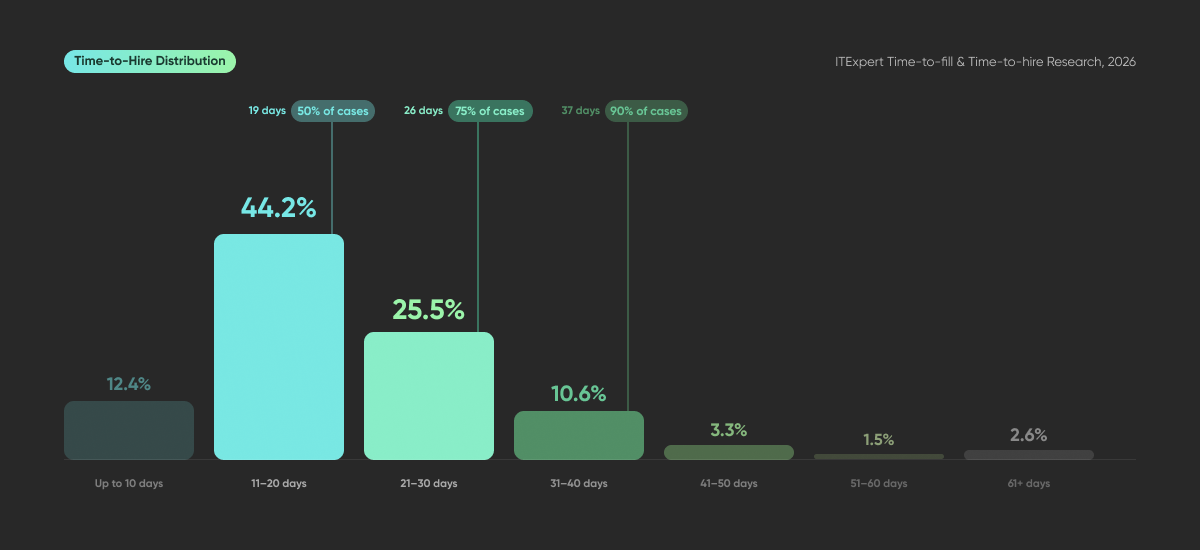
The candidate stage is more compact than the overall vacancy lifecycle. Most candidates accepted offers within 11–20 days, accounting for 44% of all cases. Another 25.5% of hiring processes lasted 21–30 days.
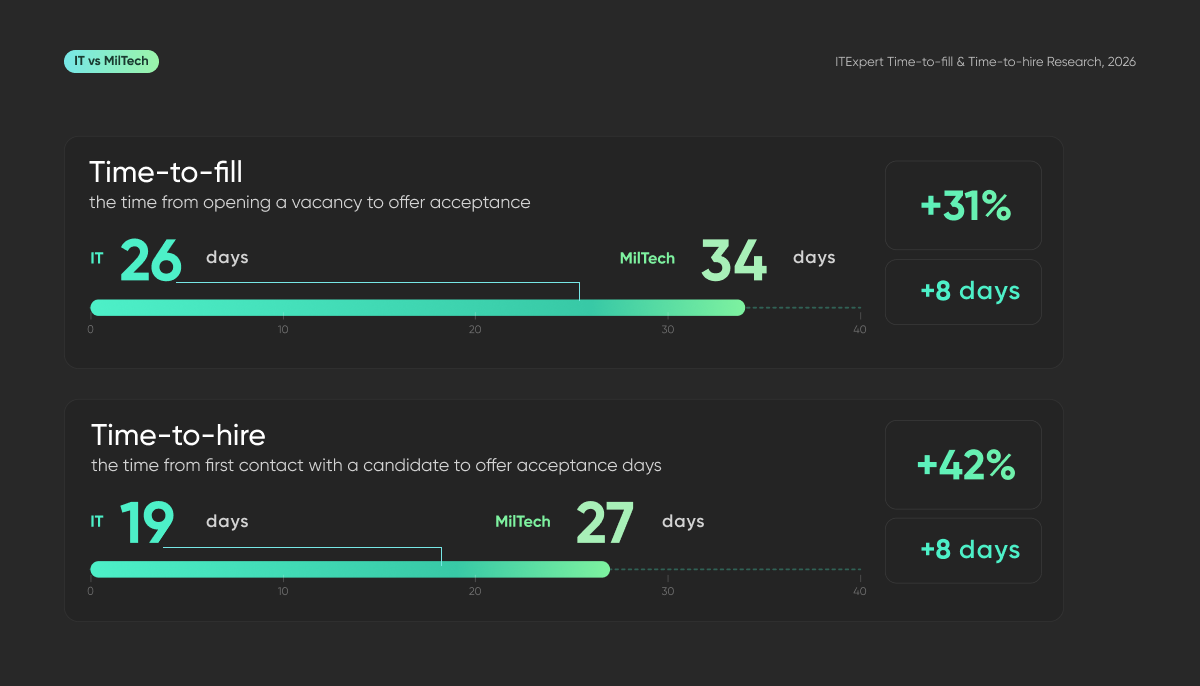
The median Time-to-fill for MilTech vacancies is 34 days — 31% longer than in the overall IT sample. The median Time-to-hire is 27 calendar days, which is 42% longer than in the broader IT sample.
The MilTech segment also includes lengthy hiring cases that affect the overall picture. For example, an Electronics Design Engineer position remained open for 117 days, even though the final candidate spent only 17 days in the hiring process.

“MilTech today resembles a red ocean with a small candidate pool and extremely high expectations. Companies are often looking not just for an Embedded Engineer or Hardware Engineer, but for someone who can own an entire product domain — hardware design and microcontrollers to autonomy systems and operation in constrained environments. In a traditional team, these responsibilities would likely be split across several separate roles.
That’s why the first challenge at MilTech is figuring out exactly who to look for. Part of the time is spent on calibration: breaking down the problem, separating must-haves from nice-to-haves, and determining where to find the required expertise. For example, for a UAV Autonomy Specialist role, the ability to build a flight system that can operate without GPS or a control signal may be more important than a specific technology stack listed on a candidate’s profile.
Hiring timelines are also affected by the selection process itself. MilTech companies often have additional stages, including security clearance checks, polygraph testing, and other procedures due to the industry’s sensitive nature. As a result, a longer hiring cycle is a natural consequence of elevated security requirements.”
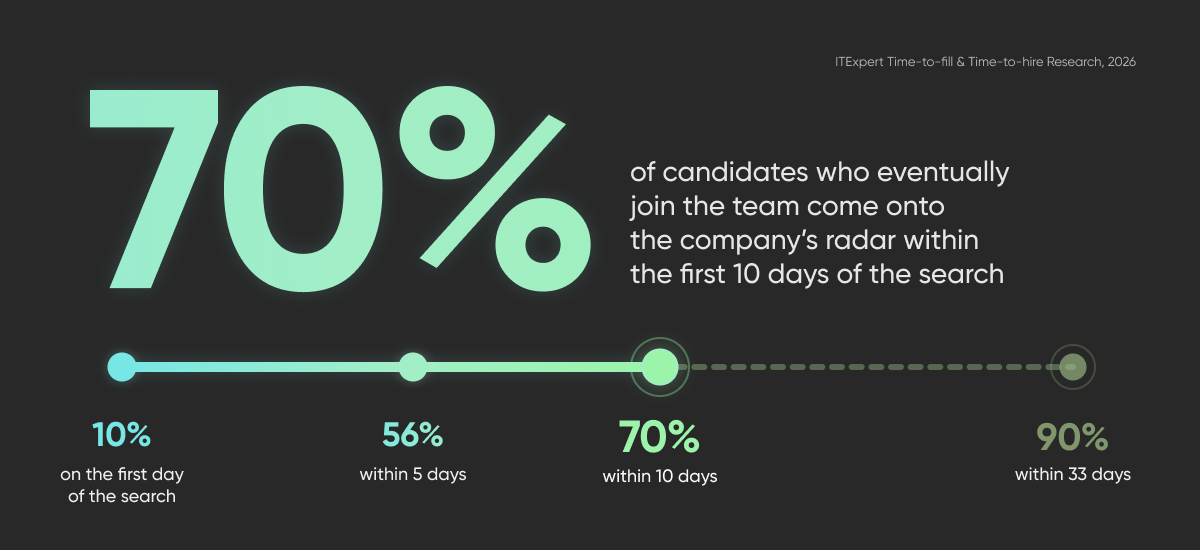
At what point in the search process does an employer first connect with the candidate who ultimately accepts the offer? In 70% of vacancies, the first contact with the successful candidate occurred within the first 10 days of the search. Interestingly:
In three out of four cases, the specialist who would eventually join the team was found within 13 days. Only 10% were first contacted after 33 days or later.
“One of the common mistakes in IT hiring is expecting recruiters to consistently present a steady stream of equally relevant candidates throughout the entire hiring process. In practice, that is rarely the case.
In most searches, the strongest candidate pool emerges early in active sourcing. After two to three weeks of intensive sourcing, the situation usually becomes more challenging. This is particularly evident when hiring for positions such as CTO, Solution/Data Architect, DevOps Engineer (Azure/GCP), or DBA. When the pool of relevant candidates is limited, companies have several options: revisit the requirements, broaden the candidate profile, improve the offer, or accept that the search will take longer, and the pipeline will gradually thin.
The practical takeaway for hiring managers is simple: don’t be afraid to hire after the very first interview if the candidate is really strong.”
According to ITExpert’s research, the median time to fill an IT vacancy is 26 calendar days. In half of the cases analysed, this is how long it took from launching the search to the candidate accepting the job offer. The average is higher, reaching 33 days, as some hard-to-fill roles can remain open for months and significantly skew the overall picture.
“Filling the role within a week” is more of an optimistic scenario than a market benchmark. Only around 5% of vacancies in the sample were filled within the first 10 days, while the largest share of hires took place between days 11 and 30.
Time-to-fill measures the full length of the hiring process, from the moment a vacancy is opened to the candidate accepting the offer. Time-to-hire is measured from the first contact with a specific candidate to their acceptance of the offer. The difference between these metrics helps identify where time is being lost: during the search for the right candidate or later in the process, across interviews, test assignments, and internal approvals.
QA roles are typically the fastest to fill, with a median Time-to-fill of 18 days and a Time-to-hire of 14 days. For Development & Engineering roles, the typical cycle is 26 and 19 days respectively, while DevOps and Analytics positions often require around a month to fill. Management and leadership roles tend to take the longest, with a typical Time-to-fill of around 40 days.
A Time-to-fill of up to 26 days can be considered typical, as half of all IT vacancies are filled within this period. Around 75% of roles are filled within 43 days, so this hiring cycle is longer than the median but still not unusual.
Once a vacancy remains open for more than 62 days, it falls within the 10% of roles that take the longest to fill. At this point, it is worth reviewing the requirements, compensation package, number of hiring stages, and how quickly candidates receive feedback.
According to ITExpert’s research, the median time to fill a MilTech vacancy is 34 calendar days — 31% longer than for standard IT roles. The period from the first contact with a candidate to offer acceptance is around 27 days, which is 42% longer than in the main IT sample.
However, timelines vary significantly within the segment. For example, the search for an electronics design engineer took 117 days, even though the candidate who ultimately received the offer completed the hiring process in just 17. In MilTech hiring, the longest stage is often not candidate assessment but finding someone with the right combination of skills in a limited talent market.
MilTech companies often look for specialists who can cover several areas of the product at once. Requirements involving circuit boards, microcontrollers, autonomous systems, operating without GPS, or working in constrained environments may combine expertise that would typically be split across several roles in a traditional IT team. The process may also include security checks, polygraph tests, and other stages related to the sensitive nature of the industry.
For 70% of vacancies, the first contact with the candidate who eventually accepts the offer happens within the first 10 days of the search. In 56% of cases, companies find this candidate within the first five days, while one in ten is identified on the very day the vacancy is launched.
The explanation may seem counterintuitive: finding a strong candidate early does not necessarily mean the role was easy to fill. The most relevant talent pool often emerges at the very beginning, while several weeks of active sourcing may only narrow the available options. Delaying a decision solely to compare the candidate with someone else can therefore be a risky strategy.
The first step is to remove delays created on the company’s side: an unclear candidate profile, lengthy approvals, too many hiring stages, or feedback provided a week after the interview. Before launching the search, the hiring manager and recruiter should align on the genuine must-have requirements, acceptable trade-offs, and clear decision-making criteria. And when a strong candidate appears in the first week, there is no need to wait for another three to five candidates simply for comparison.


