



23.09.2026
Solution Architect vs. Software Architect: Who Does Your Team Actually Need?

The race for Defense Sector Talent 2026 is becoming one of the biggest challenges in the global defense tech market. According to EY, Ukraine’s Defense Tech sector has grown from 50 private companies to 400 (eightfold growth) in just two years. The market now includes over 1,600 developments — and every one of them is hunting for embedded developers, computer vision specialists, and radio electronics engineers. These are professionals Ukrainian universities never produced at scale, and the commercial sector never had the chance to build a deep bench for.
Now add office-based work, polygraph screening, and candidates who don’t always understand how this job differs from military service. How do companies fill vacancies under these conditions? In this article, CTO of ITExpert Nick Kliestov, shares insights into defense hiring trends 2026, defense industry jobs in demand, recruitment challenges, and effective defense sector recruitment strategy approaches.
The market is slowly starting to find its footing — though there’s still no silver bullet. Students are now getting hands-on exposure to embedded systems, robotics, and radio engineering as part of their studies. On top of that, practical, industry-driven initiatives are popping up outside traditional academia. For instance, Beetroot Academy has rolled out a hardware-focused track built around four months of hands-on, project-based work. It’s not a cure-all for the shortage of senior-level talent, but it does help widen the pipeline of junior engineers coming into the field.
Still, hundreds of companies continue competing for the same specialists in the most critical defense industry jobs in demand — essentially moving the same engineers between projects without increasing the total number of talents available on the market. Everyone wants to build a fully independent production cycle from scratch.

“Previously, military demand exceeded all capabilities — there was virtually no competition between companies, and everyone grew steadily. Now the market has become more saturated, and competition has shifted toward product quality, pricing, and efficiency. And efficiency means R&D — which means people. Companies are massively hiring engineers, but even the candidates entering the market are already employed. Competition for talent is fierce.
The conclusion is simple: either build a fast and structured defense tech hiring process to outperform competitors, or delegate recruitment to those who already specialize in this niche.”
In Q1 2026, over 3,000 DefTech vacancies appeared on DOU — more than during all of 2024. Demand isn’t evenly spread across the board: some roles have next to no available candidates, while others are already getting pretty competitive — even by traditional IT standards. Here is where demand is running hottest:
Candidates usually come into MilTech knowing there will be office protocols, NDAs, and a military-style culture. But there’s a big gap between understanding that in theory and actually operating in that environment day in, day out. The real challenge is that technical screening won’t tell you whether someone can sustain that pace and context long-term. That is why it’s critical to spot early, non-obvious red flags in the very first conversation:
🚫 Strong Technical Ego. One of the most common drivers of early turnover is hiring someone who’s used to always being the smartest person in the room. A typical scenario goes like this: an engineer notices an operator using the system in a way that doesn’t match the original architecture. Instead of stepping back to understand the field reality, they start explaining, pushing back, and trying to “correct” the operator. But here is the catch — the operator, who’s logged hundreds of hours with the device in real conditions, often understands how it actually behaves far better than any spec sheet ever could.
🚫 Need for Excessive Recognition. One of the hardest profiles to detect during interviews. A person actively volunteers, has personal projects, and talks about the importance of victory. But underneath often lies a psychological need to constantly see visible proof that their contribution matters. In MilTech, public validation is rare. NDA-driven teamwork and the need for personal recognition are fundamentally incompatible.
🚫 Rejection of Hierarchy. Flat structures, bottom-up feedback culture, and the right to challenge management are normal in commercial IT. In this field, military-style management logic often exists: clear roles, subordination, and decisions that are not always open for discussion. Specialists with an “allergy” to hierarchy often perceive this as toxicity.
🚫 Excessive Empathy Toward the End User. Engineers who overthink how their work might be used in combat can start to slow things down, second-guess decisions, or get stuck in analysis paralysis. Psychologists often refer to this as over-identification with the consequences of one’s actions. Instead of keeping a clean separation between the technical task and its real-world application, they end up emotionally entangled in both — and that’s where hesitation and friction start to creep in.
🚫 Perfectionists Obsessed With Quality. In MilTech, products are expected to perform in dust, moisture, electronic warfare environments, or after physical impact. Reliability requirements are often far stricter than in most civilian industries. At the same time, there’s a constant trade-off: an 80% solution that’s already deployed in the field can be far more valuable than a “perfect” version that arrives a month too late.
Most IT companies compete for talent through familiar levers: compensation, flexible work formats, comfort-focused culture, and employer branding. MilTech loses on almost all of these points. Office-based work exists because of security requirements and the need to work with physical products. Limited communication is driven by NDAs. Strict management styles reflect military culture. Polygraph screening during hiring has become an industry norm. Yet companies can still successfully attract top defense sector talent 2026 with the following approaches:
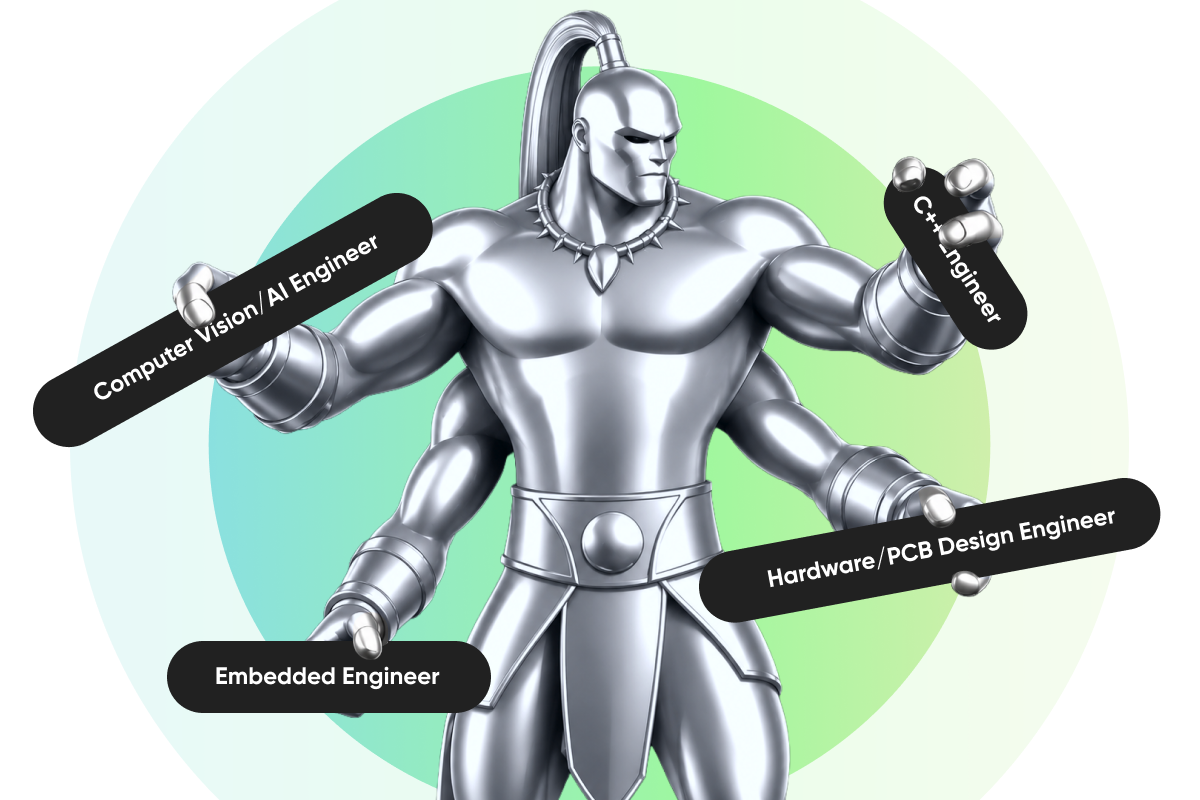
Many hiring problems begin before the search even starts. The most common mistake is framing the vacancy as a task, not a role. “Design the PCB, program microcontrollers, and engineer the product” is not one role — it is three separate positions: PCB Design Engineer, Embedded Developer, and Hardware Engineer. Looking for a “3-in-1” specialist is nearly impossible. The recruiter’s first job is to break down the hiring request before the role ever goes live.
In traditional IT, there is a shared, industry-wide understanding of what a React developer or Java backend engineer actually does. As a result, candidate experience tends to be relatively comparable across companies. DefenseTech hiring doesn’t work that way. There is no real consensus on role definitions. What one company labels an Embedded engineer might mean a completely different stack, scope, and set of responsibilities somewhere else. So if you’re looking for a perfect one-to-one match, you are not just being selective — you’re shrinking an already tight talent pool even further.
One of the biggest myths about defense industry jobs in demand is that MilTech companies cannot compete with traditional IT salaries. In reality, according to DOU’s 2025 survey, the median salary for a developer in DefTech is $2,850. The gap with the broader IT market still exists, but it has narrowed significantly. For some roles — especially backend positions — compensation is already at market level. Junior specialists are another important trend: in DefTech, juniors earn around $1,100 compared to $830 across the broader IT sector.
“At the same time, there’s an important nuance: if someone transitions, for example, from frontend into embedded development, they’ll most likely be evaluated based on their embedded skills. And at that point, they are still junior-level. So candidates should not expect to maintain the same salary immediately after making that transition. But if someone already brings relevant expertise, negotiating over an extra $200–300 usually isn’t worth it.”
Thousands of demobilized Ukrainians are returning with combat experience, strong motivation, and a clear understanding of the mission behind MilTech products. Many also had technical or leadership backgrounds before their military service. After coming back to civilian life, they are often looking for ways to stay involved in the defense ecosystem from the other side of the front line. In many cases, what employers need to do is pretty straightforward: provide a workplace that’s properly adapted to their physical needs and give them a path to apply their experience in a new context.
Students bring something the open market often lacks: genuine willingness to learn. That’s why defense workforce development needs stronger university partnerships. The collaboration models don’t have to be rigid — they can be highly flexible: lab participation, part-time roles, weekend shifts, or schedules designed around academic workloads. Right now, these are still mostly isolated experiments, but they have clear potential to scale if treated as part of a broader talent pipeline strategy.
“Another option is launching internship programs. Hardware and embedded internships are still extremely rare in MilTech compared to software companies, which makes this a very promising niche. Another strong format is working with university engineering clubs: giving students real-world tasks and mentorship from experienced specialists. Students gain practical experience, while the engineering team’s involvement stays relatively minimal compared to running full internship programs.”
Every company wants candidates with direct defense sector experience. The problem is that there simply aren’t many of them — and most are already employed. That’s why an effective defense sector recruitment strategy shouldn’t rely only on poaching talent from other DefenseTech companies. Instead, focus on candidates who can adapt the fastest. In practice, the best transitions often come from industries with similar engineering cultures: Automotive, Robotics, Industrial Automation, Telecom, and Aerospace. Professionals from these sectors are already used to strict reliability requirements, hardware-focused environments, and systems where the cost of failure is extremely high.
Office-based work in MilTech is not a preference; it’s often a necessity. But many companies simply list it as a requirement and wait for the candidate’s reaction. That approach rarely works. What performs better is explaining why office presence matters: working with physical products, participating in field testing, and maintaining direct communication with customers. For many engineers, this is actually a major advantage — the chance to work on tangible systems instead of abstract remote tasks.
The same applies to other conditions that differentiate MilTech from traditional IT. Companies should communicate them clearly and honestly from the start — not as warnings, but with proper context.
“It’s also a major advantage when a company has multiple offices or production facilities across different regions of Ukraine — that partially solves relocation concerns. Some companies, for example, operate several manufacturing sites around Kyiv, giving candidates more flexibility and location options.”
In most IT sectors, recruitment agencies are just one hiring channel alongside an internal talent acquisition team. In cybersecurity jobs defense sector and MilTech hiring overall, agencies often become the primary way to close complex technical roles because internal recruiters usually lack both the candidate network and the domain expertise required to source the right people. Specialized agencies move faster because they don’t need weeks to understand the industry context from scratch. They also have access to passive candidates and a much better understanding of how to evaluate hardware, embedded, cybersecurity, and AI engineers defense industry roles.
“There’s a clear pattern in recruitment: hiring follows a curve with the highest peak at the beginning. Early in the search, you see the largest number of candidates and the strongest talent quality. Later, the process plateaus, and finding exceptional people becomes increasingly difficult.
There is even statistical evidence showing that the probability of finding a highly relevant candidate mathematically decreases over time. In DefenseTech hiring, this effect is especially noticeable because the market is so narrow and experienced specialists are scarce. So if a truly strong candidate appears early in the process — someone capable of bringing real value — companies should fight for that person. There’s no guarantee someone equally strong will appear again anytime soon.”


