




18.03.2026
Bend But Don’t Break: How to Develop Resilience in Times of Constant Stress

Most people memorize answers, review past projects, and rehearse explanations for gaps in their CV. They show up fully prepared — but only to impress. Then they start the job, and two weeks later reality hits: the team lead micromanages every task, the team has been burned out for months, and those exciting technical challenges from the job description turn out to be a legacy monolith from 2014 that nobody wants to touch.
An interview is your chance to turn the tables and see what’s behind the curtain. It is your official opportunity to ask tough questions, push past the surface, and get honest answers. Yet many candidates play it safe. They stick to polite formalities and walk away without learning anything meaningful about the team, the manager, or what the job actually looks like day-to-day.
This guide covers questions to ask at an interview so you can understand the leadership style, team dynamics, and real expectations before signing the offer.
Many candidates wonder what questions to ask at an interview, but the real issue is quality, not quantity. If the interviewer can give a socially acceptable answer regardless of reality, the question is weak.
For instance: “What’s the feedback culture like here?” Every team lead will say feedback is open and encouraged. “How does your team usually discuss mistakes? Can you recall the last example?” Now they must either tell a real story or avoid specifics. Both outcomes tell you something valuable.
Another key principle: ask about the past, not just the future. Weak question: “How do you plan to develop the team?” Strong question: “Who on your team has grown significantly in the past year, and what enabled that growth?” Intentions are easy to declare. Facts are harder to fake.
And one more powerful insight: the most revealing answers aren’t just what managers say — but how they talk about people. Managers who speak with clarity and respect signal maturity. Those who speak vaguely or condescendingly reveal problems.
This applies whether you are preparing questions to ask at an interview as a candidate or thinking about questions to ask at an interview as an employer to build stronger teams.
You signed the offer, started your probation period — and suddenly realized you and your team lead weren’t picturing the same job. In their mind, your role is to clean up technical debt and support junior developers. In your mind, it was a position with architectural ownership and real influence on the product.
No one misled you. The gap exists because key questions were never asked during the interview. The questions below help you cut through assumptions, get clarity upfront, and make sure you and your future manager are truly on the same page before day one.
#1. Why is this role open? What didn’t work out for the previous person?
Always ask this — but frame it as genuine curiosity. Possible answers reveal very different realities:
In tech, new role sometimes means one person previously handled multiple jobs — tech lead, product owner, and mentor — and the workload was unsustainable. That context matters.
#2. What does success look like in the first 3–6 months?
In many companies, the probation period exists on paper, but no one has clearly defined what success actually looks like. As a result, evaluation becomes subjective. A person may do solid work and still fall short of expectations that were never explicitly communicated — whether related to performance, ownership, or soft skills.
A strong answer sounds concrete and behavior-based, not abstract. For example: “In the first month, the person completes onboarding, understands the system structure, and closes several small tasks. By the third month, they independently handle medium-complexity tasks. By the sixth month, they confidently navigate the architecture, participate in technical discussions, and propose improvements.” This type of answer shows the team lead understands the adaptation process and has realistic expectations.
Sometimes, there are no clearly defined criteria for passing probation in IT. And when expectations aren’t set upfront, they tend to take shape after the fact, based on impressions rather than measurable outcomes.
Another red flag is unrealistic expectations within a short timeframe. For instance: “Within the first 2–3 months, the person should fully take ownership of a key part of the system” — without mentioning support or learning time.
The team is at the center of a team leader’s day-to-day reality. That is why one of the most important things to understand during the interview is how they interact with people and whether communication is open or full of unspoken boundaries. You can’t always ask this point-blank, but the right questions to ask at an interview as a candidate help you read between the lines and get a feel for their leadership style.
#3. How do you usually communicate with team members when something isn’t working?
Team leads who are truly engaged usually have specific answers: biweekly one-on-ones, clear questions they ask, and defined signals they pay attention to. Managers who struggle in this area tend to say things like: “We have an open culture, people can always come to me with their concerns.” In practice, this often means: “I wait until the problem becomes too big to ignore.”
This is especially important in IT, because developers rarely complain directly. They simply start responding more actively to recruiters on LinkedIn.
#4. Can you tell me about someone on your team who impressed you recently?
This is an unconventional question that reveals several important things. First, it shows whether the manager can talk about team members with specificity and warmth. This indicates they see people — not just resources — and recognize individual contributions. Second, it reveals what they value most: technical excellence, initiative, ownership, or behavior under pressure.
This is one of the what are good questions to ask at an interview examples because it reveals both values and leadership awareness.
#5. What aspects of managing people do you find most challenging or frustrating?
This question often reveals deeper patterns: what gets under their skin — silence, avoidance, excuses, passive aggression, lack of ownership, or toxic debates. Just as important is how they talk about those situations and what they actually do when they happen. Do they address the issue directly, work with the person to reset expectations, and move forward? Or do they avoid the conversation — or worse, assign blame? For you as a candidate, this is also a way to understand which communication styles are accepted and which ones quickly lead to conflict.
Sometimes “we use React” means one outdated project with no active development. And “we handle highload” means three servers and a peak of 200 concurrent users. These questions to ask at an interview help uncover the truth.
#6. What technical decision from the past year would you reconsider today?
Teams that can’t point to even one example are either very new or haven’t developed the habit of reflecting on their choices. On the other hand, teams that can calmly discuss past decisions, acknowledge what didn’t work, and explain what they learned are usually more experienced, thoughtful, and safer to join.
Examples of strong answers: “We moved to Kubernetes too early. Our traffic didn’t justify it, and we spent three months on DevOps instead of product development.” Or: “We built our own monitoring tool to avoid paying for Datadog. Now we maintain it ourselves, and it costs us more in the long run.” These answers show the team learns — not just executes blindly.
#7. What’s the least popular task on the team right now?
Every team has its share of legacy code, unstable services, messy modules, or areas weighed down by technical debt. The real difference lies in whether the team lead calls it out openly — or sweeps it under the rug.
A strong answer is honest and specific: “We have an old authentication service without tests. Any changes are risky. We’re gradually adding tests and breaking it into modules.” A concerning answer avoids details or claims: “We don’t have anything like that.” Because such challenges always exist. The only question is whether you learn about them now — or after signing the job offer.
#8. How does your team handle incidents and failures?
Everyone slips up sometimes. The key difference is how the team responds. A mature team treats incidents as signs of weaknesses in the system, not as personal failures. Most of the time, the issue isn’t carelessness. It is gaps in processes, missing context, or insufficient technical safeguards.
A mature answer might sound like this: “We had a production incident a few months ago. We conducted a postmortem, identified the missing alert for a specific scenario, and added monitoring and CI safeguards.”
Notice the structure: a calm tone, no finger-pointing, and a focus on improving the system. This signals a psychologically safe environment — one where mistakes can be discussed openly, lessons are learned, and the team continuously gets better.
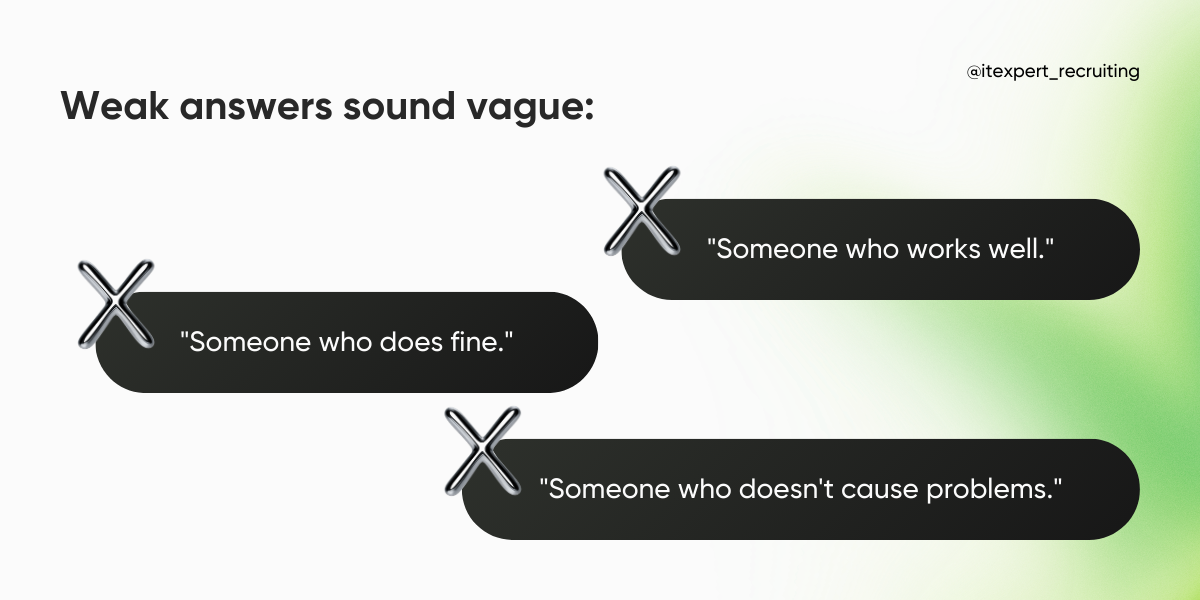
A concerning answer sounds different:
This suggests a blame culture. Also, pay attention to language: “We learned,” “We improved” means shared responsibility. “He broke it,” “She failed” reflects blame and distancing.
Final advice: mature teams don’t sugarcoat reality. They speak openly about challenges, because bumps in the road are part of any real engineering environment. If no problems come up during a 40-minute interview, it usually means you are not getting the full picture.
Also, make sure the recruiter and the team lead are on the same page. If the recruiter promised full autonomy, but the team lead mentions constant approvals with the CTO, don’t let that slide. Address it calmly and directly: “In my previous conversation, I understood X. How does that work day-to-day in practice?” Remember, it’s better to ask tough questions now than be caught off guard later.
May your dream job come without micromanagement and surprises after signing the offer.


