










16.09.2026
Employee Satisfaction: How to Tell If Your Team Is Truly Satisfied

The IT recruiting agency ITExpert regularly conduct research on the IT market. We believe that in this way, we help IT companies and candidates across the world to be on the same page, and therefore, to build effective teams faster, make data-driven hiring decisions, and create revolutionary tech products.
In the latest such study conducted in May 2023, we’ve learned:
It is important to note that the data was collected with the prospect of a full-scale invasion of Ukraine. It may differ slightly from the realities of companies from other countries. However, the data we’ve highlighted in the article will be especially useful if you are actively recruiting Ukrainian technical experts for your development teams.
Look at general data on work formats, salary review, career opportunities, as well as changes in vacations and sick leave.
With the beginning of a full-scale invasion, IT companies actively transferred their employees to remote locations. Some of them even provided relocation to safer regions or abroad. A few IT companies, for example, the Ukrainian product company Brainstack_, even rented the entire residential buildings in the western regions.
The company’s employees and their families could move there in case of a complete blackout, cold winter, and massive rocket fire. The employer installed Starlink terminals there. Moreover, Brainstack_ employees were provided with MacBooks with M1 chips due to the fact they hold a charge for up to 10 hours.
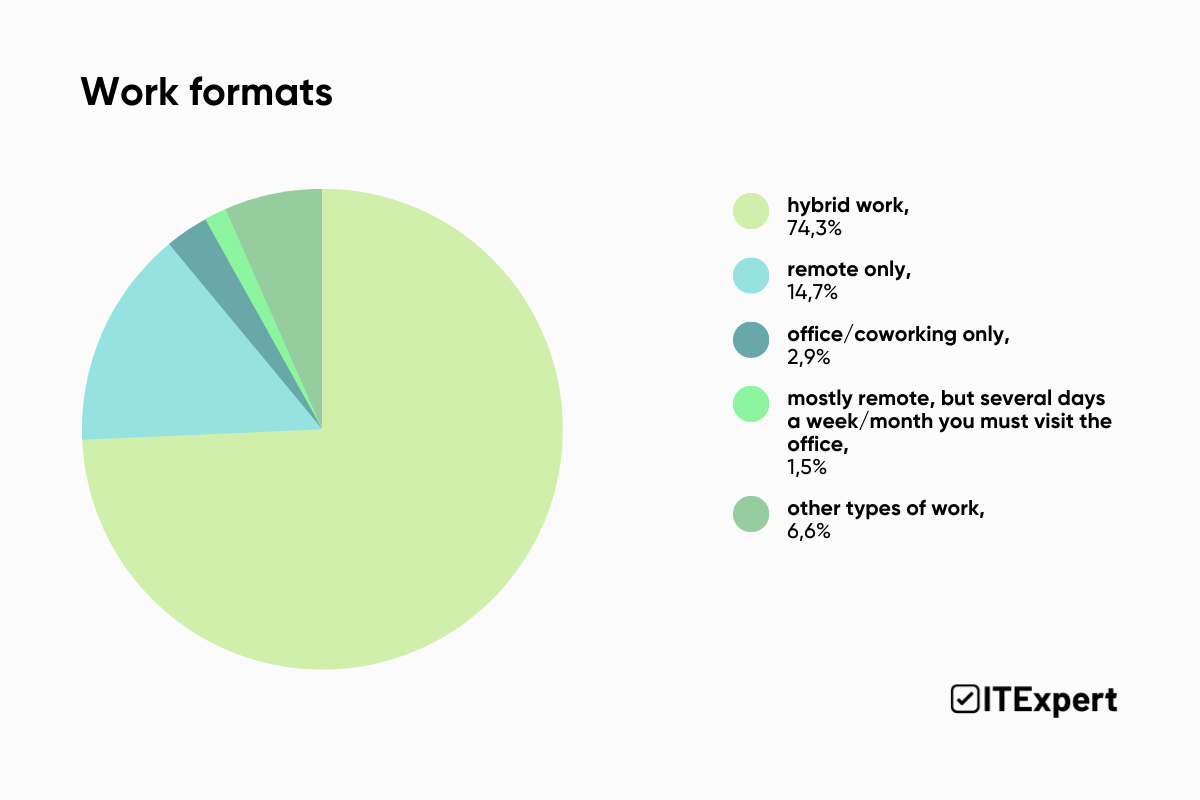
More than a year has passed since the start of the full-scale war in Ukraine. Some IT companies have returned to the office, while others have left the option to work remotely:
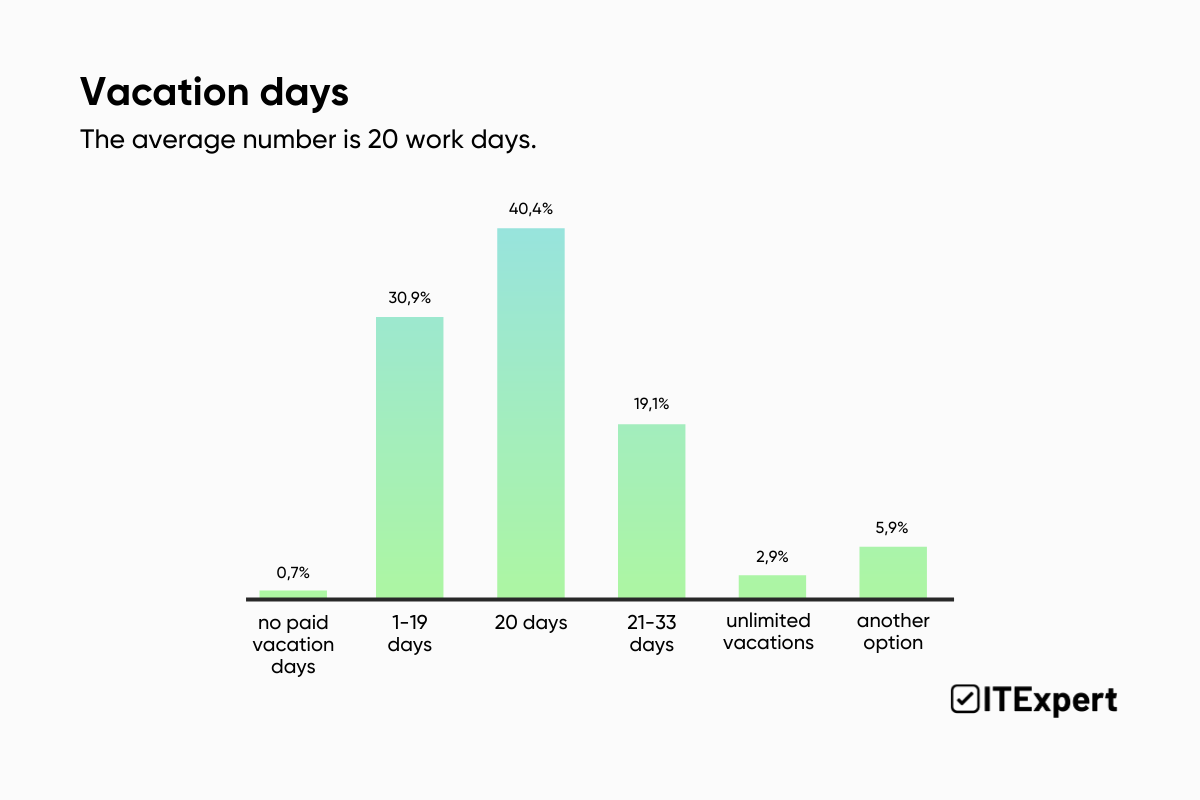
On average, IT companies cover 20 vacation days for their employees, namely:
Unlimited sick leave is offered by 14.7% of companies. Up to 10 sick leave days are provided in 25.7% of IT firms. From 11 to 30 paid sick days are provided by 16.9% of employers in IT. There are no sick leaves in 5% of firms.
In the fall of 2022, 67% of employers said their salary hasn’t changed since the start of the full-scale russian invasion. Compensation increased in 16% of companies, while it decreased in 13% of firms.
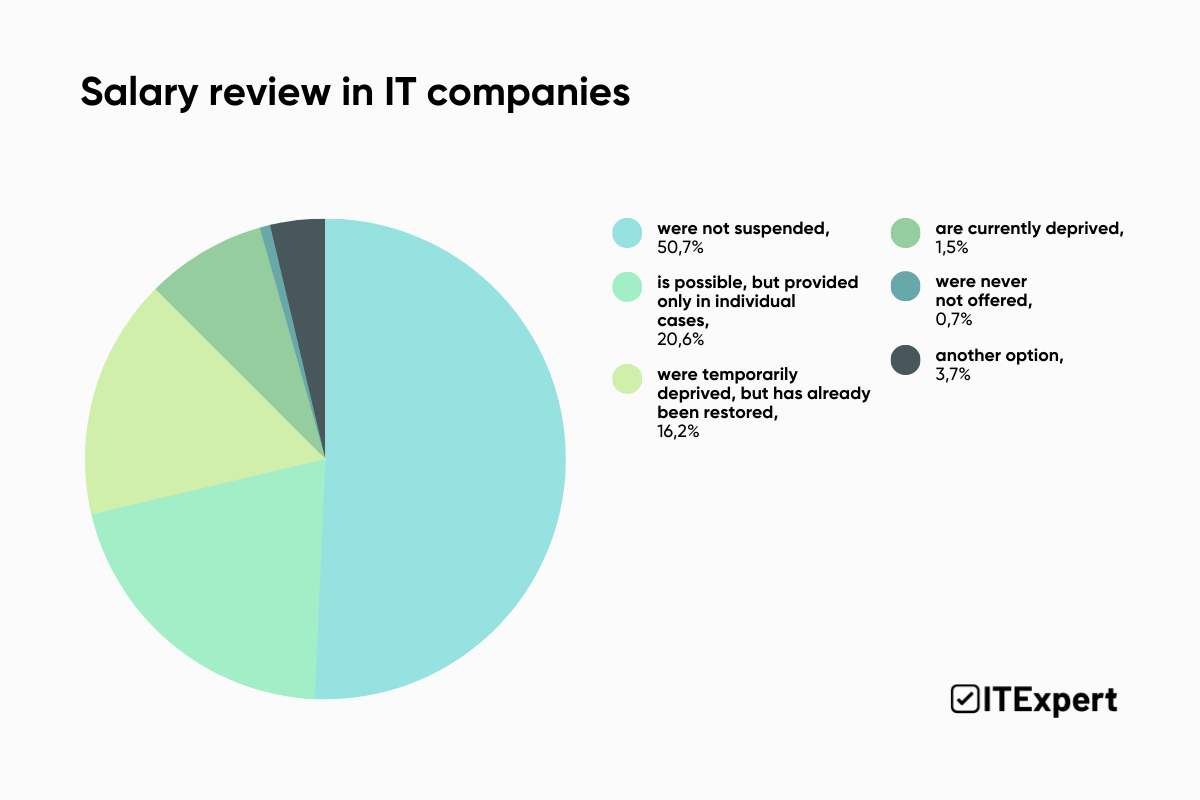
According to the results of May 2023:
This category also includes tech specialists with the opportunity to get a career promotion, but in the vast majority of cases without raising the level of compensation. Among the respondents are also those whose salary review is available once every six months for those with a salary below $1.000.
During the first months of the full-scale invasion, IT companies took more attention to the safety of their employees, not just to typical motivation tools. Employers compensated (fully or partially) housing abroad, helped with transportation, and also launched communication chats where employees could send messages with any urgent questions: how to evacuate from dangerous regions, where to look for housing, how to get to a certain city, etc.
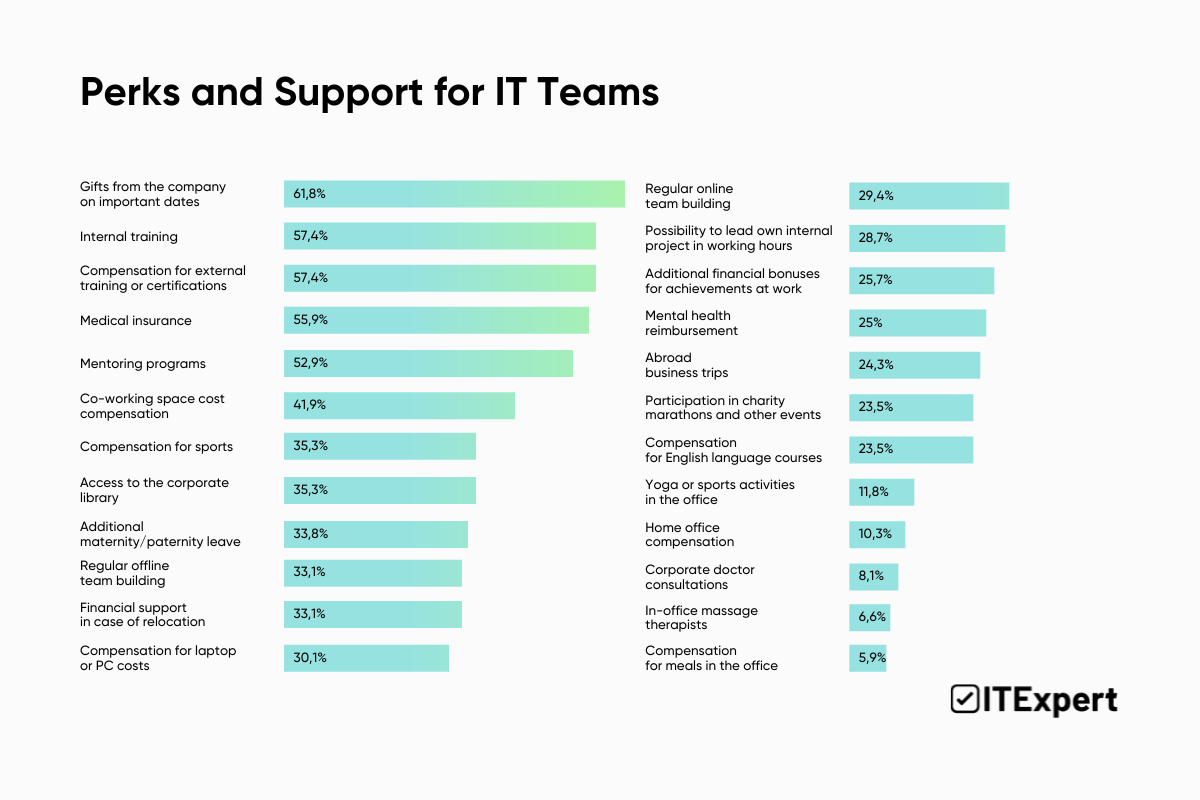
Nowadays, companies offer:
In addition, 5.9% of IT companies offer their employees a 13th salary. 3.7% of firms have a shortened working day on Friday. More than 3% of companies also offer options to their employees.
How the social package has changed and what new bonuses have been added in companies recently:
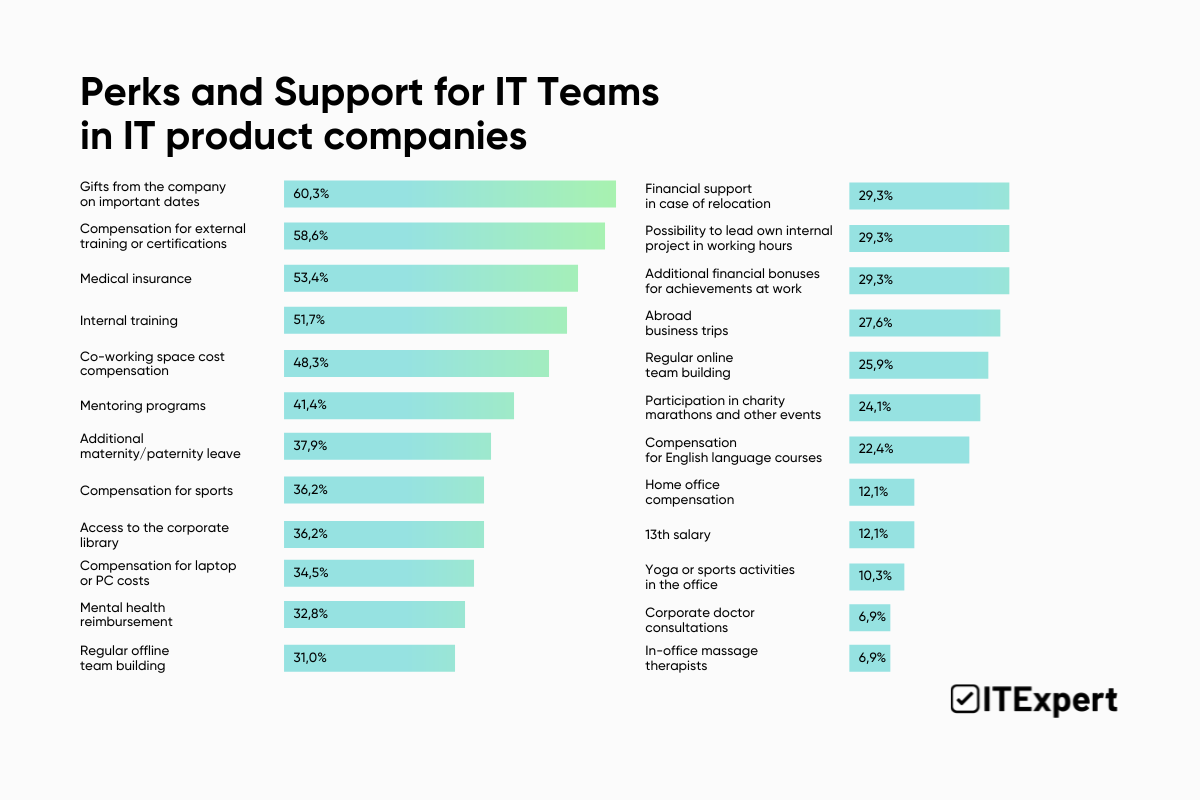
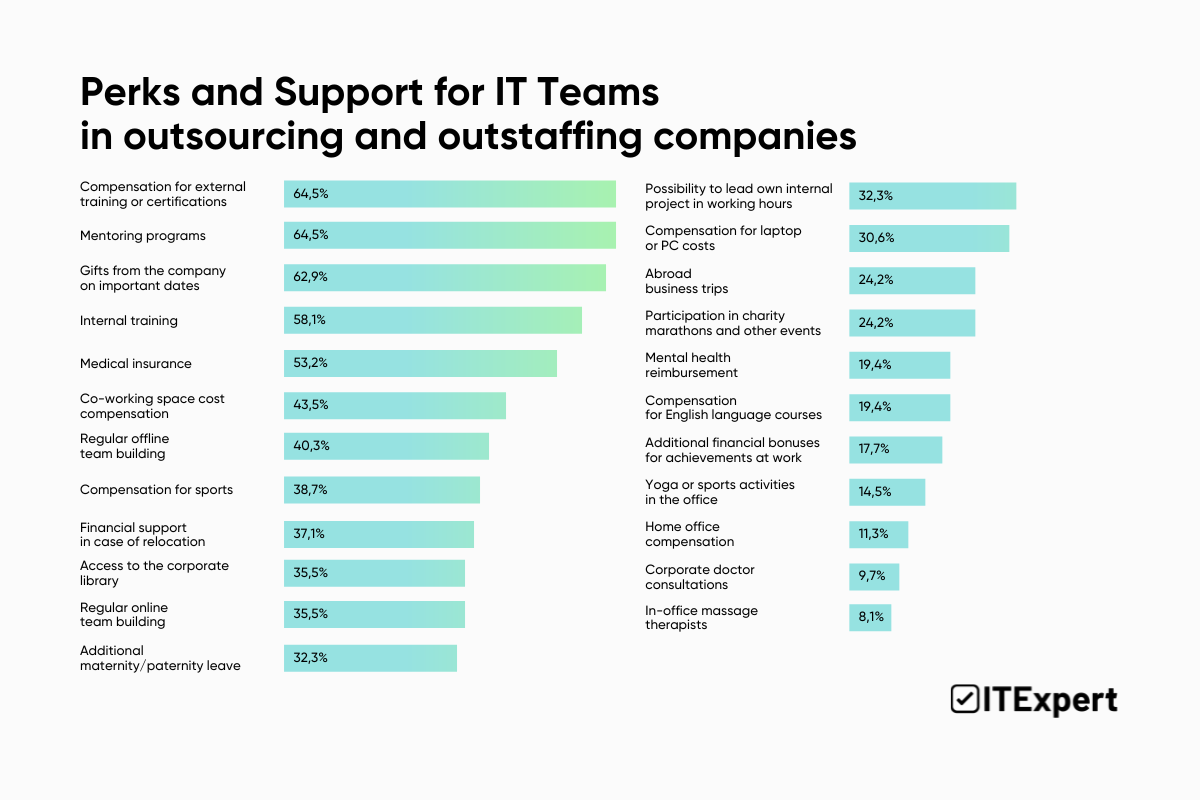
We’ve also highlighted data on how the perks and bonuses in IT product, outsourcing, and outstaffing companies have changed.
What most IT product companies offer now:
At the same time, some of the respondents noted the reduction of the social package and bonuses or noted that some of the perks that were available in their IT firms before aren’t relevant anymore: for example, conferences abroad for men with Ukrainian citizenship.
We didn’t find a significant difference between product companies and outsourcing or outstaffing firms. IT companies still provide their specialists with:
Among the interesting bonuses is the opportunity to spend a certain time on development or additional projects within the company, like it is in Google.
Some of the IT specialists noted that the social package in their companies has not changed, but new perks are “on hold”. Others have suspended medical insurance, in-office massage therapists, and business trips. Speaking clubs, compensation for lunches, and gifts for birthdays or other holidays were also canceled.
136 IT companies took part in the survey. There are representatives of:
Most of the respondents (39%) work in companies with approximately 100–1000 employees. 26.5% of survey participants work in companies with 51–100 employees, and 22.1% of respondents work in companies with ⁓50 employees. About 12.5% of survey participants said that their companies have up to 1.000 IT professionals.
Last but not least, money is an important factor. However, in the labor market, it is not the main competitive advantage for candidates and current company employees. To attract and motivate staff, as well as to promote the HR brand, companies are constantly expanding the social package. It becomes an integral part of the company’s image in the labor market, as well as a demonstration of care for employees.
For example, at the beginning of the pandemic, many IT companies added additional bonuses to the social package. Thus, the consignment company called thredUP switched to a 4-day work week, while keeping the salary at the pre-quarantine level. The IT company Nvidia allocated €500 to each employee to set up a workplace at home.
The social package minimizes concerns, supports employees, and allows them to concentrate on work better. And real care always pays off.

“IT specialists pay attention rather to the stability of the company in general. They want to keep their finger on the pulse of what will happen to the business in the next six months, a year, and a few years.
Accordingly, large companies are often considered more attractive places to work than start-ups or small firms, which are more dependent on changes in the global market. Although even large corporations have layoffs — for example, Amazon laid off 18.000, Meta laid off 11.000, and Microsoft laid off 10.000 employees.
As before, the “gold standard” that allows specialists to feel minimal security is important: 20–22 paid vacation days, 7–10 sick leaves, and medical insurance. Other bonuses are rather nice-to-have ones.
In addition, it is crucial to pay attention to the corporate culture and communication within the company. Regularly conduct one-to-ones and monitor the status of employees. This will allow you to keep your finger on the pulse and show that you care about the team.”
The PwC Global Workforce survey shows that transparency can also help build trust among employees and keep them from switching companies. A clear example of radical transparency is Netflix. The company uses a tactic known as “sunshine,” where all decision-making processes are open and employees feel free to share their ideas. That’s how Netflix got an A+ rating for retention. This means that the company has a better employee retention rate than 95% of similar companies.
We hope our research has helped you better understand the realities of the IT industry, and will help you organize effective recruitment processes in your company.


