





25.08.2026
Candidate Feedback: A Detailed Guide

According to the ISC2, the global shortage of cybersecurity professionals exceeds 4 million positions. Companies that continue operating or scaling are running into that talent crunch. At the same time, the number of cyber incidents keeps climbing — which means the need for protection is only getting more urgent.
This article is an attempt, together with CTO and co-founder of ITExpert Nick Kliestov, to bring together everything hiring teams need to know about cybersecurity recruitment strategies, how to hire cybersecurity professionals, and the realities of the cybersecurity talent shortage in one place.
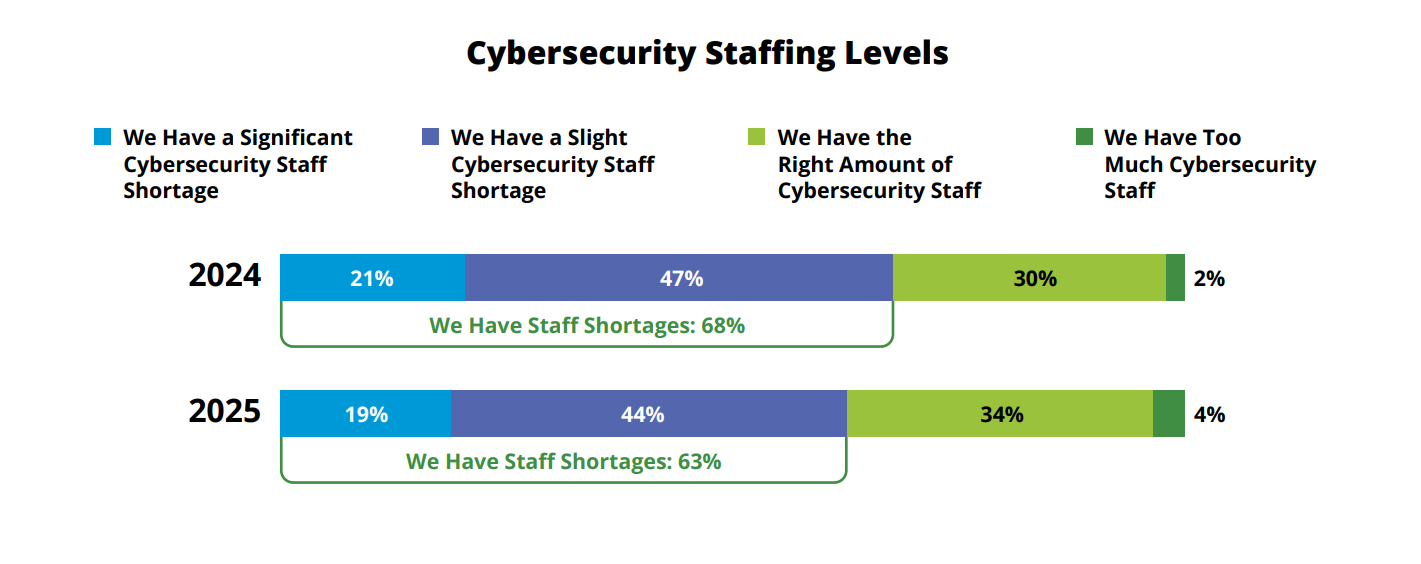
What’s happening in the cybersecurity job market in 2026? According to the ISC2 Cybersecurity Workforce Study, the global cybersecurity workforce would need to grow by 63% just to meet current demand.
Meanwhile, according to the SANS Institute 2026 study, despite the overall cybersecurity talent shortage, there is no shortage of junior specialists — only 4% of employers report difficulties hiring them. The real battle is for more experienced professionals — mid-level, senior, and expert talent account for 72% of all unfilled roles. These cybersecurity hiring trends in 2026 clearly show that companies are competing hardest for experienced specialists with advanced technical and strategic expertise.
Generative AI is already reshaping cybersecurity in a major way. At the same time, changing the kinds of specialists companies are looking for. The shift is happening on two fronts:
⚠️ On the threat side, AI is making attacks faster, cheaper, and easier to scale. Tasks that once required a ton of manual effort — sophisticated phishing campaigns, vulnerability analysis, or malicious code development — are now partially automated. Generative AI can create phishing emails in multiple languages, tailor attacks to specific companies, and generate variations of malicious scenarios. The volume of attacks is growing, and the pressure on security teams is rising right along with demand for specialists who can handle more complex and constantly evolving threats.
🛡️ On the defense side, AI is also transforming protection itself: automating alert prioritization, event correlation, anomaly detection, log analysis, incident summaries, and the initial stages of incident investigation. As a result, some junior analyst and SIEM operator tasks are gradually disappearing, while demand is shifting toward professionals who can build AI-assisted detection systems, integrate LLMs into security workflows, and work with ML models instead of relying solely on rule-based detection.
For companies focused on hiring cybersecurity engineers, this means candidates who already use AI in their day-to-day work are becoming significantly more valuable. These are now among the top cybersecurity skills in demand 2026. For example, professionals who write LLM-powered scripts for log analysis or threat intelligence, automate incident triage, experiment with AI-driven detection, or understand the limitations and risks of ML models in cybersecurity.
How do you attract cybersecurity talent? The first — and most common — mistake hiring managers make is treating “cybersecurity specialist” as one giant catch-all role. Below are the key roles, along with market insights.
Professionals in this area (PenTester, Offensive Security Engineer, Security Consultant) simulate attacks on infrastructure and applications to uncover vulnerabilities before attackers do.
SALARY (U.S.): $93K–257K + bonuses (Robert Half Salary Guide, 2026)
DEMAND: consistently high
MARKET GROWTH: +29% by 2034 according to the U.S. Bureau of Labor Statistics
Hiring challenge: experienced OSCP-certified candidates are few and far between, and they rarely browse job boards. You have to hunt for them at CTF competitions, Hack The Box, DEF CON, and Bugcrowd.
These teams focus on system monitoring, threat detection, and incident response.
SIEM engineers maintain and configure monitoring and threat detection systems, while incident responders coordinate the team’s actions during active attacks or data breaches.
SALARY (U.S.): $110K–145K (source)
DEMAND: high-volume and stable
TREND: AI is replacing L1 functions while increasing demand for L2–L3 talent
Hiring challenge: there’s an oversupply of junior candidates, but a severe shortage at the mid and senior levels.
These specialists design and build security systems — from cloud infrastructure to CI/CD pipelines and Zero Trust architectures.
It’s also worth highlighting the Application Security niche separately — an area closely tied to the Secure Software Development Lifecycle (SSDLC), where security is integrated directly into product development rather than added after launch. Companies are increasingly embedding security practices into the SDLC, implementing secure coding, automated security testing, DevSecOps, and shift-left methodologies.
At the same time, based on our agency’s experience, the market has matured: while finding AppSec specialists 5–6 years ago was incredibly difficult, today the number of candidates with hands-on secure development and application security experience has grown significantly.

“DevSecOps is a perfect example of a role where it’s almost impossible to find the ideal person on the market. The most realistic path is growing talent internally or identifying potential in adjacent roles. For example, many DevOps engineers already have a baseline understanding of security and can gradually evolve into DevSecOps roles.
For emerging disciplines, betting on a person’s ability to learn quickly works far better than chasing a checklist of the ‘perfect’ candidate.”
SALARY (U.S.): $118K–220K, architects earn even more (Robert Half Salary Guide, 2026)
SHORTAGE: critical — 36% of companies report cloud security skills gaps
TIME-TO-FILL: 4–6 months even with active recruiting
Hiring challenge: this is one of the clearest examples of the ongoing cybersecurity talent shortage and the growing importance of strategic cybersecurity talent acquisition. Look for talent in DevOps and SRE communities — many top cloud security engineers started their careers in infrastructure.
GRC Analysts, Cybersecurity GRC Analysts, and Compliance Specialists are responsible for risk management, regulatory compliance, and building security processes inside companies. These professionals work with GDPR, NIS2, DORA, SOC 2, ISO 27001, and other standards and regulations, handling audits, risk assessments, and security policy development.
SALARY (U.S.): $85K–152K (Robert Half Salary Guide, 2026)
DEMAND: growing due to NIS2 and DORA
TREND: +53% demand growth for specialized roles year-over-year (SANS Institute)
Hiring challenge: startups often underestimate the role (“we will hire them when we scale”), while large corporations tend to overcomplicate requirements.
Threat Intelligence Analysts, Threat Researchers, OSINT Analysts, and Threat Intelligence Engineers track and analyze threats before they turn into incidents. They research attacker tactics, techniques, and procedures (TTPs), conduct OSINT investigations, and publish threat reports. This is proactive work designed to stay one step ahead — unlike the reactive nature of SOC operations.
SALARY (U.S.): $95K–135K for specialists with 3+ years of experience (Robert Half Salary Guide, 2026)
SHORTAGE: rare profile, high compensation expectations
DEMAND: rising alongside threat complexity
Hiring challenge: one of the rarest profiles on the market. Source candidates through threat research blogs, CVE research publications, and conferences like DEF CON and Black Hat.
On standard job platforms, you are competing with dozens of other employers for the attention of someone who probably hasn’t even checked their feed this week. What actually works for passive cybersecurity candidates:
For recruiters, these communities are gold mines for sourcing. Top players on Hack The Box, for example, often already have strong practical skills and may be excellent candidates even without extensive commercial experience.
Most participants use nicknames. However, through Discord servers, forums, or community channels, it’s often possible to identify and contact them. The nature of the market makes verification especially important: fake candidates are a growing problem in tech hiring.
Even simply showing up at these conferences boosts employer branding. Sponsorships, booths, technical talks, and community involvement create opportunities to connect directly with high-level security professionals.
You don’t have to be a top-tier tech giant to attract cybersecurity specialists. More often than not, the deciding factor isn’t the employer brand — it is the substance of the work itself. Many candidates want to see that the role gives them the opportunity to:
Companies that are still building or transforming their security processes can actually be especially attractive. In these environments, specialists have the opportunity to help build infrastructure from the ground up, participate in tool selection and configuration, and shape security standards and approaches. For many candidates, that’s far more exciting than babysitting a fully mature, locked-down system. A structured recruiting brief helps capture and communicate this before the search even begins.
“A typical situation: the job description lists technologies and tools, but says nothing about responsibilities. Mentioning Burp Suite or Metasploit alone won’t move the needle for security professionals. Spell out the specifics: tasks, ownership areas, processes, and expectations for the role — and you’ll attract far more motivated candidates.”
In smaller companies, security specialists also often get direct access to the CTO or CEO. For professionals who want a seat at the table, that’s a major plus.
If a company operates in FinTech, HealthTech, or Defense, the industry itself can become a powerful selling point. These sectors deal with complex security requirements, unusual risks, and more advanced technical challenges. For cybersecurity specialists, that often translates into more interesting experience and bigger professional challenges. This is also a major part of understanding how to attract cybersecurity talent in a market where top candidates have endless opportunities.
Below is a list of questions that can help identify weak spots in your recruiting process.
Just as important is what happens after the hire. Companies that invest in professional development, transparent career tracks, and regular compensation reviews lose far fewer people — and in a field where replacing one specialist costs more than retaining them, that becomes a financial advantage.


