




02.09.2026
4 Practices That Help Recruiters Align Stakeholders and Secure Offers Faster

You hire an architect expecting them to get the product through to release without any major surprises. A few months in, it turns out the estimate failed to account for a critical integration, the team is stuck with an early architectural decision that no longer works, and the system has to be rebuilt to handle a load nobody planned for. The problem isn’t necessarily the architect’s skill level. Sometimes you need a different kind of architect: a Software Architect, who owns the internal architecture and how the system evolves, or a Solution Architect, who works out how to solve the business problem, how the solution connects to everything else, and what it will cost.
This article covers where to draw the line between the two roles, when you need each one, and how to tell them apart in an interview.
Start with what they share: both are architecture roles. Neither a Software Architect nor a Solution Architect works ticket by ticket. Both design systems, weigh options, and make calls the team will live with for years.
It doesn’t help that software and solution are often used almost interchangeably in the industry:
a solution is what we build,
and what we build is software.
When it comes to Solution Architect vs. Software Architect, the real difference is scope. A Software Architect focuses primarily on the software system itself. A Solution Architect starts with a business problem, where software may be only part of the answer. They might evaluate whether to buy an off-the-shelf product, rework an integration, or leave part of the process in the existing system.
The confusion runs deeper because few companies keep these roles neatly separated. In small teams, one person makes all the architectural calls. In product companies, Solution Architect responsibilities are often spread across several roles with no dedicated title at all. So the job title on a CV guarantees very little.
The two roles also tend to pay similarly. Which means companies tend to choose based on the work in front of them, not on a clear-cut distinction between the roles.
“For me, the core difference between a Solution Architect and a Software Architect comes down to the scope of the decision. A Software Architect works at the level of the system itself: how it’s broken into components, who owns state, how components interact, how it behaves when things fail, how it scales, and how expensive it will be to change over time.
A Solution Architect zooms out and looks at how the system fits into the wider landscape. More options are on the table: build something new, leave some functionality in the legacy system, buy something, reuse something, change an integration, or solve the problem without adding another service at all. A Solution Architect has to understand not just how the systems will work, but where ownership sits between them — who is responsible for what today, and who will be responsible after the change.”
“A Software Architect works at the software level: there’s an application, and it needs to be designed so it’s easy to evolve and can handle the load.
A Solution Architect works one level up, on the problem the business is actually trying to solve. And the answer might well be that it’s better to buy someone else’s product and not write any code at all. A strong architect can weigh the risks and costs of each approach, understand the trade-offs, and land on the option that actually fits the problem.”
A Software Architect answers the question: how will this system work? Their job is to design it so it survives not just the first release but everything that comes after. Those decisions set the boundaries the development team works within.
The closest analogy is an architect designing a building based on an agreed brief. They work out the structure, floor plan, and building systems, then hand the plans to the construction crew. A Software Architect does the same for a software system: they define what it’s made of, how the parts connect, and the rules for extending it.
The questions a Software Architect needs to answer:
Their core toolkit includes:
A Software Architect’s mistake doesn’t always take down the whole project, but it usually surfaces in production — under real load and at a real cost to the client.
Most Software Architects come from a development background, occasionally from DevOps. So a strong candidate’s CV typically shows several years of hands-on experience with the same stack they later architected systems in.
Pay for this role is fairly predictable: it tracks the depth of technical expertise in a specific stack. Java, .NET, and cloud all have well-established benchmarks. According to ZipRecruiter, the average annual salary for a Software Architect in the US is around $174,000. Demand is steady, particularly among product companies and teams that have spent years building a single complex product.
A Solution Architect answers a different question: what’s the right solution to this business problem? The work doesn’t start with a finished technical spec — it starts with a problem that needs the best available answer.
A Solution Architect decides:
To stretch the construction analogy, a Solution Architect is closer to an urban planner. They decide what belongs on a given site, how it connects to city infrastructure, and how it affects everything around it. Same here: a Solution Architect looks beyond a single system to how it fits into the wider landscape — how it integrates, what that requires, and what it costs.
The goal is to define the project’s architecture before development starts. At presale and early discovery, there’s no code, there may be no team yet, and the requirements are still incomplete — but the business already needs a realistic sense of cost, timelines, and risk. The Solution Architect’s job is to reduce that uncertainty enough for the project to be estimated realistically, while accounting for budget, regulatory requirements, and data constraints.
Their toolkit is broader and less focused on the internals of the software itself:
A Solution Architect is often the first to discuss the problem with the client and explain technical options to people who’ve never written code. How well they gather context and lay out the consequences of each option shapes the decision the business ultimately makes. At this stage, they work alongside the product manager: the architect assesses technical feasibility, while the PM assesses business value and potential return. From there, the Solution Architect aligns with the Software Architect, delivery managers, and the development team, while the PM works with business analysts and product owners. Delivery or the CTO joins later to weigh in on team capacity.
A Solution Architect makes some of the earliest decisions on a project, before anything is built — but their mistakes often surface much later, once the team is staffed, contracts are signed, and part of the system is live. At that point, changing direction can cost more than rewriting a module. Solution Architects also tend to stay involved throughout the project lifecycle, through launch, rollouts, and changes on the business side.
There are more routes into the Solution Architect role than into the Software Architect role. Some come from development; others from leadership and business-side roles where they were already doing this work — IT directors, heads of IT at non-tech companies, R&D managers, and presale specialists.
Compensation for Solution Architects is less predictable, too. Pay can be comparable to a Software Architect’s or considerably higher, depending on the scope of responsibility — particularly whether the role includes presale, direct client work, and architecture work across several projects or a whole portfolio. The median salary for a Solution Architect in the US is around $228,000 a year.
If the project is still just an idea, it’s worth deciding early which role you’re hiring for — and what to look for in a candidate.
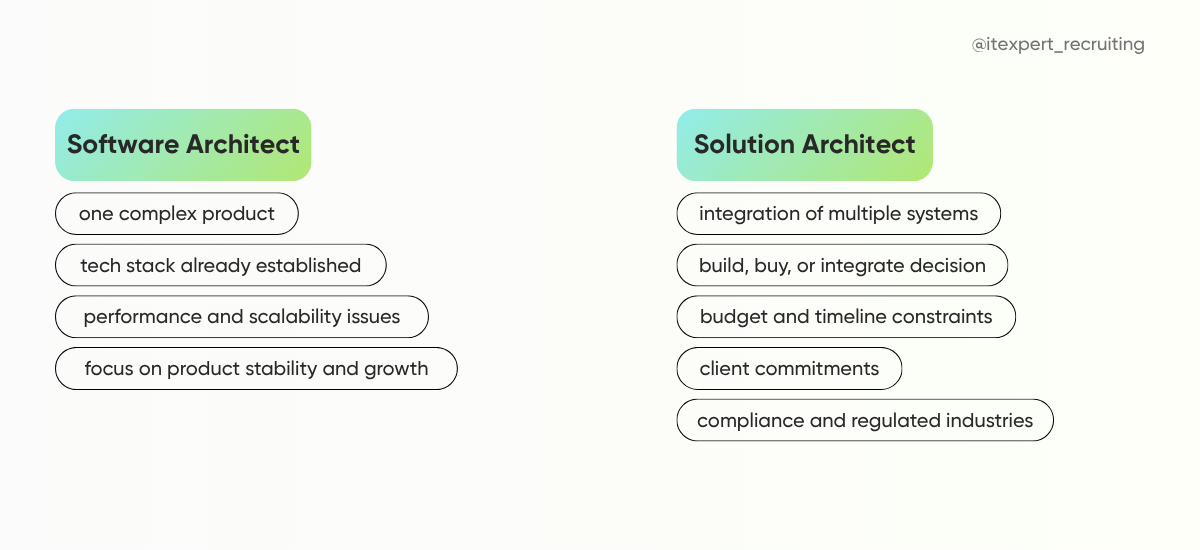
You have a single system, the team is in place, the stack is chosen. The risks ahead are performance, data consistency, behavior under load, and the cost of change a year out.
What to do: hire a Software Architect to own the system’s internal architecture and make sure it remains stable and easy to evolve.
The project spans several systems that need to stay in sync. There are legacy systems, historical data, external vendors, and constraints on where data can live. The risks sit at the seams — between systems, teams, and ownership boundaries.
What to do: bring in a Solution Architect to define how all those pieces work together.
You have a business problem, rough timelines, and a budget — but you don’t yet know whether custom development is needed at all. Until you’ve made the build-vs.-buy-vs.-integrate decision, designing the system is premature.
What to do: bring in a Solution Architect to compare the options on cost, timeline, and risk.
Banking, healthcare, fintech, and trading operate under strict compliance requirements and often involve dozens of external integrations. Every infrastructure decision comes with constraints and consequences, making the case for a Solution Architect stronger.
What to do: hire a Solution Architect when external constraints and integrations are a major part of the project.
At the prototype stage, most Solution Architect questions can wait. They become urgent once there are real users, external services, infrastructure requirements, and regulatory limits.
What to do: early on, you usually don’t need a dedicated Solution Architect. The exception is startups in areas like fintech or healthcare, where those constraints exist from day one.
In a service company, there’s an extra layer of architectural complexity because there’s a boundary between your team and the client. The real question is how many architectural decisions the client is willing to delegate.
What to do: if you can influence the stack, platform, integrations, and overall approach, there’s a strong case for a Solution Architect. If the client has already locked in the key decisions, there’s less need for one.
Look at the consequences of being wrong: what takes the biggest hit if the architectural decision turns out badly?
What to do: if the biggest risk is in the product itself — its stability and ability to evolve — you need a Software Architect. If what’s at stake is budget, timelines, integrations, and commitments to the client, you need a Solution Architect.
“What matters most isn’t company size — it’s the number of systems, teams, and external stakeholders that all have to be accounted for in a single decision. A twenty-person startup can be dealing with banks, payment providers, compliance, external APIs, and complex regulatory requirements, and in that environment a Solution Architect can be critical very early. A large product company, by contrast, may have its biggest challenge within a single large platform that scales poorly, is too tightly coupled, or has become so expensive to change that what it really needs is strong software architecture.”
“In my view, the Solution Architect’s remit is more relevant to mid-market and enterprise companies, and to large outsourcing firms, than to startups. Early on, a lot of what a Solution Architect handles gets deferred, and an in-house Tech Lead or CTO can cover the most pressing parts. During prototyping, say, a company does everything in the cloud. Once the prototype is ready to go to market, you build it properly and deploy it on private servers.
Solution architecture really comes into play once a startup is past MVP, has raised later-stage funding, and is starting to scale. That’s exactly the point where Software Architects can naturally grow into the Solution Architect role.”
For all their overlap, Software and Solution Architects talk about different things. Ask both the same screening questions, and you may miss what actually sets their experience apart. So it’s worth separating shared questions from role-specific ones in your recruitment brief.

“For a Software Architect, I might describe a system in the interview — a few services, a database, a cache, asynchronous events, and an external system. Then I ask: for this specific business entity or operation, who ultimately determines the correct state, and who has the right to change it?
A strong candidate will take that question a step further without prompting: what happens if a message arrives twice, if a service changes state but goes down before the event is sent, if the external system completes the operation but the response is lost, and how the system gets back to a consistent state after a restart or a partial failure. I’m not even that concerned about which specific technology they propose. In fifteen minutes, it’s far more telling whether the person understands ownership, consistency, and the lifecycle of state than whether they know a list of architectural patterns.
For a Solution Architect, I take that same idea of ownership and extend it beyond a single system. There’s a legacy system the client wants to replace, and I ask not only which system becomes the primary one after migration, but also:

“As a rule, Software Architects get asked about specific architectural decisions. Here’s a system that needs designing — how would you break it into modules? Then: why split it into separate modules rather than keep it as one? What risks does that mitigate, and what new risks does it introduce?
Solution Architects get asked something else. In the interview, you tell them: I have an idea; I want to build an app for people who read books on a tablet. Then you ask: how would you approach this? What would you do first? What would you find out next? Who would you involve at each stage? A good sign is when the Solution Architect starts asking questions of their own.
So for a Solution Architect, the process and communication matter more; for a Software Architect, it’s purely technical and architectural.”

“When I interview a Solution Architect, I pay attention to whether they talk about the business, not just the technology. I want to know whether they can explain why they chose that particular solution and how the alternatives compared on cost, risk, and timelines. I ask about working with several systems at once — integrations, vendor selection, reconciling requirements across the client’s departments.
With a Software Architect, I go deeper into the specific stack and product instead. What I’m after is depth of expertise: how the person makes decisions at the code and system level — how they choose design patterns, approach splitting a system into microservices or modules, handle technical debt, and scale a particular application.”
When you hire an architect, you’re not hiring a title — you’re hiring experience with a particular kind of decision. The job title on a CV can’t guarantee that: at one company, Solution Architect and Software Architect are two distinct roles; at another, one person covers both; and elsewhere, the work is spread across Tech Leads. So the better question isn’t “do we need a Solution or a Software Architect?” but “what decisions will we need to make in the coming months, and who has already worked on problems like those?” That’s what should guide the hire — not the title on someone’s CV.
The main difference lies in the scope of the decisions they make. A Software Architect designs the internal architecture of a specific software system: its components, how they interact, scalability, fault tolerance, and long-term evolution.
A Solution Architect works at a higher level, translating a business problem into a viable solution. They determine whether a new system needs to be built at all, what can remain in legacy systems, and what should be bought or integrated, while also accounting for budget, external systems, and other constraints.
At an early-stage startup, a dedicated Solution Architect is rarely necessary: some of their responsibilities can be handled by the CTO or Tech Lead. If the team has already decided what it is building and the main challenges lie within the product architecture itself, Software Architect expertise is usually sufficient.
The need for a Solution Architect grows when the product:
This is why company size alone is not a reliable indicator. Even a 20-person team may need a Solution Architect if its product depends on banks, payment providers, external APIs, and compliance requirements.
Software Architects most commonly come from software development backgrounds and, less often, from DevOps. The role requires deep hands-on expertise in a particular tech stack, as well as experience working with the types of systems they will later be responsible for architecting.
There are more potential career paths into Solution Architecture. Solution Architects may come from software development or Software Architecture, as well as roles that already sit at the intersection of technology and business, such as IT Director, Head of IT, R&D Manager, or presales specialist.
There is no universal reporting structure. It depends on the size of the company and how responsibility for architecture is distributed across the organization.
A Software Architect typically sits closer to the engineering function and may report to a CTO, VP of Engineering, or another senior technical leader. A Solution Architect more often operates at the intersection of engineering, product, delivery, and business, so their position within the organization tends to vary more depending on the company and the types of projects it handles.
It depends on the company structure and the scope of the decision. An architect typically evaluates the available options, constraints, and technical trade-offs and makes a recommendation, but they do not necessarily make the final decision alone.
For the architecture of a specific product, the Software Architect may play a key role alongside the CTO. If the decision affects multiple systems, infrastructure, vendors, budget, or integrations, a Solution Architect is likely to be involved as well, while final approval may rest with the CTO or another leader responsible for the company’s technology strategy.


