













23.09.2026
Solution Architect vs. Software Architect: Who Does Your Team Actually Need?

Researchers at the University of Toledo found that it takes just 15 seconds to form a lasting impression of a candidate. Other studies show that first impressions are often formed within the first few moments of meeting a candidate — before the interview even gets off the ground.
Without a structured framework, the brain tends to shift from evaluating skills and competencies to simply “liking” a candidate. A scorecard pulls the focus back to objective, job-related criteria. In practice, though, interviewers often skip it altogether or only fill it out after they’ve already made up their mind. More often than not, the issue comes down to poor design: a typical recruiting scorecard with 10–12 vague criteria can make the process feel like a chore and lead to procrastination instead of better decision-making.
We’ve gathered practical guidance on how to build a recruitment scorecard template people will actually use — how many criteria to include, how to align your rating scale with a recruiting scorecard template, how to tailor it for different roles and interview formats, and how to calibrate evaluations across interviewers.
What is the purpose of a candidate scorecard, and what is it exactly? An interview scorecard is a structured document where the interviewer records candidate evaluations against predefined criteria (skills, experience, cultural fit) during or shortly after the conversation. A candidate scorecard helps solve several common interview problems:
28%
Of employers primarily based on “gut instinct,” when making hiring decisions — even when they believe they are evaluating candidates objectively.
2×
Structured interviews backed by a scorecard are twice as effective at predicting whether a candidate will actually thrive in the role compared to free-flowing, off-the-cuff conversations.
35%
Candidates who go through a structured interview process with a scorecard are 35% more likely to walk away with a positive impression of the experience — even if they don’t get the job.
For recruiters, a technical interview scorecard is also a safety net: if someone asks a year later, “Why didn’t we hire that candidate?” you are not left scrambling to piece the story together. You have clear, documented reasoning behind the decision. And if you’re looking to take some of the heavy lifting off your hiring team, AI recruiting tools can help automate parts of the process while keeping everything organized and consistent.
Most scorecards are built to justify decisions after the fact rather than help make better ones in the moment. As a result, interviewers put them off, fill them out just to check the box, or skip them entirely. An effective job interview interview scorecard looks very different: fewer criteria, clearer rating scales, and dedicated space to capture real evidence before assigning a score.
✅ 3–6 competencies maximum per interview. Research shows this is the optimal number of criteria for high-quality evaluations.
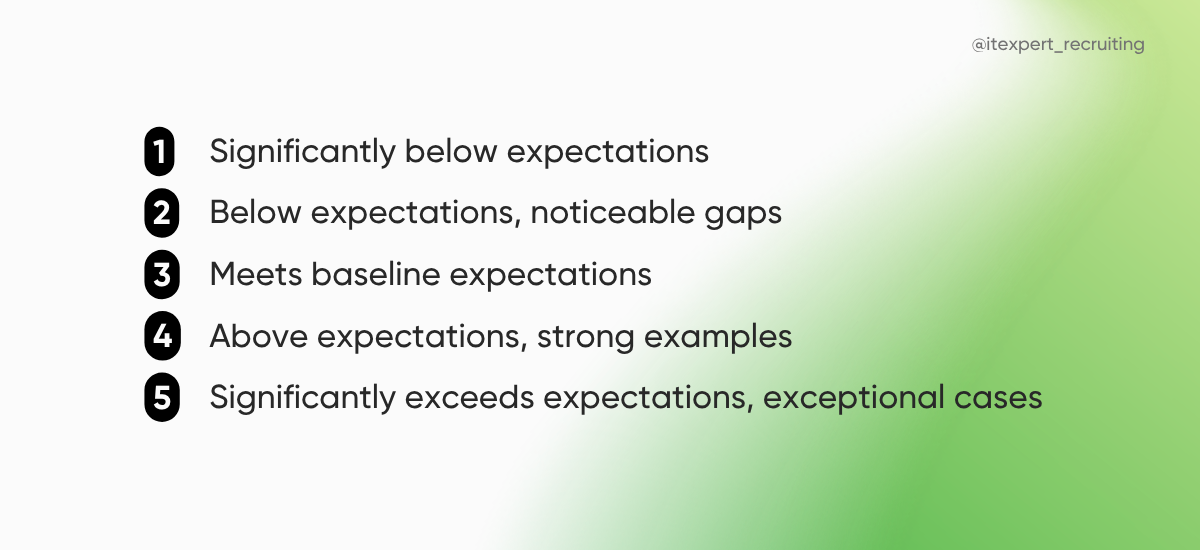
✅ Behaviorally Anchored Rating Scales (BARS). Each score describes specific behavior rather than generic “good/bad” labels. Example:
“4 = candidate provided 2+ concrete examples with measurable outcomes, including one from a complex environment.”
✅ Evidence field before the score. Interviewers should first write down what the candidate actually said, and only then assign a rating. Without that step, it’s easy to slip into a “like or don’t like” judgment first and then, knowingly or not, build the reasoning to match it afterward.
✅ Each stage evaluates its own area. A technical interviewer shouldn’t be rehashing role-fit questions the recruiter has already covered.
❌ A scale without behavioral definitions. A “rate from 1 to 5” scale without clear definitions for each point turns the assessment into guesswork rather than a real evaluation.
❌ Overly long scorecards. A sample interview scorecard with 15+ criteria usually results in rushed or skipped evaluations.
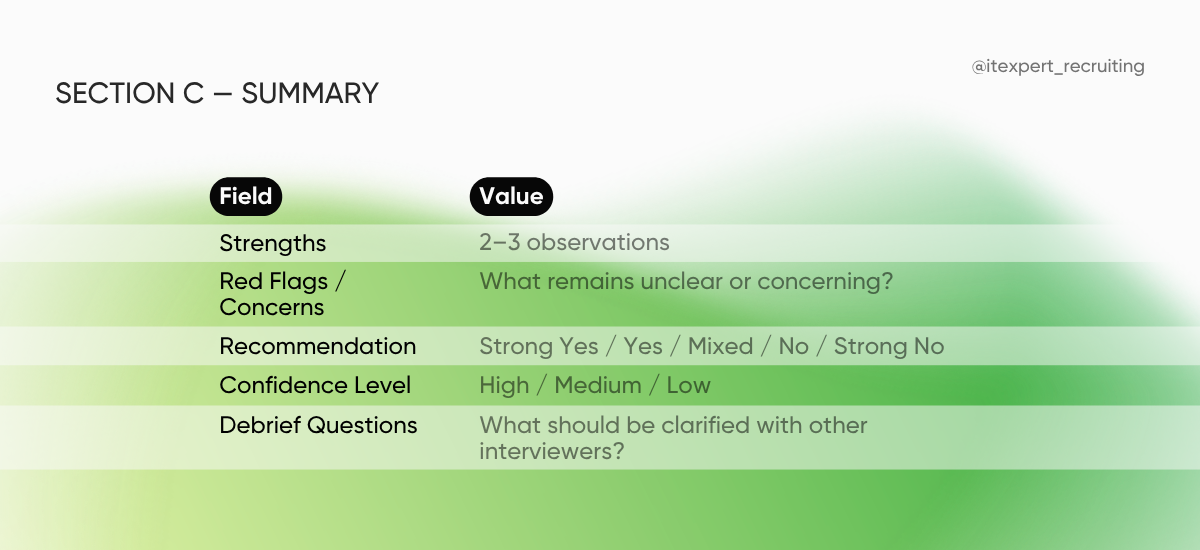
❌ “Hire / No Hire” recommendations without competency breakdowns. Without detailed scoring, it is impossible to understand what actually influenced the decision.
A 5-point scale is the most common setup, but it only works when each point is clearly defined. Without that, interviewers tend to stick to the middle — mostly 3s and 4s — avoiding the edges where the real signal lives.
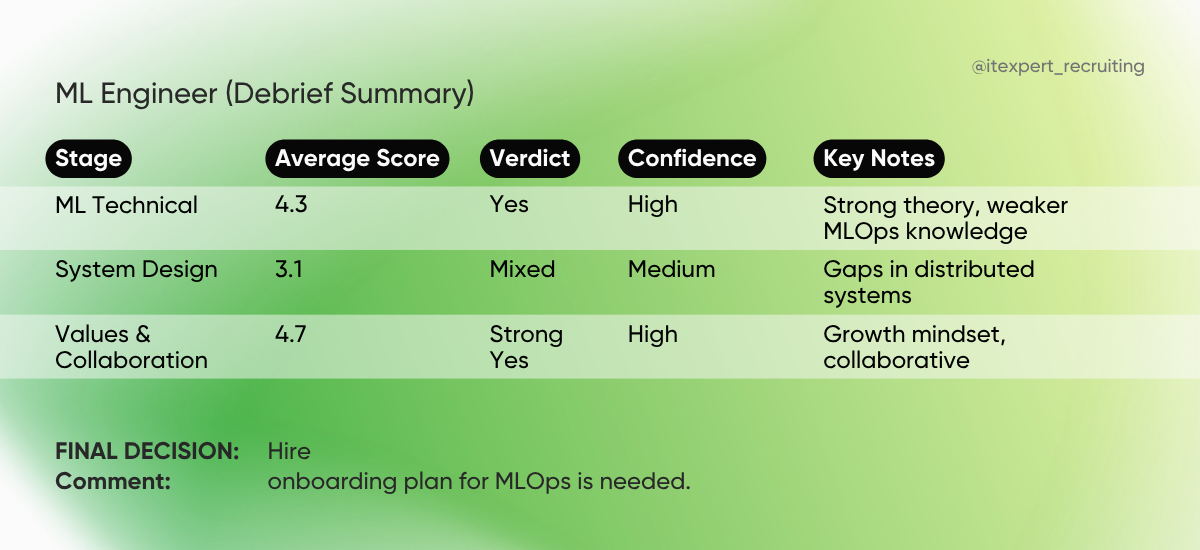
An alternative for technical roles is the “Strong No / No / Mixed / Yes / Strong Yes” scale, which is easier to adapt.
Below are five interview scorecard examples for different roles and interview formats. Each hiring scorecard example shows a distinct approach to structure, scoring, and presentation.
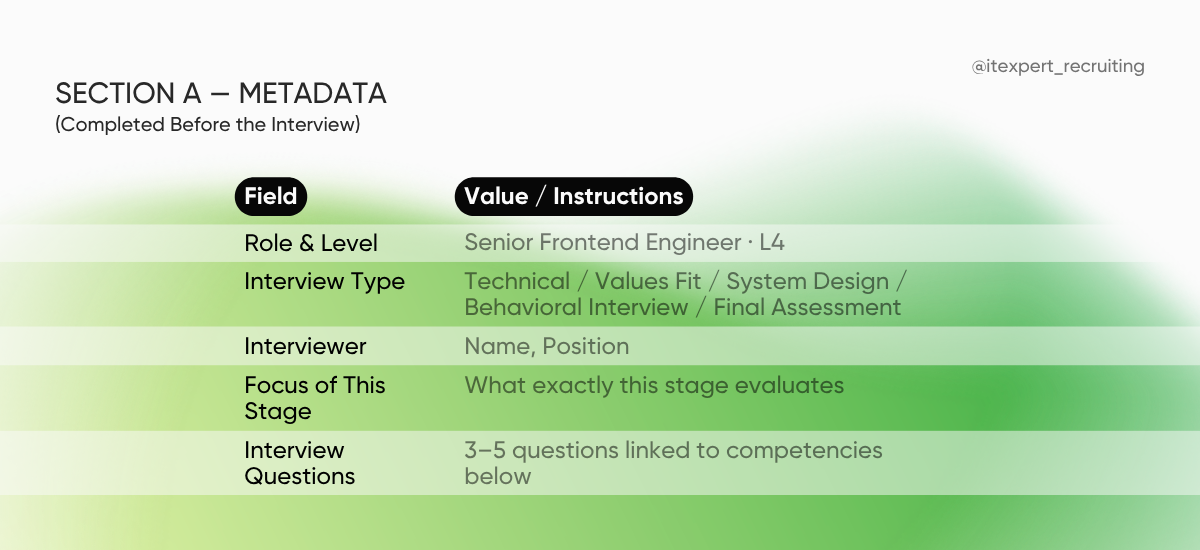
This hiring scorecard template is a framework that should be adapted for every role. Competencies, questions, and priorities change, but the logic stays the same:
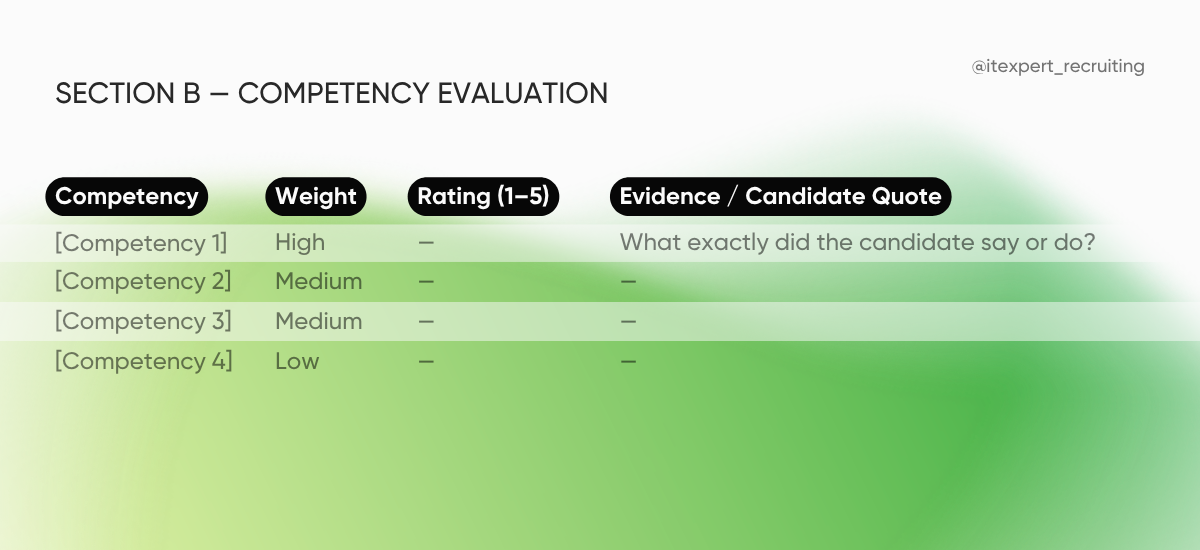
Not all competencies are equally important. Critical competencies — for example, “can independently lead a project from idea to production” for an IC6 role — should be weighted differently. A score of “1” in a critical competency may be a hard stop regardless of other scores.
The same candidate scorecard template cannot effectively evaluate both a senior engineer and a customer success manager. Therefore, every recruitment scorecard should be adapted to the role, interview stage, and evaluation method.
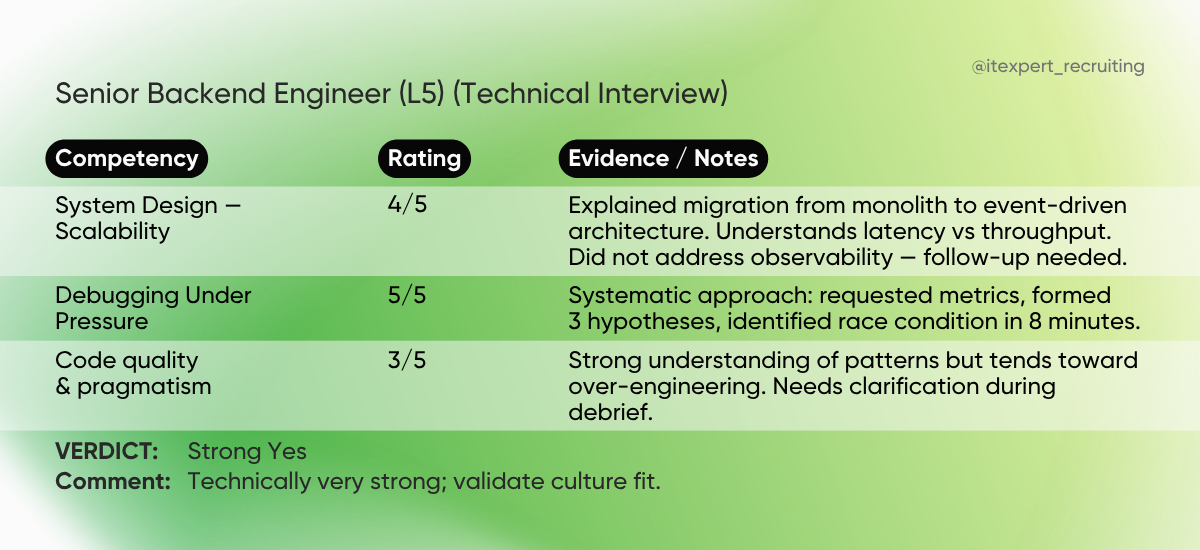
The main signal comes from live coding or a system design task, not abstract questions about past experience. What really matters isn’t just whether the candidate lands the solution, but how they get there: did they ask clarifying questions before jumping in? Did they talk through their reasoning? Did they approach debugging in a structured way?
In many cases, the “problem-solving approach” section carries more weight than the final answer itself. A correct solution without a clear thought process doesn’t give much confidence that the candidate will be able to handle real-world, on-the-fly challenges.
A technical interview scorecard should use BARS (Behaviorally Anchored Rating Scale), where each score reflects a specific behavioral example tied to the technology stack. Not “4 = good,” but rather: “4 = proposed a workable solution but missed edge cases without prompting.”
One critical deal-breaker: can the candidate independently resolve production debugging issues? This evaluates not just knowledge, but the ability to operate under uncertainty.
Behavioral questions work best when they follow the STAR framework, where candidates walk through a real situation from their experience, setting the context, explaining the task, describing the actions they took, and sharing the outcome. This matters because hypothetical answers like “I would do…” don’t say much about how someone actually behaves in the real world.
Evaluation criteria should also translate company values into concrete, observable behaviors. For instance, if a company values “openness to feedback,” the criterion should not be a vague “is open to feedback,” but something specific like: “Gives a clear example of a time feedback changed their decision.”
It’s also worth steering clear of subjective labels like “easy to communicate with,” since they are hard to verify and open the door to bias. As a rule of thumb, it’s better to focus on up to three competencies per interview — otherwise, the quality of evaluation drops, and nothing gets assessed particularly well.
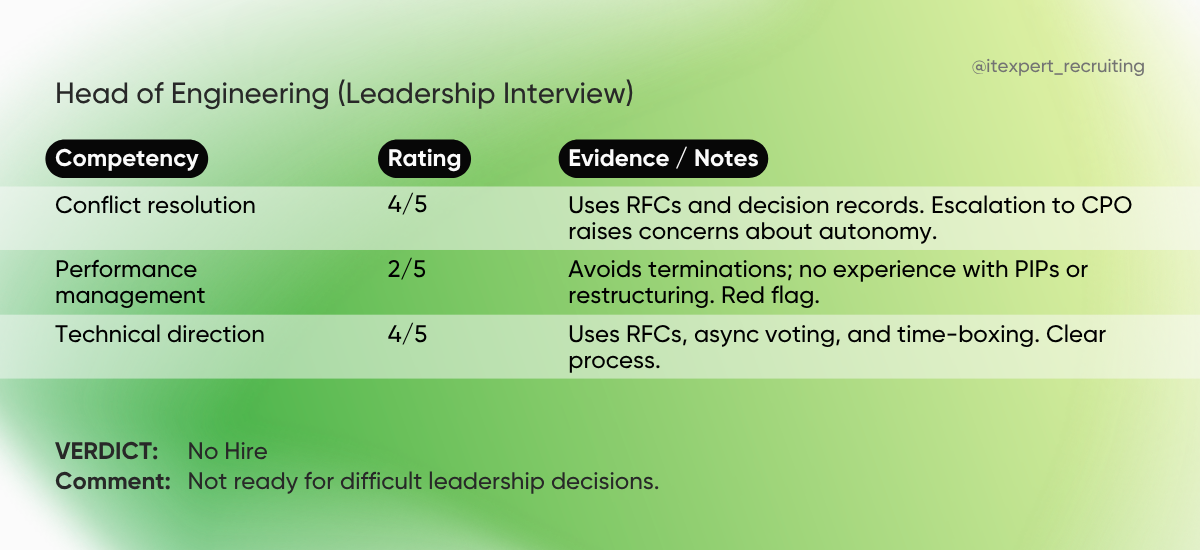
The focus should be on situations where the candidate had to step into resolving conflicts, delivering hard feedback, or making calls on underperformance. The key is not theoretical questions about management style, but specific examples: “Tell me about a time when you had to terminate someone’s employment.” Questions around difficult conversations and performance management are key because they quickly separate managers who shy away from conflict from those who can handle it without flinching.
A big red flag is vague, feel-good answers like, “We always worked things out together,” with no real details behind them. That kind of response can signal either a lack of hands-on experience or a tendency to dodge ownership. Context also matters: managing a team of 3 people and managing a team of 30 require very different competencies.
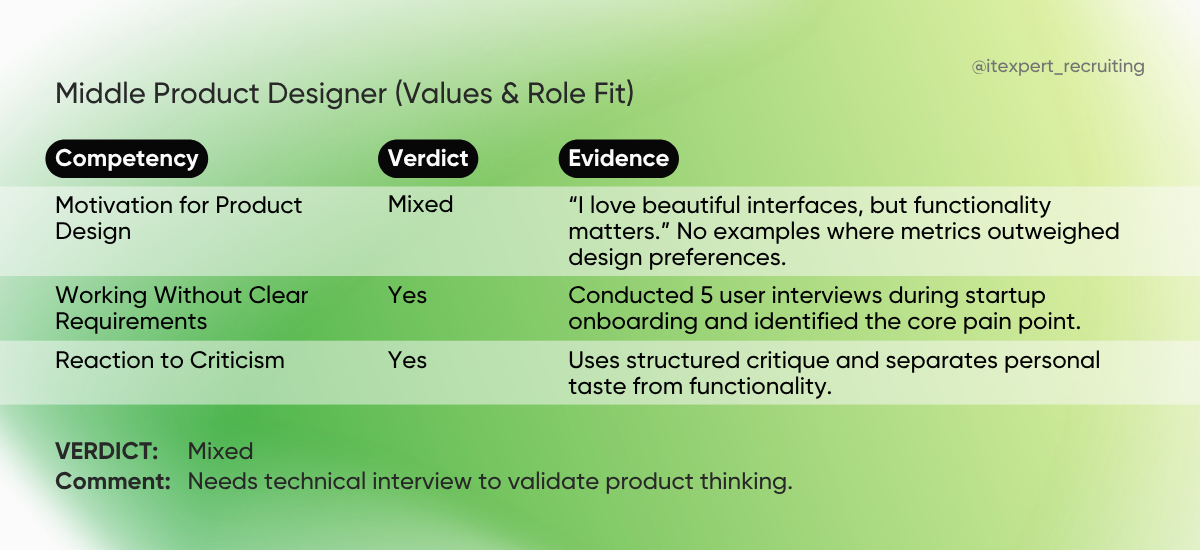
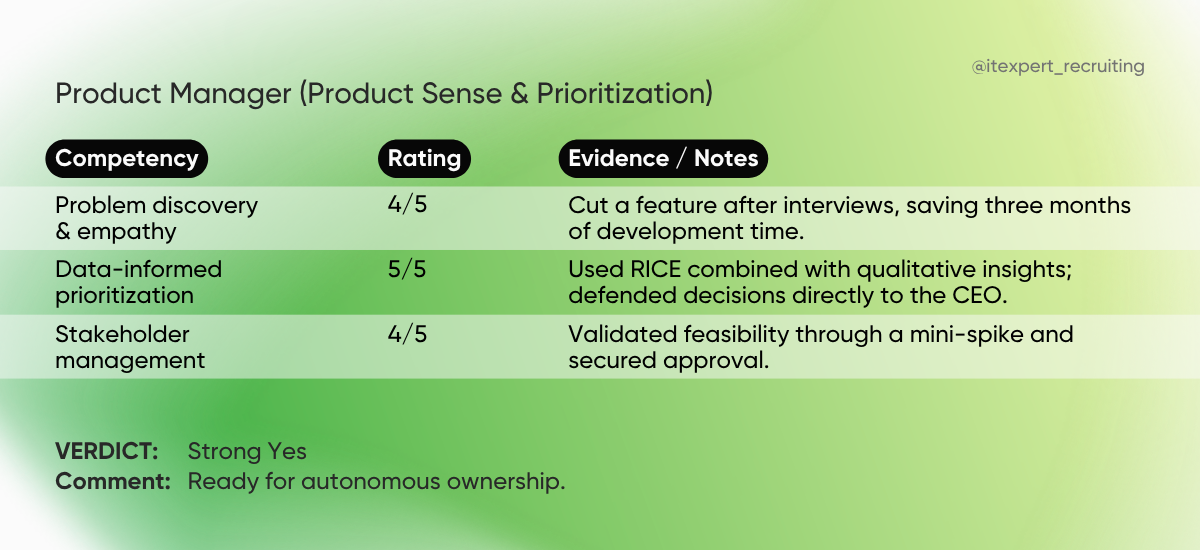
Portfolio reviews and product sense should be evaluated as two separate signals, since they reflect different skill sets. A portfolio shows what someone has already shipped, while product sense reveals how they think through new, unfamiliar problems. Questions like, “What would you do differently?” are especially useful for testing self-awareness and the ability to admit mistakes — often more valuable than polished, picture-perfect case studies.
For designers, it also helps to add a dedicated “feedback response” section during critique sessions. This focuses on how they react in the moment when their work is challenged: do they get defensive, shut down, or stay open and engaged in the discussion?
One key deal-breaker to look for: clear examples of when a candidate has cut or deprioritized features based on data. That’s a strong signal they truly understand product metrics and business outcomes, not just design aesthetics.
Last but not least, a recruitment scorecard is effective only if four conditions are met:
1️⃣ It must be completed before the debrief session — otherwise interviewers unconsciously adapt their evaluations to what colleagues have already said.
2️⃣ Every interviewer should evaluate independently to preserve their individual perspective before discussion.
3️⃣ Evidence should be documented before assigning a score — otherwise notes become post-facto rationalizations of a conclusion that has already been made.
4️⃣ Before the first interview for a new role, the panel should spend 30 minutes calibrating expectations. Each interviewer should explain what a “4” means for a key competency, using concrete examples: “Here is what I would expect to hear from a candidate to assign this score.”
A calibration session before interviewing the first candidate often aligns interviewer evaluations significantly — even without changing the scorecard itself. In practice, this can noticeably improve recruiting metrics and hiring consistency.


