






23.09.2026
Solution Architect vs. Software Architect: Who Does Your Team Actually Need?

Does this sound familiar? A role that seemed all but filled suddenly gets sent back for “just one more clarification.” The hiring manager’s expectations don’t line up with the budget, the team is feeling the crunch, and C-level executives want to see the big picture.
In IT, where recruiters are constantly caught in the crossfire of competing priorities, stakeholder management isn’t a nice-to-have — it is mission-critical. We’ve broken down the strategic approaches and practical tools that help recruiters not just fill roles, but do it efficiently, predictably, and without unnecessary friction for everyone involved.
The hiring manager is just the tip of the iceberg. If you build your strategy around their request alone, you are missing the bigger picture — an entire web of influence that will inevitably come into play later. That’s why it is essential to broaden your definition of who a stakeholder really is. A stakeholder in recruitment is any person or group that:
→ Shapes candidate requirements: defines, refines, or adjusts the job profile.
→ Controls resources: influences the budget, signs off on compensation, or allocates the resources needed to make the hire happen.
→ Makes or blocks decisions: has the formal or informal authority to give the green light — or stop the process in its tracks — at any stage.
→ Has skin in the game: is directly affected by the success or failure of the hire, whether through their day-to-day work, KPIs, or project outcomes.
Before starting any recruiting project, ask yourself these questions — or better yet, discuss them with the hiring manager. This will help you create an initial stakeholder map.
If more than two or three different people come to mind, congrats — you are operating in a multi-stakeholder environment. That means it’s critical to map out all stakeholders, align on what success looks like, identify the ultimate decision-maker, and lock in clear timelines. Otherwise, you won’t be managing the hiring process — you’ll be stuck cleaning up the fallout from misaligned expectations.
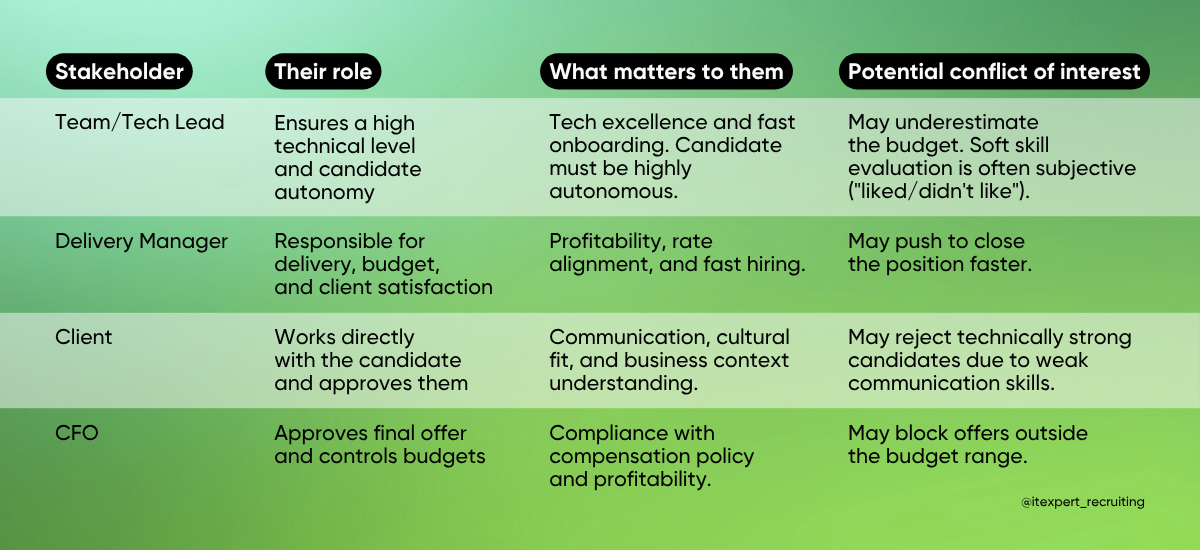
Imagine you need to hire a Senior Python Developer for a long-term outsourcing engagement. At first glance, it may seem like there is only one stakeholder — the hiring manager (Team Lead). But once you start asking a few more questions, it becomes clear there’s more to the story:
😥 You might find the perfect candidate for the Team Lead — only to have the Delivery Manager push back because their rate is too steep.
😥 You might get full internal approval — only for the client to turn the candidate down at the final interview.
😥 You might make it all the way to the offer stage — only to have the CFO pull the plug because it is 15% over budget.
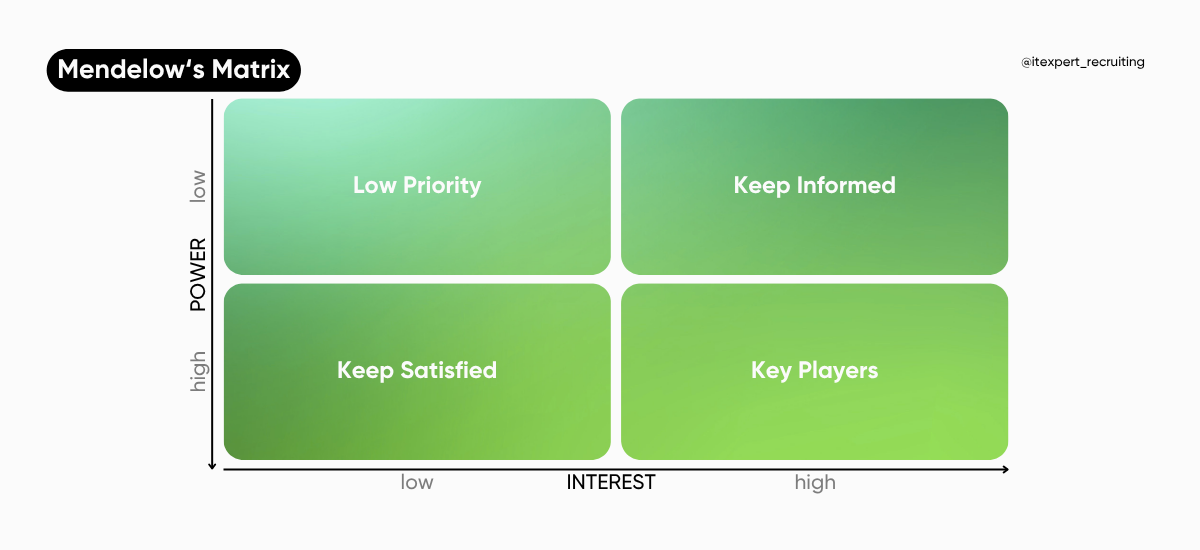
Have you ever spent hours putting together reports for someone who never even opened them — only to get blindsided by a last-minute objection from a stakeholder who suddenly has concerns? That’s a classic sign your priorities are off. The Mendelow Matrix is a practical tool that helps you quickly identify where to invest 80% of your time — and who just needs to be kept in the loop.
The matrix is built on two axes:
1️⃣ Power: the stakeholder’s ability to influence decisions, budgets, or the recruiting process — whether officially or behind the scenes.
2️⃣ Interest: how much the stakeholder actually cares about the hiring outcome and how actively they stay involved.
Where a stakeholder in recruitment falls on the matrix determines the smartest way to engage them.
These stakeholders wield the most influence and are highly invested in the success of the hire.
Examples: the hiring manager, department head, technical expert conducting final interviews, or the outsourcing client.
Engagement strategy:
✅ Provide regular, proactive updates. Set a clear communication rhythm — daily check-ins, weekly meetings, and detailed progress reports.
✅ Collaborate on decisions. Involve them in candidate profile discussions, CV reviews, and interview feedback sessions.
✅ Ensure fast, structured feedback. Set SLAs (Service Level Agreement). For example, a 24-hour response time.
This group of stakeholders in IT holds serious sway over the recruiting process. They can sign off on budgets, shift priorities, or shut things down entirely. But they are not interested in the day-to-day nuts and bolts of hiring. Their expectation is simple: the process runs smoothly and doesn’t create headaches.
Examples: CFO (Chief Financial Officer), C-level executives (CEO, CTO), or the head of a large department who isn’t the direct hiring manager but has the final say on opening new roles.
Engagement strategy:
✅ Short, structured, and targeted updates. Provide information that is relevant to them: key recruitment metrics (time-to-fill, cost-per-hire, market constraints), and the status of critical roles. Avoid excessive detail.
✅ Focus on outcomes and business impact. Communicate how recruiting supports the company’s strategic goals and how filling roles affects revenue, innovation, or efficiency.
✅ Proactive communication about risks and budgets. Report any budget deviations or potential delays, and propose possible solutions.
These stakeholders don’t have direct control over major recruiting decisions, but they care about the outcomes. While their dissatisfaction won’t necessarily derail the process, it can create friction or impact the team’s reputation.
Examples: HR Business Partner (HRBP), sourcing team working on the same role, other recruiters, or potential future colleagues of the new hire.
Engagement strategy:
✅ Be transparent about the process. Give them access to role status, profile updates, and overall progress — via shared dashboards, regular email updates, or internal meetings.
✅ Tap into their interest. They can be a valuable source of insights, referrals, or support. Involve them in informal discussions, candidate feedback sessions, or market intelligence gathering.
This group of stakeholders has minimal influence on the recruiting process and low interest in the details. They usually don’t require active communication, especially when things are running smoothly.
Examples: legal department (if no specific issues arise), administrative staff, or other departments not directly involved in hiring but interested in the company’s growth.
Engagement strategy:
✅ Keep contact minimal but predictable. General updates or automated notifications about role openings and closings are typically enough.
✅ Be ready to engage. Even with low interest, be prepared to provide information or support if needed — for example, the legal team may need to review a contract, or HRBP/Compensation & Benefits may need to validate candidate motivation.
✅ Monitor for changes. Keep an eye on whether their influence or interest shifts, which could move them into a different quadrant.
Document the matrix in writing and review it regularly, since levels of influence and interest can change. For instance, C-level leadership might move to “High Interest” if a critical role or hiring challenge arises.
Why do some companies fill roles in two weeks while others leave them open for months, even with the same budget? Often, it comes down to how the recruiter plays the game within the team. We’ve put together tried-and-true stakeholder management practices from around the world to help you build a system where everyone pulls in the same direction.
Before you kick things off, you need to “lock in” the basics: non-negotiable must-haves, a realistic budget (in line with the market), and feedback turnaround times.
Pro tip: name a single decision-maker. After meetings, always send out recap notes to all participants. This keeps everyone on the same page and shields you from sudden pivots.
Clearly define responsibilities:
Even a simple table in your ATS or shared doc can squash 80% of conflicts around approvals and final interviews.
Every team has unofficial power players — people who can torpedo a candidate even if they are not on the interview panel. Spot them by watching team dynamics or chatting casually with the hiring manager.
Pro tip: get them involved early. Ask for their take on a candidate profile or invite them for a quick coffee chat. Give them a seat at the table — they often become your biggest allies instead of blockers.
Any tweaks to profiles, budgets, or interview steps should be written down — email, ATS notes, or Confluence pages.
Pro tip: for major changes, get confirmation from key stakeholders. A written record keeps everyone accountable, ensures transparency, and protects you from the dreaded “I never said that” at the eleventh hour.
Take your hardest-to-fill role and map it out: Who’s the silent saboteur? Who holds the remote control on the job offer? Are you bending over backward for a stakeholder whose influence is outdated, or missing someone who can tank months of work with one word? Knowing the lay of the land saves you headaches and keeps hiring moving.


