





25.09.2026
Why Does a Company Need an EVP?

Friday, 5:40 p.m. A manager opens the Kanban board, sees three unfinished tickets, and writes in the team channel: “Folks, looks like we’ll need to put in a few hours this weekend.” No one pushes back. Three months later, two people from that team leave “to pursue other challenges.”
Was that one Friday really the problem? Unlikely — the team had been here before. Each time, there was a perfectly reasonable explanation. Together, though, those one-off exceptions had formed a pattern.
So where’s the line between reasonable overtime and a pattern that puts the team at risk? We unpacked what counts as overtime, when it can be justified, and when it becomes a problem with Tetiana Melnyk, Engineering Manager at Preply, and Nadiia Shymanska, Senior Talent Acquisition Specialist at CLUST.
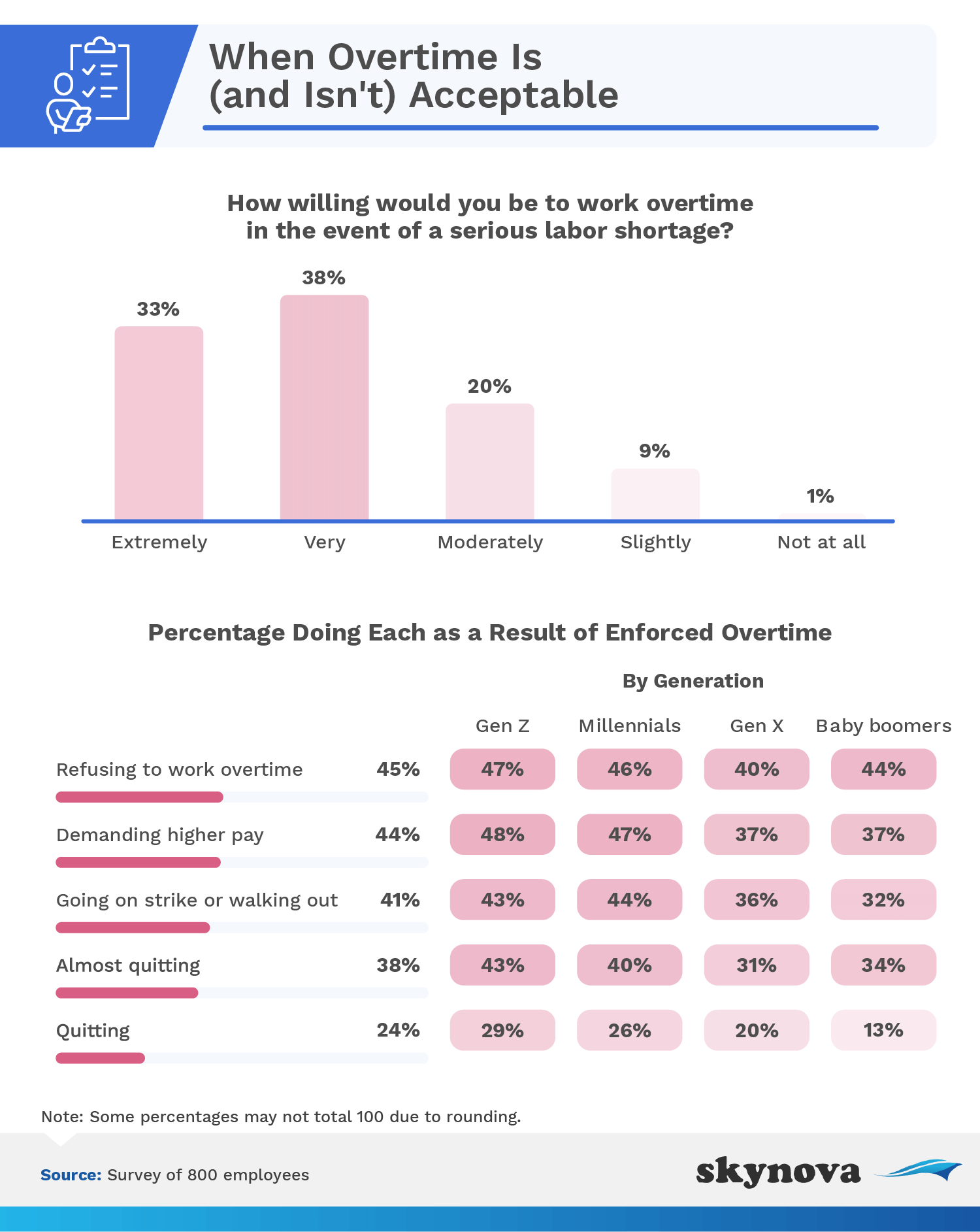
Overtime means working beyond your regular hours. When it becomes systemic, it can push people to leave. According to Skynova survey, 38% of employees have considered quitting because of mandatory overtime, and 24% eventually did. Occasional overtime is viewed far more calmly: 70% of respondents see it in a positive light.
Gallup research shows that the risk of burnout rises noticeably once the workweek exceeds 50 hours, and sharply beyond 60. That said, how people perceive their workload affects burnout more than the actual number of hours worked. Employees may prioritize well-being even over higher pay. According to the Financial Pulse Report 2025, 65% of respondents would turn down a better-paying role if it came at the expense of their well-being — including because of inflexible working conditions or an excessive workload.
Eliminating overtime altogether isn’t always realistic. An emergency, a release with a hard deadline, an audit, or a regulatory deadline can sometimes mean staying late — that’s a response to a specific event, not a broken process. The trouble starts when the exception becomes the rule: this week it’s a release, next week an incident, then a client changes the requirements three days before the demo. What wears people down isn’t one late night before a release — it’s knowing there’ll always be another one.

“For me, it’s less about how many hours someone works and more about why they’re working them. I think it’s perfectly normal for someone to want to achieve more, progress faster, or take on more responsibility — and therefore choose to put in extra hours from time to time. That’s their choice, and they understand why they’re doing it.
The problem starts when that choice disappears and overworking becomes the only way to keep up. At that point, I’d be looking at workload, priorities, and processes to understand what’s driving the overtime.”
It’s worth distinguishing between three situations:

“The best kind of overtime is when an engineer chooses to put in extra hours. In my experience, it’s often about learning: you’re so keen to figure something out that waiting until Monday feels impossible — you’d rather finish it today. That’s where a team lead needs to pay attention: notice it, support it, but don’t kill that motivation.
I allow myself to ask for overtime only when I’m confident the benefit clearly outweighs the cost to the team in the long run. A demotivated team isn’t going to deliver great results. But if there’s an external commitment, something important is at stake for the business, and the team only needs one last push — that’s something I can work with.”
If even one of these criteria isn’t met, overtime is unlikely to help:
Overtime can help you finish the work, but it won’t fix what caused the overtime in the first place. If the problem lies in planning, resources, or processes, extra hours only paper over it.
According to the LeadDev Report 2025, 65% of engineering leaders said their scope of responsibility had grown over the past year, and only 3% said their workload had decreased. Responsibility keeps growing, while expectations and available resources aren’t always adjusted accordingly.
Then there’s invisible overtime: someone regularly works longer because the work simply doesn’t fit into the day. The team isn’t officially in crunch mode, and nobody asked them to work late — so those extra hours don’t show up in the metrics or in their pay.
“Putting in some extra hours before a release is a normal part of the job, and candidates usually talk about it matter-of-factly. But when you ask someone why they’re looking for a new role and the answer is, ‘I’m working late all the time,’ that’s a red flag about the company they’re leaving, not the candidate. Another sign is referrals: teams where overtime has become the norm tend to get fewer employee referrals. People stop recommending the company to their friends, even when everything looks fine on paper.”
Break the conversation into two stages: first establish whether overtime is needed at all, and only then agree on the terms. The first stage is a conversation about scope. If you involve the team in finding a solution before overtime becomes the only option, many of those “unavoidable” late nights turn out to be avoidable.
If overtime is really needed, the conversation should cover four things.
At the retro, write down exactly what you’ll change to prevent the same issue from happening again.
“Personally, I’d rather keep overtime to a minimum. A healthy team is what keeps people motivated and the work moving forward. Once you introduce financial compensation, you risk creating the wrong incentive, where people start seeing overtime as a way to earn extra money. I do support bonuses when I can see that, given the circumstances, someone genuinely went above and beyond, helped others, and consistently put in extra effort. In that case, I’d consider a cash bonus as a way to recognize that effort. Time off works well too, but you need a policy in place so these things stay transparent.
I believe good planning is the single biggest factor in avoiding overtime. And the best advice here is to trust your people. If the team says a deadline is unrealistic, sit down and work out why: clarify the acceptance criteria, set priorities, defer unclear requirements. The right decision depends on the project — sometimes you can move the timeline; sometimes it’s better to cut part of the scope. But what you definitely shouldn’t do is dictate to the team or make those decisions without involving them.”
“People sometimes overwork because of a heavy workload and a fear of looking ‘slow.’ Even though that kind of overtime is technically voluntary, it’s worth being honest with yourself: speed isn’t the only — or even the main — measure of someone’s value. A strong performer isn’t the person who spends the most hours at their desk — it’s the one who delivers good work consistently and reliably. Everyone has their own pace, and that’s fine.
Treat the conversation as a practical discussion, not an apology: instead of saying, ‘Sorry, I’m slow,’ explain which task is taking longer than expected and why. Suggest options: getting help, reviewing the scope, or reprioritizing the work. And ask directly whether the expected pace is actually realistic.”
Overtime can be a sensitive subject for both employees and managers, and there are a few common ways these conversations can go wrong.
Lines like “we’re all one team here” or “everyone’s giving their all right now” turn a professional conversation into emotional one and can breed a toxic workplace where disagreement is treated as disloyalty. Anyone who says “I’m not available this weekend” ends up looking like they’re letting their colleagues down, rather than someone who simply didn’t accept the terms.
“The guys have already agreed to come in on Saturday,” “some people actually volunteer for this” — that’s the fastest way to destroy the very thing the manager is counting on. Willingness to work weekends is not a measure of competence: people have different lives outside work, and none of that should affect how they’re judged at work.
A message at 6 p.m. on Friday isn’t communication; it’s an imposition: people already have weekend plans, even if the manager doesn’t know about them. One such Friday is an inconvenience. If it happens three times in a quarter, that’s a sign that the company treats the team’s personal time as reserve capacity by default.
After the second “last time,” the team stops believing the manager. The more honest version: “The root cause is how we estimate work. Here’s what we’re changing — though I can’t promise it works on the first try.”
This is the opposite extreme of micromanagement: instead of asking directly, the manager describes how critical the situation is and waits for someone to offer to stay late. Technically, they never asked anyone — which also means nobody discussed timelines, scope, or compensation. On paper, the person volunteered for overtime, but when that decision is made under pressure, calling it voluntary is a stretch.
“To my mind, the most unfair situation of all is when someone stays late not because of a release or an emergency, but simply because the workload is unrealistic — and none of those extra hours are tracked anywhere. That’s often what pushes people to start looking elsewhere.
The most important thing an employee can do here is state the fact rather than ask permission. Not ‘Would it be okay if I worked some overtime?’ but ‘Closing the current sprint at the agreed scope will take X additional hours this week.’ That shifts the conversation from a personal request to resource planning.”
When a team ships a release, overtime looks free: the work got done, the deadline held, the budget didn’t move. The bill arrives a quarter later as burnout, a drop in productivity, or resignations. The best safeguard is to catch overtime while it’s happening — not when the first resignation letter lands on your desk.
Overtime can be justified in exceptional situations: a critical incident, a release tied to an external commitment, a regulatory deadline, or another unforeseen event. What matters is that the extra hours genuinely help the team get through the final stretch of work and that everyone knows when they will return to their regular schedule.
If almost every sprint depends on overtime, however, the problem is probably not that the team is moving too slowly. Regular overtime can point to underestimated tasks, understaffing, too many meetings, accumulated tech debt, or growing responsibilities without a corresponding workload review. A simple test: if removing overtime from the plan immediately makes the deadline unrealistic, those extra hours have effectively become part of the process.
Overtime gives the team more hours, but it does not address the reason those hours are needed in the first place. If tasks are consistently underestimated, deadlines are set without the team’s input, or four people are expected to handle a workload designed for six, a few extra evenings might save a particular release. The next sprint, however, will start with exactly the same problem.
Recurring overtime should therefore be treated as data that can help improve planning. Sometimes the scope needs to be reduced; in other cases, priorities need to change, the timeline needs to move, or resources need to be reassessed. If the team keeps pushing through and delivering anyway, management may never see the team’s actual capacity — because on paper, the plan is still being met.
The key rule is to agree on compensation before the overtime happens rather than deciding afterward how to reward the team. This might mean an additional day off or another form of compensation covered by company policy. The terms should be transparent: how much overtime qualifies for compensation and when employees can use it.
At the same time, compensation should not turn overtime into a separate incentive system. If working extra hours becomes a regular way to earn a bonus or get an extra day off, the company is effectively rewarding overtime itself instead of addressing the reasons behind it.
If overtime genuinely cannot be avoided, telling the team that “we just need one final push” is not enough. The conversation should cover four specific points:
This gives the team clear expectations and a defined end point. After the crunch is over, it is also worth running a retrospective to identify what should change so that the same scenario does not repeat itself a month later.
The first step is to make the overtime visible. Instead of asking, “Can I work late today?”, say something like: “To complete the full scope planned for this week, I’ll need about five additional hours.” This shifts the conversation from individual productivity to resource and workload planning.
The next step is to work with the manager to decide what needs to change: priorities, scope, deadlines, or task distribution. It also helps to explain what is taking longer than expected and check whether expectations around delivery speed match the actual workload. If the answer for months is simply “you just need to get it done,” systematic overtime should no longer be treated as an individual time-management issue, but as a problem with how the work is organized.


